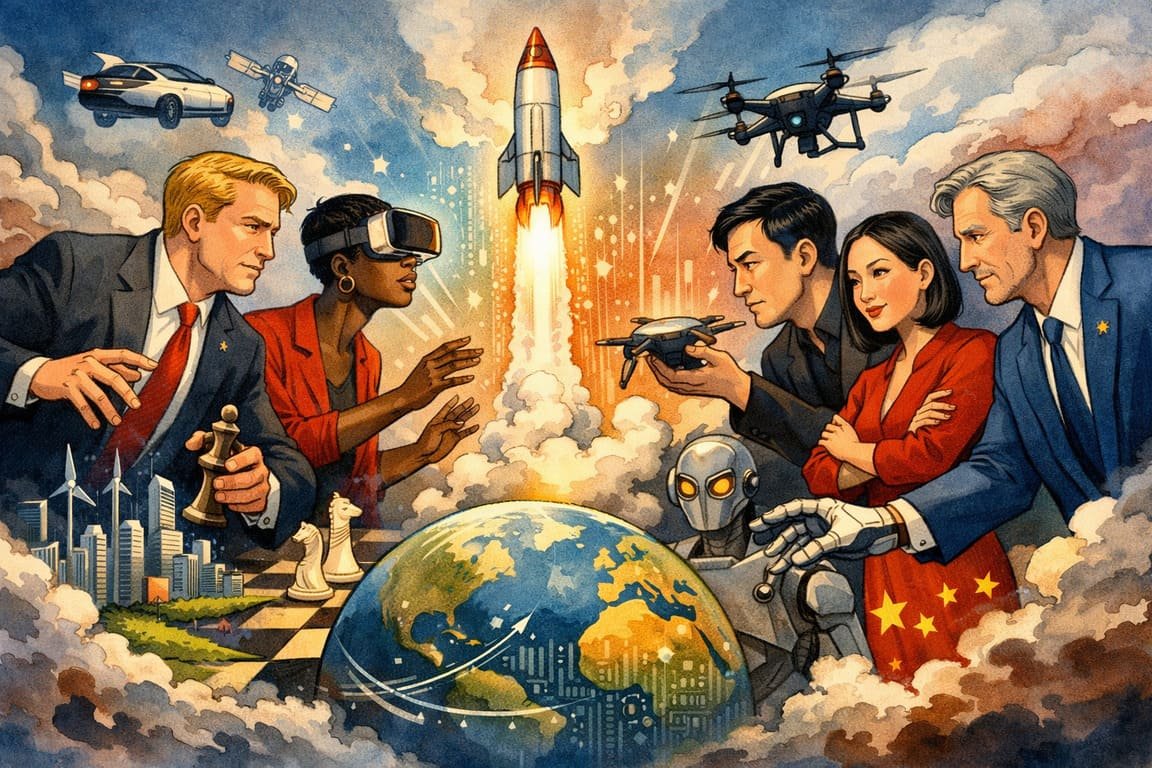
A satellite glides silently above the clouds while engineers on different continents chase the same invisible prize. Every breakthrough in artificial intelligence, semiconductors, quantum computing, and advanced manufacturing echoes far beyond laboratories because each innovation quietly redraws the balance of global influence. The competition rarely resembles a dramatic sporting event. Instead, it unfolds through patient investment, strategic partnerships, resilient supply chains, and technological ecosystems that steadily reshape economies long before headlines recognize the transformation.
Technology leadership has become a systems challenge rather than a contest for isolated inventions. Nations increasingly compete by strengthening research institutions, digital infrastructure, advanced education, manufacturing capability, cybersecurity, and entrepreneurial ecosystems that reinforce one another over decades. Artificial intelligence may capture public attention, yet leadership depends equally upon data governance, semiconductor production, cloud computing, and trusted innovation networks. Countries succeeding in these interconnected areas create durable competitive advantages that extend across industries instead of relying upon individual technological breakthroughs.
Taiwan’s semiconductor industry demonstrates how deep specialization can influence the entire global technology economy through advanced chip manufacturing. South Korea has similarly strengthened its international position by combining electronics expertise, research investment, and industrial coordination across multiple sectors. Emilia advised an emerging technology manufacturer searching for reliable international suppliers during periods of geopolitical uncertainty. Diversifying partnerships across several trusted regions protected production, reduced operational risk, and transformed resilience into a competitive strength rather than an emergency response.
The strongest technology powers increasingly resemble living ecosystems instead of isolated champions dominating individual markets. Universities, governments, investors, startups, multinational corporations, and skilled workforces generate continuous feedback loops where knowledge spreads rapidly between research and commercialization. Kaito coordinated innovation partnerships connecting academic laboratories with manufacturing companies pursuing advanced robotics and intelligent automation. Shared digital platforms accelerated experimentation because every successful prototype immediately strengthened future development across the wider collaborative network instead of remaining trapped inside organizational boundaries.
Winning this global competition will require more than building faster processors or launching smarter artificial intelligence platforms. Digital trust, ethical governance, resilient infrastructure, environmental sustainability, and workforce development increasingly determine whether innovation creates lasting prosperity or temporary advantage. Organizations operating internationally already recognize that technology leadership depends upon cooperation alongside competition. The most resilient economies combine ambitious research with adaptable institutions capable of learning continuously while responding confidently to changing technological landscapes and geopolitical realities.
History rarely remembers the loudest competitor because lasting influence belongs to those who quietly build foundations others eventually depend upon. The future will not be decided by one dramatic invention or one victorious nation standing alone above everyone else. It will emerge through countless connected decisions shaping how technology serves businesses, societies, and generations still waiting beyond today’s horizon. The greatest victory will belong to those who build innovation strong enough to earn global trust before claiming global leadership.
