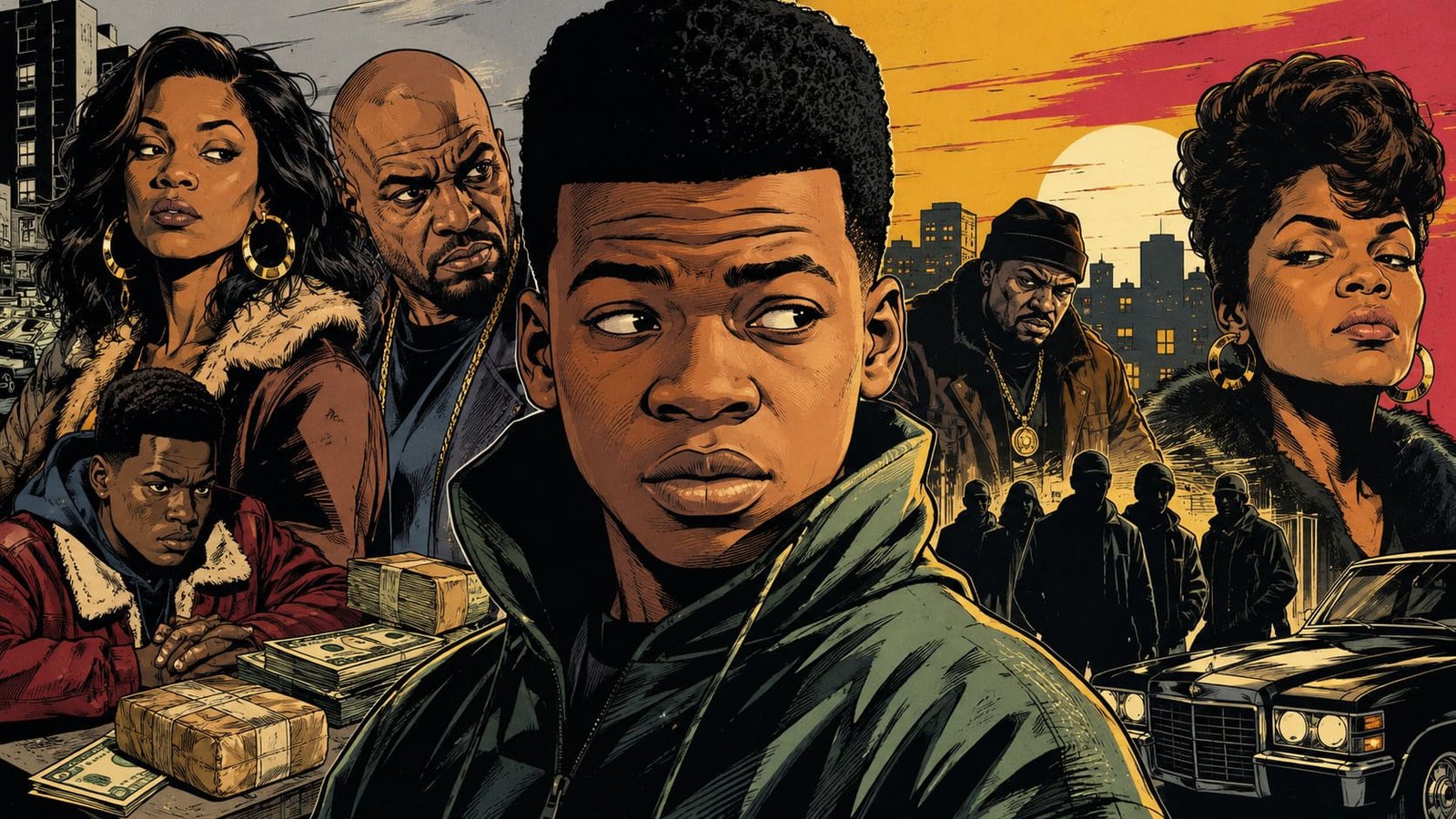
Queens moves like a heartbeat wrapped in gunpowder. Summer heat sticks to apartment walls. Music spills from passing cars while young men study the street corners the way future executives study market charts. Mothers pray quietly in kitchens where survival plans are discussed beside half-finished dinners and unpaid bills. Power Book III: Raising Kanan understands something many crime dramas miss entirely: empires are rarely born in boardrooms or back alleys alone. They are born at family tables, inside emotional inheritances passed from one generation to the next like coded survival manuals. Beneath the violence and ambition sits a devastating story about how identity gets engineered long before adulthood arrives.
Kanan Stark begins the series as a teenager searching for orientation inside a world where power feels more trustworthy than innocence. That tension gives the show its emotional voltage. He is not yet the hardened figure audiences recognize from the original Power universe. He is observant, impressionable, hungry for approval, especially from his mother. Watching Kanan evolve feels less like witnessing corruption and more like observing social conditioning unfold in real time. The series quietly asks one of the most uncomfortable questions in modern psychology: how much of human behavior is truly chosen once systems, family structures, economic realities, and emotional modeling start shaping identity during childhood?
Raquel “Raq” Thomas dominates the narrative with astonishing control. Patina Miller plays her with the composure of someone who understands that softness inside violent systems often becomes a liability others exploit immediately. Raq is strategist, provider, manipulator, protector, and architect all at once. Her leadership style reflects a painful contradiction many ambitious people recognize instinctively. Systems built around survival rarely reward emotional transparency. Raq loves her son deeply. She also weaponizes influence around him because she believes control is the only reliable form of protection available. Modern organizations often operate through similar emotional mechanics. Executives claim to mentor employees while quietly molding them into instruments serving larger strategic goals.
The brilliance of Raising Kanan lives inside its systems thinking. Every decision emerges from overlapping forces: poverty, race, masculinity, family loyalty, institutional neglect, and economic desperation. Nobody exists in isolation. The drug economy functions not simply as criminal enterprise but as alternative infrastructure filling gaps abandoned by formal systems. That complexity gives the series intellectual credibility beyond entertainment. During interviews about urban economic inequality, several sociologists have noted that informal economies often emerge where official institutions fail to provide stability or opportunity. Raising Kanan dramatizes that reality without flattening it into simplistic morality plays.
A deeply revealing storyline emerges through Lou-Lou Thomas and his dream of building a music career outside the family business. His struggle captures one of the central emotional conflicts of the series: the desire to reinvent identity while carrying the gravitational pull of inherited systems. Jamal, who grew up in South London around organized street networks, once described feeling guilty after leaving a profitable but dangerous environment to pursue graphic design. Friends mocked him for chasing “soft dreams.” Relatives worried he was abandoning loyalty itself. Years later, he admitted the hardest part was not changing careers. It was surviving the emotional suspicion attached to transformation. Raising Kanan understands that invisible pressure intimately.
Visually, the series creates an atmosphere soaked in emotional memory. Neon storefronts glow against humid night air. Old-school hip-hop drifts through apartments carrying both nostalgia and warning. The streets feel alive with opportunity and danger simultaneously. Every conversation carries strategic subtext because information equals survival currency. The production design captures the era beautifully without becoming trapped in sentimental nostalgia. Instead, the setting feels psychologically alive, a city teaching young people lessons about power before they fully understand the consequences of learning them.
The emotional intelligence of the show becomes especially sharp in its portrayal of parenting. Raq does not simply raise Kanan biologically. She trains him psychologically. Every interaction teaches him how to interpret trust, fear, respect, masculinity, and vulnerability. That process mirrors broader social systems shaping modern identity formation. Children often absorb emotional logic long before they can intellectually evaluate it. A venture capitalist from Atlanta once admitted during a podcast discussion that his obsession with winning originated less from ambition than from watching financial instability terrify his parents during childhood. The room grew quiet because everyone recognized the pattern instantly. Adults frequently mistake inherited survival instincts for authentic personality.
What elevates Raising Kanan beyond ordinary crime storytelling is its refusal to separate love from damage cleanly. Characters hurt one another while genuinely believing they are protecting each other. Family loyalty becomes emotionally sacred even when it accelerates destruction. That contradiction feels painfully human. Modern culture often imagines toxic systems as emotionally cold structures imposed externally. The series reveals something more unsettling. Harm frequently arrives wrapped in care, tradition, loyalty, or sacrifice. That complexity makes judgment emotionally difficult because nobody inside the story views themselves as villains.
Then arrives the deeper philosophical wound lingering beneath every family dinner, every street negotiation, every quiet betrayal. Raising Kanan recognizes that people rarely inherit freedom cleanly. They inherit unfinished wars, emotional reflexes, survival scripts, and invisible expectations shaping their choices long before adulthood feels real. Queens glows beneath summer streetlights while young men dream about escape and dominance in equal measure. Music echoes from open windows. Mothers stare silently into uncertain futures disguised as routine evenings. Somewhere inside the machinery of ambition and survival, another generation learns that power can protect the body while quietly imprisoning the soul. And once that lesson settles deep enough into a family’s bloodstream, entire empires begin reproducing themselves emotionally long before anyone notices the cycle has started again.
Editorial Disclaimer: Whether a TV Show is rooted in fiction or inspired by real events, the actions, decisions, and behaviors portrayed within are not intended to be encouraged, replicated, or endorsed in real-world settings. This review exists solely to analyze the storytelling, characters, themes, and business dynamics presented in the TV Show for educational, analytical, and entertainment purposes. Any ethical or unethical conduct depicted in the TV Show does not reflect the views, values, or endorsements of ESYRITE.
