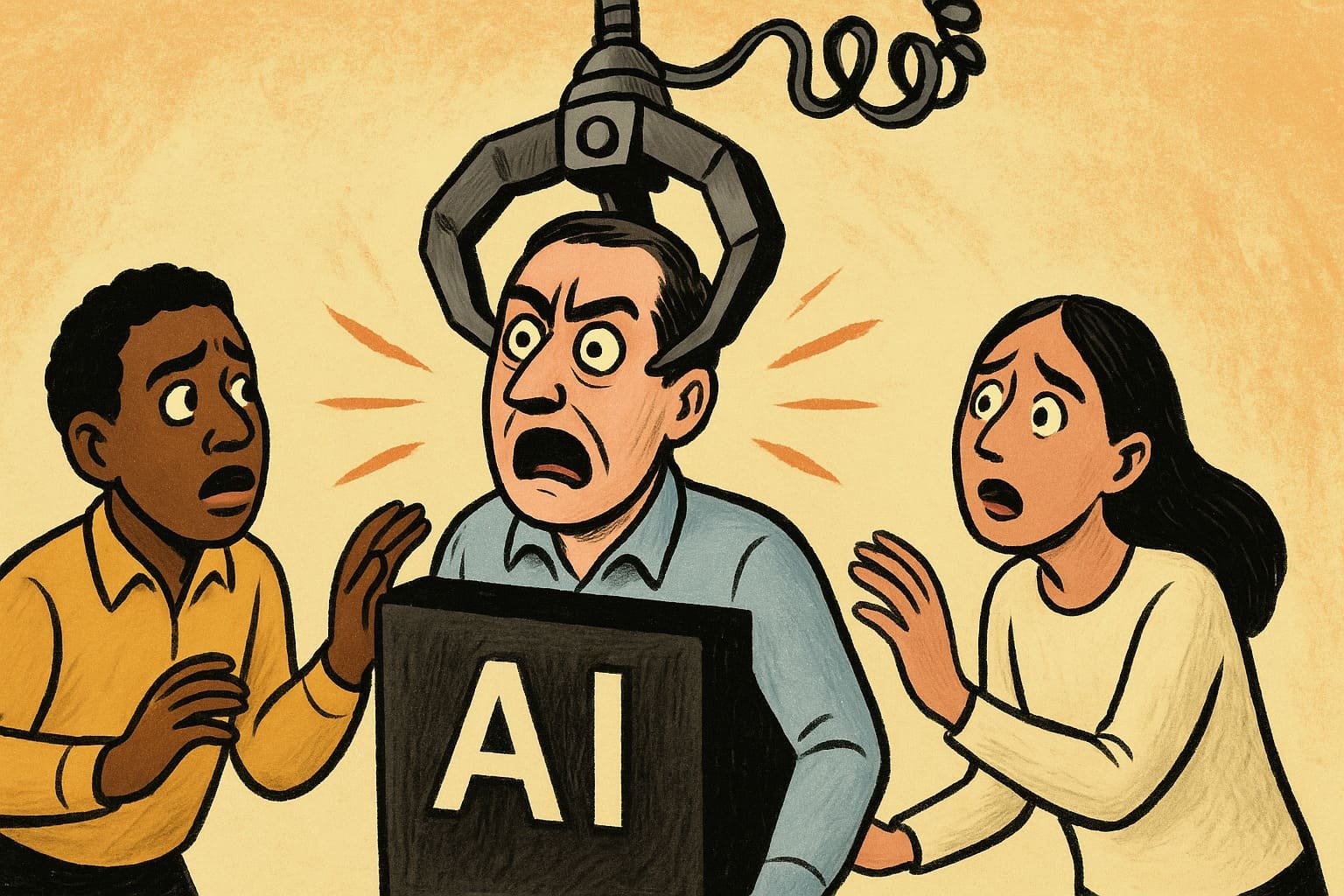
Electric blue light spilled across a museum where visitors stood before famous paintings without raising their eyes from glowing screens explaining what they were supposedly seeing. Every masterpiece remained in plain sight, yet interpretation increasingly arrived from software before emotion had time to breathe. Nobody questioned the convenience. That quiet surrender marked a profound shift. Artificial intelligence is no longer helping people discover meaning. In many moments, it is beginning to supply meaning first, leaving human judgment to arrive only after algorithms have framed the conversation.
Generative AI has transformed how people search, write, design, learn, and solve problems with astonishing speed. These systems compress vast collections of knowledge into immediate answers that feel authoritative and effortless. Convenience, though, creates a subtle tradeoff. When every difficult question receives an instant response, curiosity risks becoming passive rather than active. Critical thinking grows through wrestling with uncertainty. Remove every struggle, and understanding can quietly become shallower even while productivity appears to soar.
OpenAI demonstrated how conversational AI could make complex knowledge accessible to millions, dramatically lowering barriers to learning and creativity. GitHub Copilot followed a similar path by accelerating software development through intelligent code suggestions rather than replacing developers outright. During a product workshop, software architect Julian watched junior engineers accept AI-generated solutions without questioning hidden assumptions. Later, one overlooked design flaw forced the entire team back to the whiteboard. Speed had increased, but thoughtful verification remained irreplaceable.
Businesses now face an unfamiliar leadership challenge. Competitive advantage no longer depends only upon adopting artificial intelligence quickly. It depends upon preserving human judgment while embracing machine efficiency. Adobe encourages creators to treat generative tools as collaborators rather than substitutes for imagination. Consulting firms increasingly emphasize review processes where experienced professionals evaluate AI-generated recommendations before clients ever see them. Organizations discovering that balance often produce stronger decisions because automation expands capability without diminishing accountability.
History offers a useful reminder. Calculators never eliminated mathematics, and search engines never replaced expertise. Instead, both shifted which skills became most valuable. Artificial intelligence represents another transition of similar magnitude, although moving far faster than previous technological revolutions. Management thinker Peter Drucker argued that knowledge workers succeed by asking the right questions rather than collecting endless answers. That observation feels increasingly significant because intelligent systems excel at producing responses, yet meaningful progress still begins with thoughtful human inquiry.
Ash drifted gently above a fading campfire where glowing embers revealed hidden warmth beneath an ordinary layer of gray. Human meaning survives in much the same way. Algorithms can organize information, predict patterns, and generate convincing language, but purpose still emerges through lived experience, moral judgment, and genuine connection. Every remarkable machine will continue becoming more capable with each passing year. Never surrender the privilege of deciding what truly matters, because no intelligence can replace the responsibility of being fully human.
