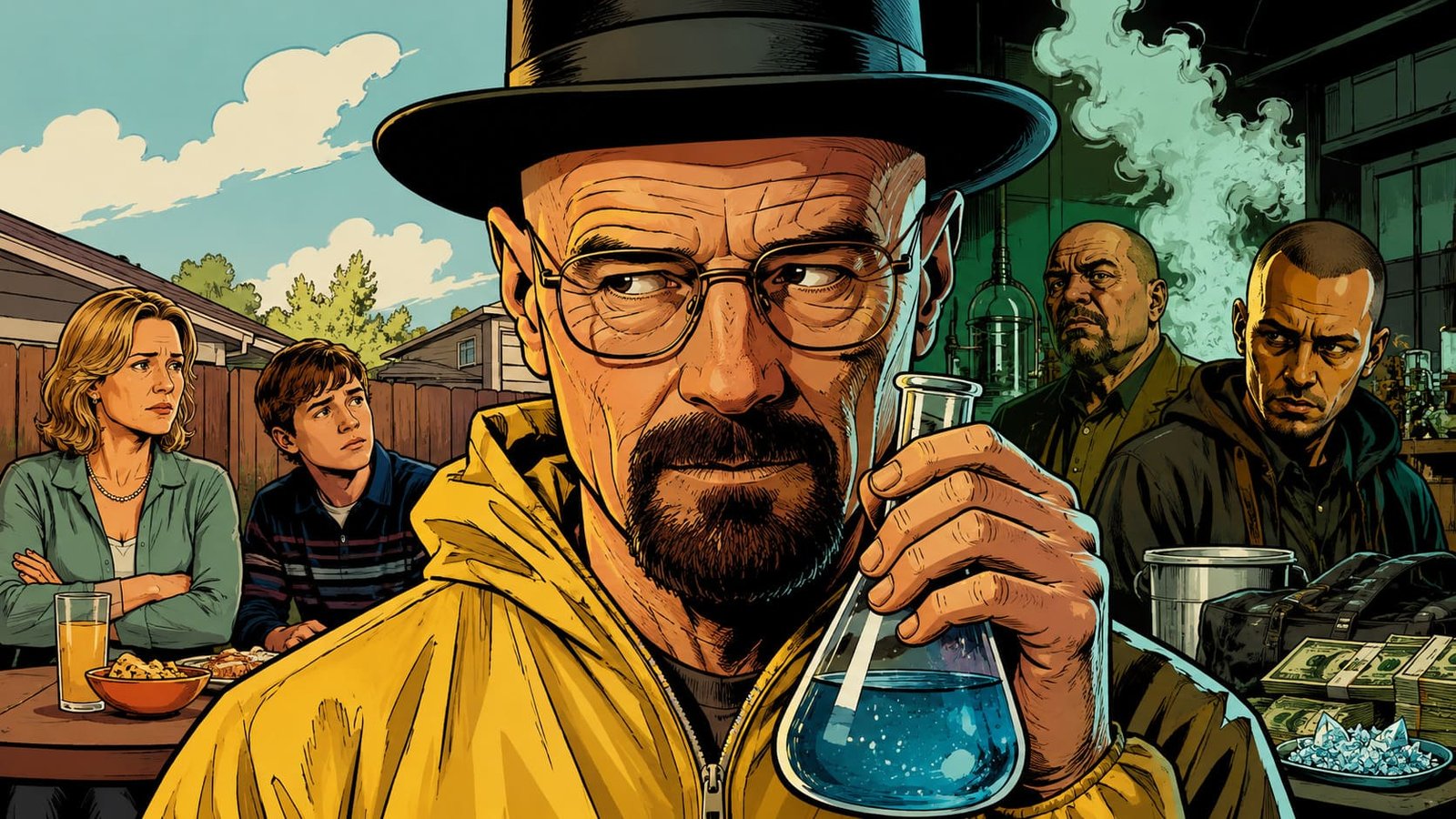
The desert stretched endlessly beneath a bruised sky while an old RV rattled through dust like a coffin refusing to stay buried. Somewhere inside that chaos stood a chemistry teacher wearing stained khakis and carrying the exhausted posture of a man civilization had quietly overlooked. Breaking Bad begins with financial fear and terminal illness, yet what unfolds becomes one of television’s most devastating examinations of ambition, identity, masculinity, and moral corrosion. The series does not ask whether ordinary people can become dangerous. It asks something far more uncomfortable: how much darkness already exists beneath the routines society calls respectable?
Walter White enters the story carrying invisible humiliation. Brilliant but underachieved, disciplined yet emotionally starved, he moves through suburban life like someone trapped behind glass watching other people experience significance. That emotional architecture matters deeply. The show understands many personal collapses begin not with greed but with wounded pride. Walter’s cancer diagnosis becomes less an origin story than a permission slip. Suddenly the rules he spent decades obeying feel meaningless. What begins as financial survival mutates into something psychological and almost spiritual. He no longer wants merely to provide for his family. He wants to feel powerful before death erases him entirely.
The genius of Breaking Bad lies in how gradually it transforms morality into negotiation. Walter rarely wakes up intending monstrosity. Each compromise feels temporarily justifiable. A lie protects loved ones. Violence prevents exposure. Manipulation secures survival. Step by step, rationalization rewires identity until Heisenberg emerges not as a separate personality but as buried hunger finally unleashed. That progression mirrors countless real-world systems beyond crime itself. Corporate scandals, political corruption, and institutional collapse often begin with individuals convincing themselves exceptional pressure excuses ethical compromise. The series becomes terrifying because audiences recognize how ordinary the emotional logic initially feels.
A pharmaceutical sales director named Vincent Hale once described watching a respected executive slowly transform after aggressive revenue targets threatened his career. At first the executive manipulated minor reporting details to satisfy quarterly expectations. Months later entire regional figures were being distorted. Staff who questioned the strategy were quietly marginalized. Vincent recalled one especially chilling moment during a leadership dinner when the executive calmly toasted “necessary adaptation” while junior employees stared silently into untouched wine glasses. Years later the company faced federal investigation. Vincent admitted the scariest part was how incremental the corruption felt while living through it. Breaking Bad captures that exact psychological drift with almost unbearable precision.
Jesse Pinkman provides the emotional counterweight that keeps the series from becoming emotionally hollow. Beneath the impulsiveness and slang exists a wounded conscience still capable of horror and grief. Jesse repeatedly discovers that criminal success extracts psychological costs no amount of money can neutralize. Watching him oscillate between loyalty, guilt, trauma, and desperate hope gives the series much of its humanity. He becomes a tragic symbol of people emotionally crushed beneath systems more ruthless than they initially understood. Walter grows colder as power expands. Jesse becomes more emotionally exposed. Their relationship resembles a distorted father-son tragedy unfolding through chemistry and violence.
The business mechanics of the drug empire are also strangely sophisticated. Supply chains, distribution strategies, brand differentiation, operational efficiency, risk management, territorial competition, and negotiation all pulse beneath the narrative. Gus Fring embodies corporate professionalism weaponized into terrifying discipline. Calm, methodical, and emotionally restrained, he operates like a Fortune 500 executive hiding inside a fast-food franchise. The brilliance of Gus lies in how recognizable his management style feels. He rewards competence, punishes unpredictability, and protects organizational stability above sentiment. Remove the methamphetamine operation and portions of his leadership philosophy would sound disturbingly familiar inside elite boardrooms.
A restaurant owner named Amara Ndlovu once recalled partnering with an investor whose discipline initially impressed everyone around him. Meetings ran precisely on schedule. Staff performance metrics were obsessively tracked. Every operational weakness received immediate correction. Yet beneath the efficiency sat emotional emptiness that slowly poisoned the culture. Employees became terrified of mistakes. Creativity disappeared. Loyalty transformed into fear disguised as professionalism. Amara eventually walked away despite financial success because the environment no longer felt human. She later described the experience as “working inside a perfectly organized panic attack.” That description could summarize Gus Fring’s entire empire.
There is another haunting layer beneath Breaking Bad that explains why it became cultural mythology rather than ordinary prestige television. The series exposes modern masculinity as performance under pressure. Walter feels invisible because society taught him worth depends on dominance, provision, and recognition. Financial instability wounds his identity more deeply than illness itself. Instead of vulnerability, he chooses conquest. Instead of honesty, performance. The tragedy is not simply that Walter becomes dangerous. It is that power finally makes him feel awake. That emotional revelation lingers because countless institutions still reward aggression more consistently than emotional truth.
Somewhere tonight fluorescent lights still buzz softly inside forgotten industrial spaces while exhausted men convince themselves one final compromise will secure the future they deserve. Dust drifts across empty highways. Cash sits stacked beside loneliness no fortune can anesthetize. A chemistry equation fades from a classroom board while another empire quietly rises beneath the surface of ordinary life. That is the lasting wound left by Breaking Bad. The series reveals how easily intelligence can become self-destruction when ambition loses moral gravity, and how often society mistakes transformation for empowerment while a human soul slowly disappears behind the smoke. The terrifying part is not that Walter White became Heisenberg. It is how understandable the first step felt before the avalanche began.
Editorial Disclaimer: Whether a TV Show is rooted in fiction or inspired by real events, the actions, decisions, and behaviors portrayed within are not intended to be encouraged, replicated, or endorsed in real-world settings. This review exists solely to analyze the storytelling, characters, themes, and business dynamics presented in the TV Show for educational, analytical, and entertainment purposes. Any ethical or unethical conduct depicted in the TV Show does not reflect the views, values, or endorsements of ESYRITE.
