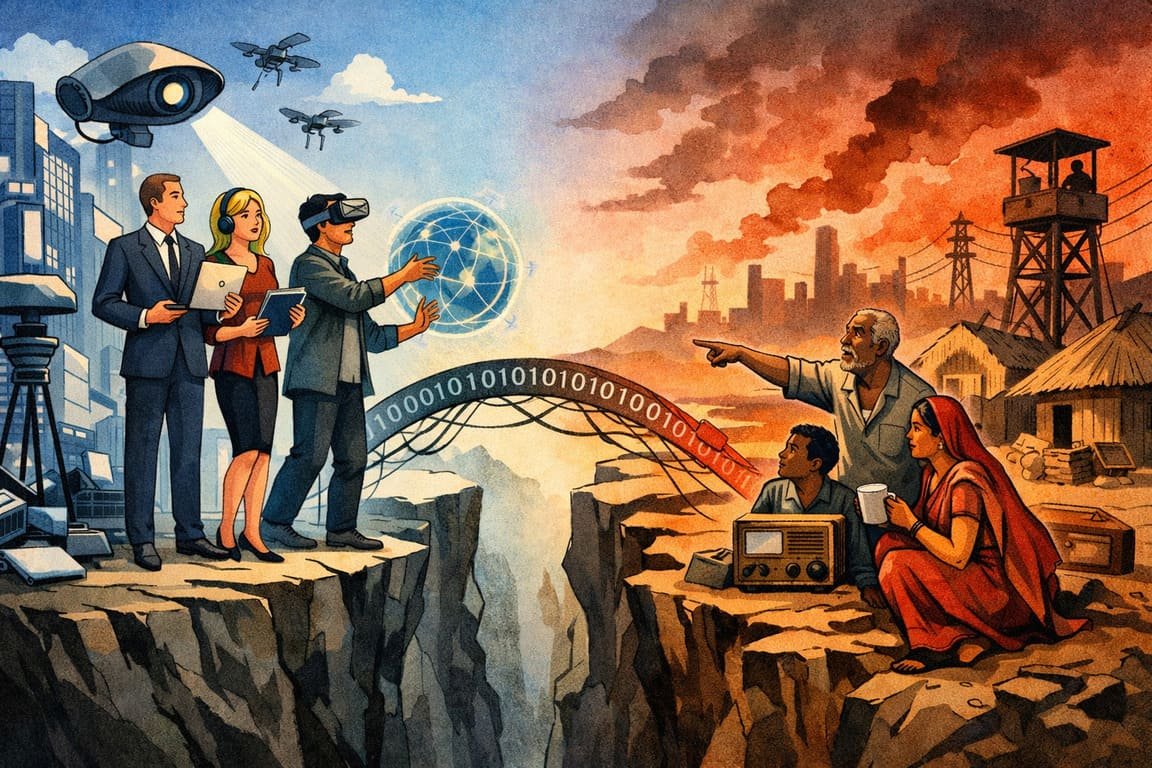
The glow of a screen fills one room while another stays dark, not because of night, but because access never arrived. The modern world speaks through cables, satellites, and servers, yet participation remains selective. Technology promised connection. Instead, it reorganized influence. The digital divide no longer sits on the margins of development reports. It has become a governing structure, deciding who is heard, who is watched, and who is ignored.
Politics now runs on connectivity. Campaigns mobilize online. Policies circulate digitally. Dissent organizes through platforms before it reaches streets. Those without access do not merely miss convenience. They miss relevance. In a digital society, visibility equals power. Silence is not neutrality. It is exclusion disguised as circumstance.
Governments understand this leverage intimately. Infrastructure choices determine who participates in civic life. Platform regulations shape speech more effectively than laws ever did. Surveillance tools promise security while quietly redefining privacy. Control does not always arrive with force. Sometimes it arrives through updates, permissions, and invisible filters that decide what travels and what stalls.
The divide cuts both globally and locally. Wealthy nations debate the ethics of artificial intelligence while poorer regions fight for stable signals. Within countries, urban centers accelerate while rural communities lag behind. This imbalance breeds resentment. Citizens watch others thrive through remote work, digital banking, and online education while they remain locked out. Inequality sharpens through pixels.
Education reveals the fracture most clearly. A student with a reliable connection accesses libraries, lectures, and networks once unimaginable. Another relies on outdated materials and intermittent access. Talent does not disappear in these gaps. It gets blocked. Systems then mislabel outcomes as merit rather than access. The injustice hides behind performance.
Economies follow the same pattern. Digital markets reward scale and speed. Platforms consolidate influence across borders. Small businesses struggle without online tools. Workers without digital skills face shrinking options. Governments promise reskilling, yet disruption moves faster than reform. The market advances. Policy chases.
Culture absorbs this hierarchy quietly. Online discourse sets agendas. Trends define relevance. Movements born digitally often overlook those offline. Representation narrows without intent. People excluded from the feed feel detached from national conversation. Alienation grows. Politics loses texture when entire populations vanish from the narrative.
Surveillance deepens the imbalance. Data becomes currency. States collect, analyze, and predict behavior at scale. Monitoring rarely distributes evenly. Marginalized communities face disproportionate scrutiny. Algorithms inherit bias while claiming objectivity. Technology that markets neutrality often reinforces existing power structures more efficiently than any ideology.
Global politics reflects this shift. Nations with technological dominance set standards others must follow. Software norms become diplomatic tools. Sanctions extend into app stores and payment systems. A country can be isolated digitally without a single border closing. Power migrates from territory to infrastructure.
Resistance does not vanish. It adapts. Communities build local networks. Activists rely on low tech coordination. Innovation emerges under constraint. Yet resilience should not excuse inequality. Survival is not justice. The divide persists because it serves interests, not because it is inevitable.
Philosophically, the digital divide challenges the meaning of citizenship. If participation requires access, then access becomes a civic right. Democracy assumes informed consent. Technology mediates information. When mediation excludes, legitimacy erodes. Representation becomes procedural rather than real.
The future raises the stakes further. Artificial intelligence, automation, and digital governance deepen reliance on systems already unevenly distributed. Those excluded today risk permanent disadvantage tomorrow. Closing the divide requires more than cables and devices. It requires intention, investment, and restraint in how power gets coded.
Somewhere, a signal drops mid sentence, a voice lost to buffering, a decision made without input. The system continues without pause. The digital age will not slow down to ask who was left behind. What remains unsettled is whether societies allow access to determine worth, or whether they step in before silence becomes the most decisive political force of all.
