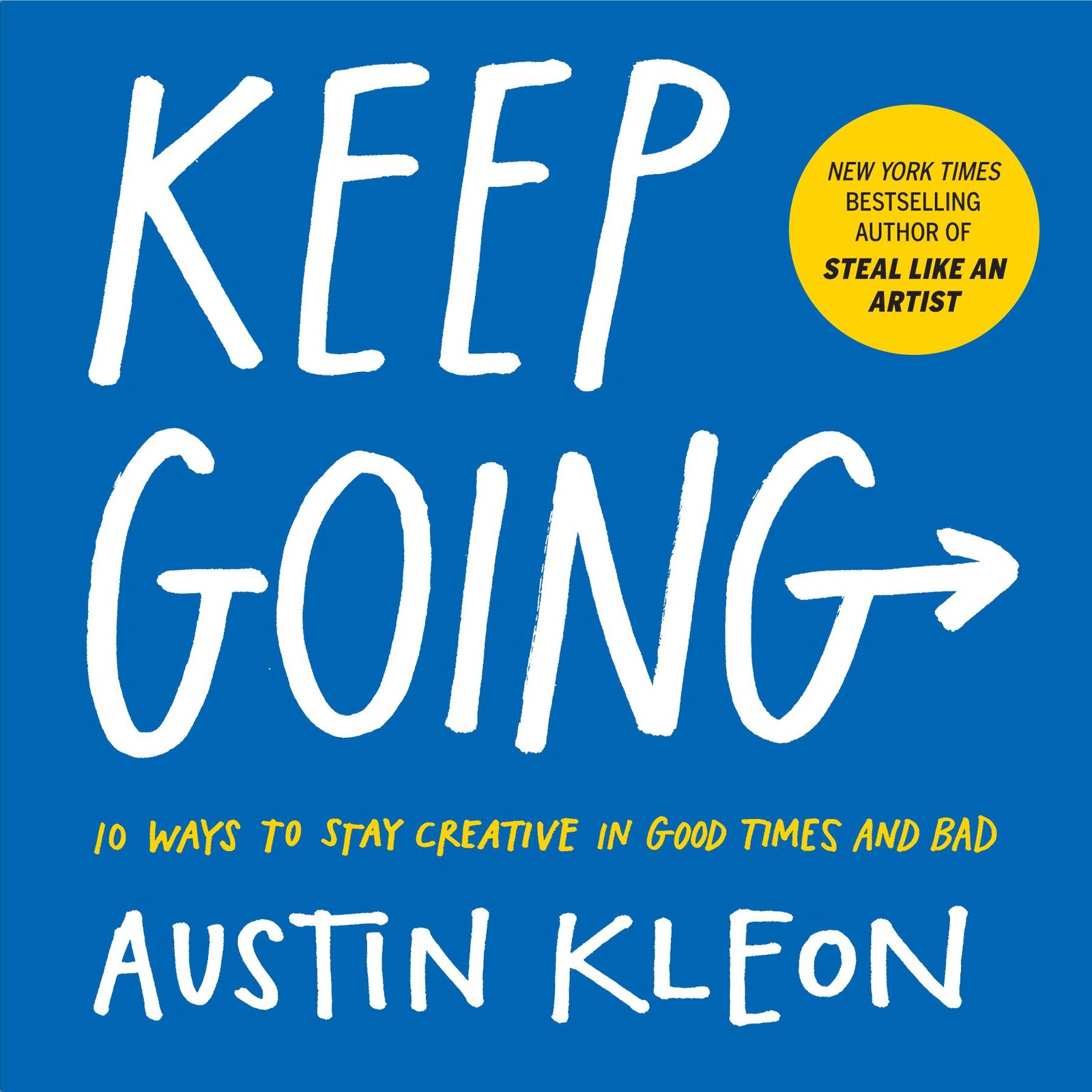
Every creative spirit faces that dreaded gray stretch where ideas stall, passion wavers, and every project feels like trudging uphill in the rain. In those moments, the advice we crave is not a lofty manifesto but a practical, heartfelt reminder that grit, humor, and small rituals can resurrect inspiration. Austin Kleon’s “Keep Going: 10 Ways to Stay Creative in Good Times and Bad” arrives like a trusted friend who hands you a coffee, cracks a joke, and tells you not to give up just yet. He understands creative blocks are not unique, and that self-doubt plagues even the most gifted. Kleon’s pages radiate warmth, urgency, and above all, permission to keep showing up.
Instead of championing relentless hustle or the myth of overnight brilliance, Kleon unpacks the power of routine, boundaries, and honest work. His wisdom is grounded in lived experience, not abstract theory. Readers feel seen, not judged. The message is not about creating masterpieces, but about nurturing the act of making itself. This shift in focus from product to process is a seismic relief in a culture obsessed with metrics, followers, and instant success.
What separates “Keep Going” from other creativity books is its gentle authority. Kleon does not prescribe a rigid program, nor does he pretend that inspiration alone can weather life’s storms. Instead, he delivers practical strategies to refuel your spirit, sharpen your focus, and reclaim joy in making. Whether you write, paint, design, teach, or invent, his ten principles offer a toolkit that can be picked up whenever life’s noise drowns out your creative voice.
Kleon’s voice is refreshingly relatable. He weaves in comics, anecdotes, and tangible exercises, making even the most overwhelmed reader believe that one small step is possible today. By blending vulnerability with humor, the book refuses to sugarcoat struggle but also refuses to let it win. The simplicity of the advice is deceptive: routines, analog habits, and solitude are not luxuries but essential lifelines.
Anyone stuck in a rut, haunted by the blank page, or feeling invisible in a world that prizes only the finished product, will find in “Keep Going” a powerful, practical antidote. It is a book you’ll want to keep by your desk or bedside, dog-eared and full of scribbled notes—a lifeboat for your imagination.
Quick Notes
- Emphasizes the importance of daily routines and habits over raw inspiration for sustainable creativity.
- Urges creators to embrace boredom, solitude, and analog methods as fertile ground for ideas.
- Encourages establishing boundaries and disconnecting from digital distractions to reclaim attention.
- Champions community, sharing, and collaboration without succumbing to comparison or burnout.
- Provides actionable, bite-sized wisdom perfect for immediate use in both personal and professional creative pursuits.
The Art of Moving Forward
Austin Kleon’s “Keep Going” unfolds with ten concise, actionable chapters, each offering a new lens on how to reignite creativity. From the first page, the book confronts the real enemy: the myth that inspiration always feels good. Instead, Kleon insists creativity is an act of persistence, often powered by small, unglamorous habits rather than lightning-bolt moments. This practical perspective liberates readers from the tyranny of waiting for motivation.
Routine emerges as a recurring theme. Kleon argues that building a “bliss station”—a sacred, regular space or time to create—can be more powerful than chasing inspiration. Simple rituals like morning pages, sketching before breakfast, or daily walks become non-negotiable acts of self-care. By doing the work every day, creators cultivate resilience that endures both triumph and turbulence.
Analog practices hold surprising power in Kleon’s playbook. He celebrates the value of stepping away from screens to doodle, journal, or simply be bored. This analog pause, he suggests, creates space for reflection and unearths ideas that constant connectivity smothers. In a world that glorifies hustle and digital noise, Kleon’s advice to unplug is both radical and restorative.
“Keep Going” also tackles the dark side of sharing: comparison, envy, and burnout. Kleon acknowledges that social media can inspire but also corrode creative confidence. He urges creators to focus on process over applause and to curate their inputs as fiercely as their outputs. By setting healthy boundaries and seeking out genuine community rather than endless validation, creators can thrive without losing themselves.
Throughout the book, Kleon’s tone remains fiercely supportive. He avoids preachiness, instead inviting readers to experiment with his ten principles and adapt them to their own lives. Comics, hand-lettered quotes, and real-life anecdotes bring each chapter alive, making the wisdom sticky and memorable. The cumulative effect is both reassuring and galvanizing—a reminder that the creative journey matters as much as any destination.
Enduring Wisdom: Key Lessons and Insights
The book’s central lesson is clear: creativity is not about waiting for magic, but about building practices that welcome it. By anchoring your work in daily rituals and tangible actions, you build creative momentum that can weather life’s storms. This approach is not just effective; it is deeply humane.
Solitude and boredom are not enemies but allies. In a digital world engineered to keep us constantly stimulated, Kleon reminds readers that real breakthroughs often happen in quiet moments, away from the algorithm. Stepping away from the noise allows creative voices to surface and find form.
Boundaries are a form of liberation. “Keep Going” underscores the importance of saying no, shutting the laptop, or going offline to preserve mental space. These acts are not selfish but essential. In doing so, creators safeguard their attention and recharge their energy.
Comparison is a thief of joy, especially in creative circles. Kleon’s perspective on sharing work—do it for community, not for competition—helps artists, writers, and makers reconnect with why they started creating in the first place. The point is not to be the best, but to keep making what only you can make.
Perhaps most importantly, Kleon insists that everyone’s creative journey will include dry spells, setbacks, and doubts. Rather than viewing these as failures, he urges readers to see them as inevitable parts of the process. Endurance, not perfection, is the mark of a true creative. With each small act, each page, each sketch, creators claim their place in the world.
Igniting the Flame: Critical Insights for Real-World Creativity
Personal anecdotes from artists, teachers, and business leaders reveal how Kleon’s advice translates into diverse settings. For example, a school principal in Chicago credits daily journaling—sparked by Kleon’s “bliss station” principle—with transforming her approach to leadership and decision-making. By carving out a consistent time for reflection, she weathered both professional upheaval and personal grief with newfound clarity.
A startup founder, struggling through the rollercoaster of funding rounds and team pivots, shares how unplugging from the relentless stream of notifications (inspired by Kleon’s advice) rekindled both strategic thinking and genuine joy. By embracing analog brainstorming sessions with her team, she discovered unexpected solutions to complex problems, proving that creative breakthroughs often emerge from simplicity, not noise.
Visual artists who once felt paralyzed by social media envy found fresh freedom after reading Kleon’s chapter on boundaries. By limiting online exposure and focusing on their daily craft, they reignited their passion and forged more authentic connections with local peers. Instead of chasing trends, they cultivated work that reflected their true voice.
Even in highly structured environments, such as law firms and consulting agencies, Kleon’s principles have sparked change. Partners who adopted daily rituals of analog sketching during lunch breaks reported not only improved mental health, but also more original client solutions. The ripple effect extended beyond the individual, fostering a more vibrant, innovative workplace culture.
These cases highlight a universal truth: “Keep Going” is not just for professional artists. Its wisdom applies across fields, ages, and contexts, offering an accessible, actionable blueprint for anyone determined to sustain their spark in the face of chaos.
Navigating Resistance: The Power of Creative Resilience
Creative blocks are inevitable, but “Keep Going” reframes them as stepping stones rather than dead ends. The book champions resilience over raw talent, discipline over drama. This mindset is especially powerful in a world obsessed with overnight success and viral hits.
The principle of “showing up every day,” regardless of mood or circumstances, is a cornerstone. Small daily acts, done without fanfare, accumulate into meaningful bodies of work. This is not about romanticizing suffering, but about recognizing the value in simply continuing. Artists who track their progress over time often find their most important breakthroughs emerge not from flashes of genius, but from periods of consistent, patient effort.
Humor plays a key role in surviving tough times. Kleon’s witty sketches and irreverent commentary invite readers to laugh at their own insecurities and to view setbacks as part of a larger story. Embracing imperfection, even celebrating it, disarms the fear that often freezes creative momentum.
External recognition, while gratifying, cannot be the engine that sustains creative practice. “Keep Going” encourages readers to create for themselves first, finding satisfaction in the process. By detaching self-worth from external metrics, creators develop a deeper, more sustainable relationship with their craft.
Lastly, community support matters. Kleon urges readers to find or build circles of encouragement, whether online or offline. Sharing struggles and triumphs with like-minded peers can transform isolation into solidarity, turning solitary work into a shared adventure.
Practical Strategies: Turning Inspiration Into Action
The advice in “Keep Going” is intentionally practical. Kleon provides checklists, prompts, and exercises designed for immediate use. These tools are simple yet powerful, making creativity less mysterious and more approachable for everyone.
Daily “bliss stations” can be as humble as a kitchen table or as grand as a home studio. What matters is not the setting, but the commitment to show up. Readers report that setting aside even ten minutes a day for creative work can shift mindset and productivity dramatically.
Analog activities—sketching, handwriting, collage—break the spell of digital fatigue and reconnect creators with the tactile joy of making. Many readers rediscover forgotten skills and pleasures through these simple acts, fueling a more playful and experimental approach to work.
Boundaries around technology are another game-changer. By scheduling “no screen” times or days, readers reclaim focus and reduce anxiety. This intentional disconnect creates space for reflection, reducing overwhelm and improving the quality of creative output.
Kleon’s suggestion to “make gifts” instead of chasing sales or likes is both countercultural and liberating. When creators approach their work as an offering rather than a commodity, they reconnect with their original motives. This shift can reinvigorate even the most burnt-out artist or entrepreneur.
Celebrating small wins, instead of waiting for big breaks, keeps motivation alive. By tracking progress, reflecting on each day’s effort, and sharing milestones with trusted friends, creators build resilience that outlasts external setbacks.
Why “Keep Going” Matters Now More Than Ever
In a post-pandemic world, where uncertainty is the only constant, Kleon’s message rings louder than ever. The book’s strategies for weathering creative droughts apply equally to navigating global upheaval. By prioritizing process over perfection and community over competition, readers discover not only how to survive, but how to thrive in unpredictable times.
For those working remotely, juggling family and deadlines, or launching a side hustle in the margins of the day, “Keep Going” offers permission to make small, meaningful progress. This mindset shift—from pressure to possibility—transforms ordinary moments into creative opportunities.
Cultural shifts towards wellness and mental health also align with Kleon’s advocacy for analog, restful routines. Instead of glorifying burnout, the book models a sustainable, balanced approach that honors both productivity and play.
Entrepreneurs, teachers, healthcare workers, and parents alike will find that Kleon’s insights help manage stress, nurture curiosity, and build confidence, no matter what challenges arise.
In every way, “Keep Going” is a manual for building creative resilience in a world that never stops testing it.
Critical Analysis: Where the Book Shines and Where It Challenges
Kleon’s work stands out for its accessibility. Short chapters, engaging visuals, and relatable stories ensure that even the busiest reader can absorb key lessons quickly. This user-friendly format democratizes creativity, breaking down the myth that only a privileged few are “creatives.”
However, the simplicity of Kleon’s advice may underwhelm readers seeking detailed, research-driven frameworks. The book’s greatest strength—its straightforwardness—may be perceived as a limitation by those who crave deeper theoretical insights or extensive case studies.
Yet, this accessibility is intentional. Kleon’s aim is to reach anyone teetering on the edge of giving up, not to impress scholars. He sidesteps academic jargon, opting for plainspoken encouragement and immediate tools. In a saturated market of self-help books, “Keep Going” wins by meeting readers where they are, with honesty and humor.
While some may wish for more data or long-form narratives, Kleon’s anecdotal approach makes the wisdom highly memorable. Each principle becomes a mantra that can be posted on a wall, scribbled in a planner, or shared with a friend in need.
The book’s focus on analog habits and boundaries challenges the hyperconnected world, making it both timely and slightly rebellious. Readers seeking “hacks” or shortcuts may find the advice unglamorous, but its enduring effectiveness is its greatest legacy.
Why “Keep Going” Deserves a Place on Every Creative’s Shelf
By the final page, Kleon’s book has accomplished more than a pep talk. It offers a philosophy of creative living rooted in humility, humor, and daily action. Every story, tip, and sketch builds toward a simple truth: enduring creative success is less about moments of genius and more about refusing to quit.
The advice, while gentle, has teeth. Showing up every day, protecting your attention, and embracing imperfection are not just platitudes, but survival skills for anyone determined to keep making in a world that often makes it hard.
Kleon’s faith in small steps and honest effort feels radical in an era of hype and hustle. Readers who have struggled with imposter syndrome, burnout, or creative exhaustion will find in “Keep Going” not just comfort, but a way forward.
Perhaps the most valuable gift the book offers is its universality. Whether you’re an artist, entrepreneur, scientist, or parent, the core principles translate across disciplines. The book invites everyone to claim their right to create and to value the journey as much as the destination.
“Keep Going” is more than a book—it is a companion for every creative season, reminding us that even on the hardest days, the act of making matters.
About the Author
Austin Kleon is a writer and artist renowned for his sharp insights into the creative process and his innovative approach to making art accessible to all. Based in Austin, Texas, he first captured global attention with “Steal Like an Artist,” which quickly became a modern classic for creatives in every field. Kleon’s signature style blends visual wit, humor, and practical advice, often using blackout poetry and hand-drawn graphics to illustrate his ideas. His talks, workshops, and books—including “Show Your Work!” and “Keep Going”—have inspired millions to embrace creativity as a daily practice, not a distant ideal. Kleon’s work resonates deeply in today’s noisy, fast-paced world by emphasizing the value of simplicity, persistence, and authentic expression.
Disclaimer
Note that the ideas and content in the book are solely from the Author of the book and not the ESYRITE Editorial Team. All opinions expressed in this book review are entirely from the ESYRITE Editorial Team. This review may contain affiliate links, meaning ESYRITE may earn a small commission if you make a purchase through these links, at no additional cost to you.
