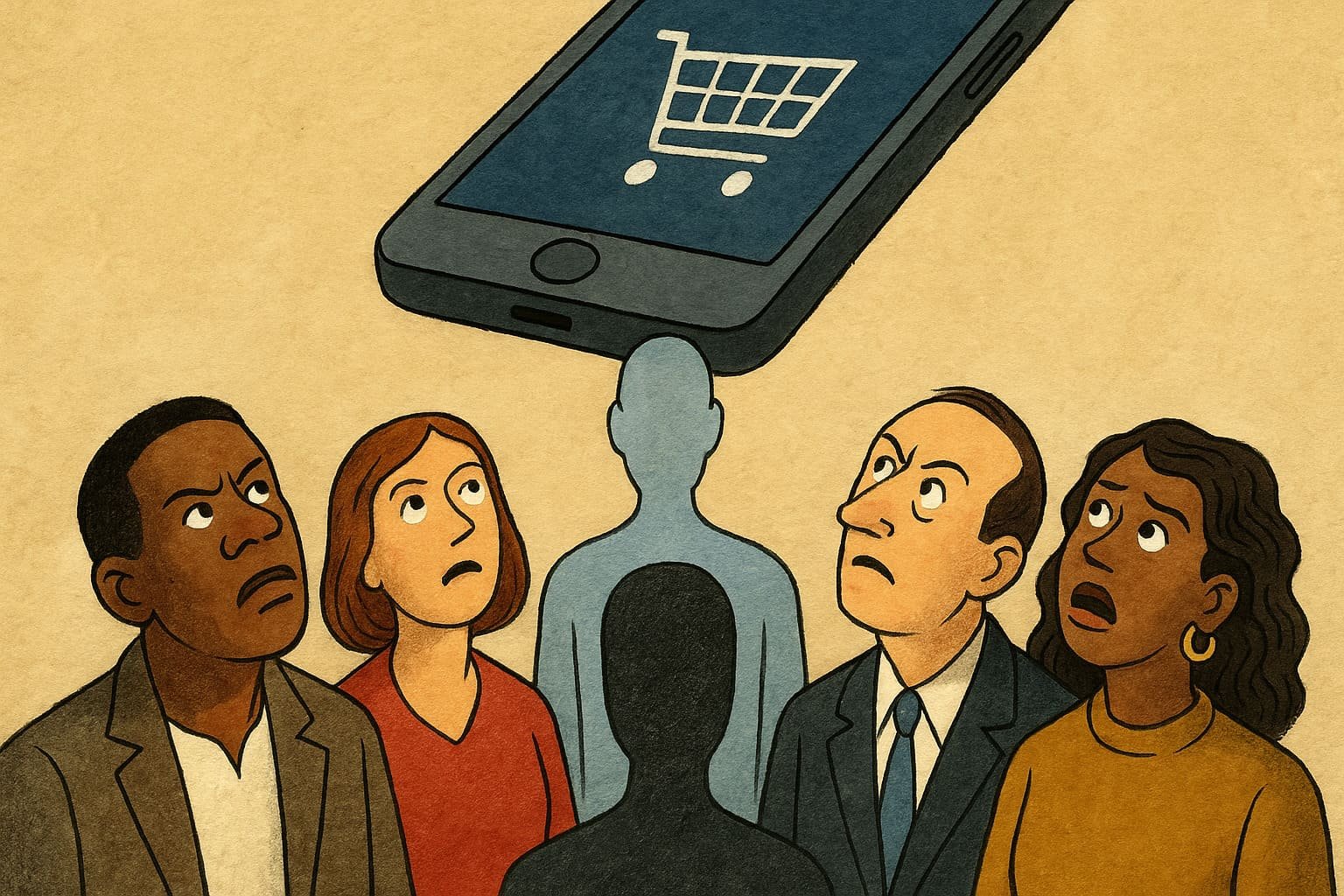
An ancient vault, once filled with gold, now hums with blinking servers. Safety deposit boxes have been replaced by passwords, crypto wallets, and contracts written in lines of invisible code. In the center, a young entrepreneur unlocks his digital safe, revealing a trove of NFTs, virtual land deeds, and encrypted personal archives. His face glows in the pale light, but the room is silent—no laughter, no stories, just the mechanical pulse of ownership redefined.
Across town, a retiree dusts off a shoebox of faded photographs, wondering who will cherish them when she’s gone. Her grandson’s memories live in the cloud, his friends’ faces flickering across screens but rarely sitting at her table. In a chic office tower, an investor marvels at her digital portfolio—artworks, collectibles, even songs—wondering if she truly owns any of it, or merely rents space in someone else’s server farm.
Outside, a protest winds through city streets, its chants livestreamed, tokenized, and sold as digital memorabilia before the day ends. Reality fractures; moments become assets, memories become data, and every heartbeat is another potential entry on the blockchain. The city’s story is for sale, but who owns the soul behind the bytes?
Quick Notes
- The Illusion of Digital Possession: As everything moves online, ownership grows abstract—what you “have” is often only licensed, borrowed, or subject to instant erasure.
- Hollow Wealth: The race to collect digital assets leaves people wealthier in pixels, but poorer in meaning, connection, and legacy.
- Lives for Sale: Personal moments, culture, and even identity are packaged, traded, and resold—raising profound questions about value, privacy, and control.
- Searching for Substance: People and communities grapple with the emptiness of digital abundance, seeking ways to recover meaning and humanity.
- What Remains?: In a world where everything can be owned, the true treasures are what cannot be bought, sold, or uploaded.
The Age of Pixel Possession – Redefining What We Own
The old icons of ownership—land deeds, family heirlooms, battered novels—fade into nostalgia as pixels take their place. In Silicon Valley, a developer brags about his “digital mansion,” a virtual estate bigger than any real-life home. Visitors pay to tour its 3D halls, but the property exists only as code, forever dependent on servers and shifting terms of service. “I built my dream,” he declares, but a power outage proves how fleeting that dream can be.
Young artists mint NFTs, selling ownership of digital art that anyone can screenshot. Some get rich overnight, others are left behind when platforms vanish or values collapse. A painter in Seoul turns her last canvas into an NFT, trading pigment for pixels. She worries her legacy is now only as secure as the next software update.
Subscription culture takes root. Music, movies, even books are accessed, not owned. A teenager in London realizes her favorite playlist disappears when she misses a payment. She searches for the songs her grandmother loved but finds them trapped behind paywalls. “Nothing lasts,” she texts a friend, “it all just floats away.”
Game worlds become marketplaces. Players in Lagos spend real money on rare skins, weapons, and avatars. When a server shuts down, years of achievements evaporate. “It’s like my childhood was deleted,” one gamer mourns in a support forum.
Real estate isn’t immune. Investors buy shares of property, never visiting the homes they partially own. A landlord in Miami brags about earning rent from tenants he’s never met, his holdings mapped on spreadsheets, not neighbourhoods. For him, value lives in data, not in stories or roots.
Meaningless Abundance – When More Means Less
The abundance of digital assets fails to fill the emptiness left by real connection. A collector in Dubai boasts of thousands of digital baseball cards, each rare, each backed by blockchain. Yet when he tries to share them at a party, conversation stalls. “You can’t hold them,” his friend jokes, “can’t even lose them in the laundry.” Laughter rings hollow.
A musician in Nashville streams her concerts to virtual audiences, selling exclusive “moments” as clips and mementos. Her fans collect, trade, and resell the fragments, but she wonders who actually hears the music. “It’s like singing into a mirror,” she confides in an interview, “I see myself, but nobody else.”
Online identity fragments across platforms. A marketing executive in Tokyo keeps profiles on six social networks, each a carefully managed persona. She spends hours curating content, responding to followers, polishing her digital image. At a reunion, she’s recognized not for her work, but for a viral dance posted years before. She wonders if she’s still real or just a collection of digital impressions.
Cultural memory erodes. An elder in Mexico City laments the disappearance of street murals replaced by digital projections. “They fade as soon as the power goes out,” he says, “our stories, erased by daylight.” He gathers his grandchildren, telling them tales they cannot download.
Children inherit logins, not legacies. A teenager in Sydney receives a hard drive as a birthday gift—family photos, letters, scanned diaries. “I wish I knew their voices,” she says, scrolling through folders. The past survives as files, stripped of scent, warmth, and laughter.
The Marketplace of Moments – When Life Becomes a Commodity
Everything can be sold—memories, achievements, even grief. A viral video in Johannesburg captures a marriage proposal. The couple sells the footage as a “unique digital experience,” splitting the proceeds with the platform. Their friends cheer the windfall, but the bride’s mother mourns the lost intimacy. “That moment belonged to us,” she whispers, unseen.
Celebrities auction digital autographs, access to private chats, and slices of their daily lives. A young fan in Chicago spends her savings on a limited-edition emoji, a token of connection she’ll never touch. When the platform folds, the token vanishes. “I thought I owned a piece of her,” she says, “but it was just a ghost.”
Political protests are livestreamed, clipped, and sold as NFTs. A street artist in Hong Kong discovers his mural, painted in defiance, is now a collector’s item for someone halfway around the world. The message is lost, the art commodified. He returns at night to repaint, reclaiming the wall with fresh defiance.
Personal data becomes currency. Fitness trackers, smart fridges, and connected cars record every detail, building profiles for advertisers and insurers. A chef in Toronto receives a discount on groceries for sharing her recipes. When a data breach exposes her eating habits, she feels violated, her life traded without consent.
Privacy erodes as everything is documented. A boy in Moscow becomes a meme after a playground accident is caught on camera. The clip is remixed, shared, and sold. Years later, he’s recognized by strangers who know nothing of his real story.
Searching for Substance – The Human Longing for Meaning
For every hollow transaction, there’s a rebellion—a search for substance and soul. Book clubs trade paperbacks, their margins filled with notes and coffee stains. A carpenter in Vermont builds furniture by hand, gifting each piece with a story and a signature. Buyers queue for the chance to own something real, something that endures beyond the next app update.
Artists rebel by refusing to digitize. In Athens, a sculptor buries his work in a garden, inviting discovery instead of purchase. Visitors leave gifts in return, weaving a tapestry of secret exchanges. “It’s not about ownership,” he explains, “it’s about belonging.”
Communities reclaim rituals. A family in Cairo hosts storytelling nights, sharing poems, recipes, and memories. Phones are left at the door, the stories passing from mouth to ear, never entering the cloud. “These are ours alone,” the grandmother insists, her eyes shining.
Some companies experiment with “slow ownership”—objects designed to age, change, and bear witness. A watchmaker in Geneva crafts timepieces with handwritten guarantees, promising repair, not replacement. Buyers cherish each scratch and scar, the marks of a life well-lived.
Philosophers urge a return to meaning. Online forums debate what can never be digitized: love, forgiveness, the warmth of a hand held in silence. The conversation turns, slowly, from what can be owned to what must be cherished.
The Last Unbuyable Things – What Humanity Can’t Upload
At the far edge of digital ownership, treasures remain that money and code can’t capture. Friendship survives in laughter, not in messages stored on servers. A mother braids her daughter’s hair, singing a lullaby learned from her own mother—no filter, no NFT, no playback.
Communities gather for festivals, parades, and rituals, their joy unrecorded by design. A chef in Barcelona hosts secret suppers, the location whispered, the menu unknown until the last guest arrives. “This is for us, and us alone,” she smiles as candles flicker.
Heirlooms return. A craftsman in Nairobi repairs a family’s broken chair, carving new initials alongside old ones. The wood creaks with stories, more precious than any digital badge.
A teacher in New Orleans collects student drawings, storing them in a battered folder instead of the cloud. Years later, graduates return to see their childhood dreams, paper faded but memory sharp.
Hope survives, unbuyable and unbroken. A stranger in a crowded subway offers a seat, kindness exchanged without a trace. The moment fades from view but lingers in the heart.
The Final Key: Finding What Can’t Be Taken
Night falls over the city, windows glowing as people retreat into digital keeps. In quiet homes, old photos are passed from hand to hand, laughter and tears rising unfiltered. Outside, servers spin, minting new tokens, claiming new moments, but within these walls, the treasures remain untouched by code.
A child asks for one more story. The grandfather smiles, knowing some gifts are too big for any vault, too fragile for any blockchain, too alive to be uploaded. The world may chase ownership, but the heart remembers what can never be bought. Now, you carry the final key—what will you protect from the hollow rush of digital everything?
