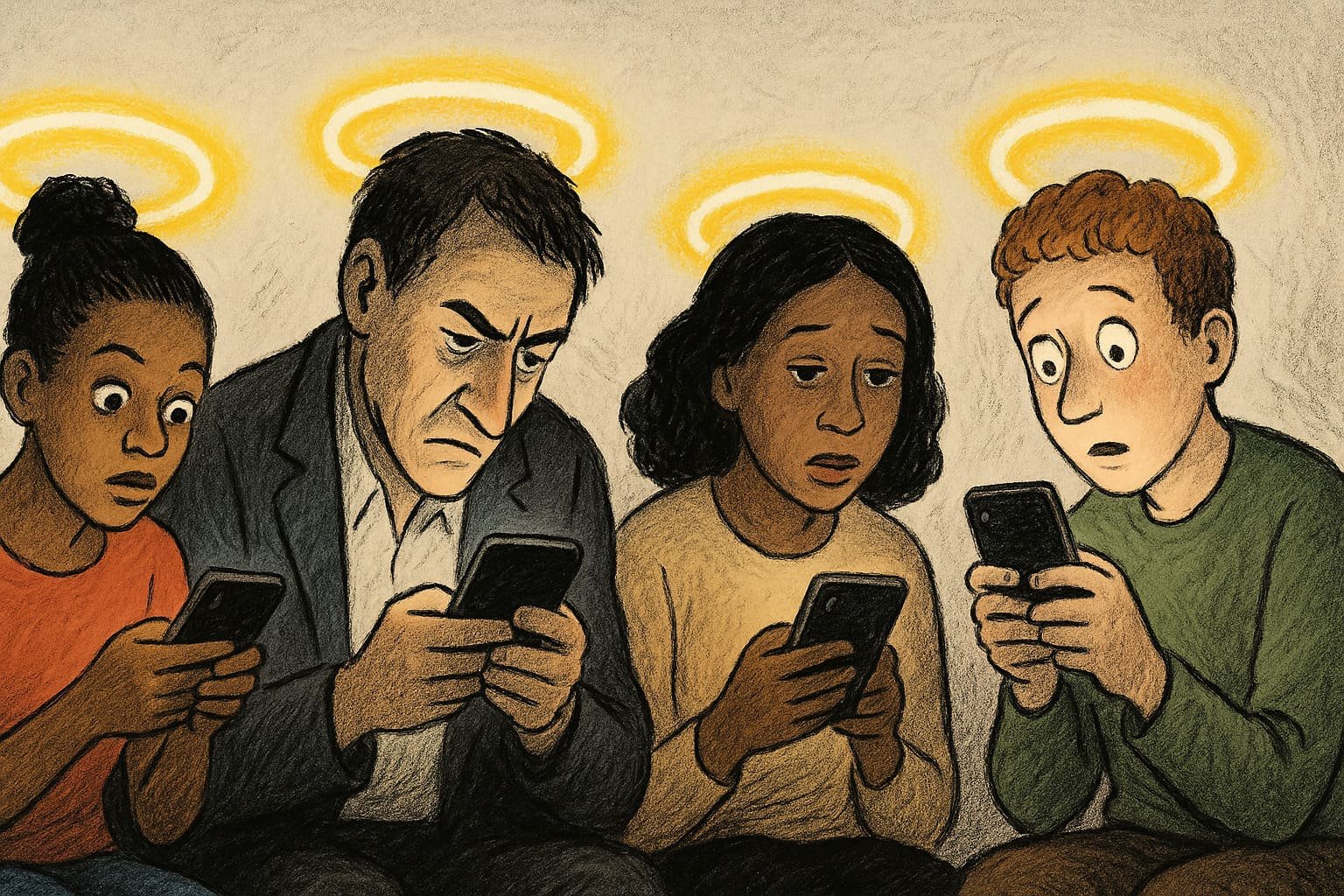
Night falls across the city, but the cathedral never closes. Neon halos flicker behind windows. Shadows gather around cold glass altars, eyes reflecting the holy glow of pixels. In every apartment, an endless congregation kneels, not in prayer, but in worship before luminous screens. Hands hover, twitch, and scroll; fingers twitching rosaries made from likes, swipes, and red notification dots. Somewhere, a child’s laughter echoes from a living room, barely audible over the soft pulse of a TikTok soundbite looping for the thousandth time. Nobody moves. Nobody breathes. The ritual of connection feels almost sacred, yet underneath, an ancient hunger gnaws.
Screens replaced the village square, the family table, even the confessional booth. Modern saints do not fast or flee to deserts. They chase streaks, hunt dopamine, burn midnight candles in Instagram’s confessional glow. The cost? Sleep, intimacy, memory, perhaps even the memory of memory itself. In a world where even CEOs confess to being “enslaved by email” and teens track self-worth through daily “streaks,” the question is no longer whether obsession exists, but whether sanity survives it.
The streets outside pulse with the energy of a new faith. News anchors speak in hashtags. Brands baptize customers in loyalty apps. Tech giants offer redemption in 30-second updates. Meanwhile, the faithful grow restless. When the screen locks, anxiety flares. The silence feels radioactive. Can you imagine a world where silence isn’t terrifying?
Last week, Maya, a mid-level project manager, called her phone her “lifeline.” She laughed, but her knuckles stayed white as she scrolled through Slack messages. In another city, digital monk Alex, age fifteen, achieved a 300-day Snapchat streak. His parents celebrated with pizza, not realizing his real friends were now ghosts in a chat log. Rituals change, but the longing for meaning never fades.
The scent of burnt coffee mingles with the hum of charging cords. Everyone is searching for the same thing: not knowledge, not money, but belonging. In the pixel-lit darkness, each soul is alone but convinced they are part of something massive, important, eternal. The old saints prayed for vision. The new saints pray for Wi-Fi.
Quick Notes
- Screens Are New Altars: You live in a world where devotion is measured in screen time. Rituals aren’t religious; they’re relentless.
- Social Validation Is Addictive: Dopamine hits from every like and comment drive behavior, warping attention and identity with frightening efficiency.
- Tech Giants Are the High Priests: Behind every app, unseen architects engineer your habits, trading your focus for their fortunes.
- Humanity Gets Fragmented: Obsession with screens erodes memory, relationships, and meaning. Each notification chips away at your authentic self.
- You Can’t Opt Out Without Fear: The only thing scarier than being “always on” is missing out. Digital sainthood demands endless sacrifice, but the exit fee is loneliness.
Pixel Pulpits: Worshiping at the Church of the Infinite Scroll
Society’s new religion is practiced in the glare of liquid crystal. You find yourself praying for signal strength more often than for wisdom. In the sanctuary of your living room, each device becomes a pulpit, broadcasting sermons crafted by marketers, influencers, and AI that knows your secrets. The scroll never ends. Each flick of the thumb is another bead on a rosary of distraction, engineered to draw you deeper into the faith.
Picture Oliver, a startup founder in Berlin, whose life turned into a 24/7 Slack thread. He slept with his phone on the pillow, convinced every vibration held a new miracle or disaster. Friends became avatars, feedback loops replaced conversation, and by year’s end, Oliver had more notifications than actual friends. His company scaled, but his memories blurred.
The infinite scroll preaches abundance but delivers anxiety. Social feeds, news apps, and productivity dashboards promise transformation, but rarely provide fulfillment. The doctrine: there is always something else you should be doing, buying, learning, improving. If you stop scrolling, the silence feels like a kind of death.
The architecture of your digital cathedral is ruthless in its beauty. Algorithms know when you’re vulnerable. Push notifications appear in moments of doubt. Like a preacher sensing weakness, your apps offer redemption for a click. Meanwhile, the real world dims: coffee cools, pets go unwalked, children sigh as adults check Slack at the playground.
Each ritual starts innocently: “Just checking.” The trance comes next. The outside world fades, priorities reorder, and soon, the screen is both sword and shield. You are worshipping, and the gods you serve are invisible.
Social Dopamine: The Holy Sacrament of the “Like”
Validation is no longer internal; it’s measured in digital applause. Every heart, star, and retweet is a sacrament delivered instantly, making ancient rituals look slow and clumsy. You’re not alone. Executives and interns alike admit to chasing the rush of digital approval, caught in loops of posting, refreshing, and longing.
Remember Priya, a high-performing analyst at a global consulting firm, who built her self-worth around LinkedIn endorsements. Her calendar was full of client calls, but every spare second was spent polishing posts, replying to comments, and tracking engagement. One viral post triggered a week of euphoria. When the algorithm moved on, the crash felt like exile.
Neuroscientists call it operant conditioning, but you know it as addiction. Each notification lights up the same part of the brain as chocolate or cash. You scroll, you crave, you chase a feeling that always fades. The hunt for “likes” becomes its own form of fasting and feasting, a pendulum swinging between pleasure and pain.
Social platforms understand their role as digital priests. They dole out affirmation, punish silence, and reward outrage. Real friendships risk decay as online connections multiply. Genuine compliments feel hollow next to the rush of public recognition. The price of belonging keeps rising.
This is not just a youth problem. Boardrooms are full of leaders checking engagement stats before reading emails. The hunger for external validation has become the defining vice of our era—packaged, exported, and monetized at global scale.
Tech Titans: Architects of the Infinite Temple
The architects behind these altars aren’t saints; they’re high priests of persuasion. Each product launch, every interface tweak, is designed to extract maximum attention from minimal resistance. The architects wear sneakers, eat sushi, and quote Steve Jobs. Their prayers are conversion metrics.
Consider Jenna, a former engineer at a major social network, who left after realizing her team’s goal was to “increase daily engagement at all costs.” She described design sprints built around boosting time-on-site. Users weren’t customers; they were data points to be optimized. When Jenna left, she said she wanted to “build something people could close and feel whole.”
Algorithms have no conscience. They select for outrage, envy, tribalism, and fear, because those emotions keep people clicking. The most successful platforms are the ones that hijack attention the longest, with the fewest interruptions. Your desires, weaknesses, and routines are all accounted for in the code.
There is an irony to the architects’ lives. Many tech leaders now send their own children to “no screens” schools, having seen the effects up close. Meanwhile, their creations spread around the world like digital gospel. The high priests rarely live by the sermons they write for others.
Ethics panels and privacy watchdogs try to challenge the architects. Still, most people accept the deal. Free products, in exchange for a piece of your life. The architects win every time someone unlocks their phone in the middle of a meal. The most sacred spaces are now the most monetized.
Fragmented Souls: The Price of Eternal Connection
Constant connectivity fractures the psyche. You feel it in the emptiness that lingers after hours online, the restlessness in quiet moments. Relationships wither under the weight of split attention. At dinner, faces glow blue from screens. Laughter gives way to silence as everyone checks their feeds.
Take Marcus, a university student whose friendships faded as he replaced face-to-face talks with group chats. He described feeling “surrounded, but unseen,” always in touch but rarely touched. The boundaries between work, play, and rest eroded, and soon, Marcus found it hard to tell what he actually enjoyed.
Memory is another casualty. You trust photos, not recollections. Events blur, conversations slip away, replaced by the curated record of the feed. Life feels lived twice: once in the moment, then again as content. Nostalgia arrives early, and the hunger for newness never ends.
The quest for meaning turns into a hunger for distraction. Each notification is a chance to escape discomfort, but the escape is temporary. The result: a generation trained to avoid reflection, seeking solace in the next scroll, swipe, or stream.
Screen obsession sells a dream of connection, but often delivers isolation. Technology promised to bring people closer, but the lines between friend and follower, family and audience, have blurred. The price of being “always on” is never truly being present.
Exit Anxiety: The Fear That Keeps Us Plugged In
You dream of leaving the temple, but the doors feel locked from the inside. Digital sainthood comes with a steep exit fee: the terror of missing out. Silence is no longer peaceful; it’s suspicious, unnerving, even dangerous. To unplug is to risk irrelevance.
Recall Sophia, a marketing executive who tried a “digital detox” retreat. The first day felt like withdrawal. She reached for a phone that wasn’t there, her mind racing with phantom buzzes. Colleagues texted, wondering if she was sick. By the end of the week, Sophia described clarity and calm, but also a fear that she had missed something vital; an opportunity, a trend, a crisis.
Platforms exploit this fear. Features like “read receipts,” “seen” indicators, and “streaks” keep users hooked by turning absence into anxiety. If you miss a message, the world might move on without you. The cost of stepping away isn’t just loneliness; it’s obsolescence.
Even the most disciplined feel the pull. You tell yourself you’re in control, but the fear of missing out lingers. Life moves fast. The feed never sleeps. The cost of devotion isn’t just time; it’s agency.
No one wants to be the last to know, the one left behind in a world that never stops. So you stay, scrolling, praying for meaning in a ritual that never ends.
Sanctuary of Shadows: Where Silence Holds Its Breath
Beneath the endless blue light, a city slumbers restlessly. Towers hum, screens flicker, and somewhere, a forgotten friend leaves a voicemail that no one hears. In the old cathedrals, pews stand empty, while the new sanctuaries glow from pocket altars across the world. The high priests of code retreat to glass offices, their faces reflected a hundred times in the mirrored walls. Each believer clings to the comfort of the screen, unwilling to risk exile for a taste of quiet.
A child stares at the stars outside the window, wondering if anyone else remembers the night sky. In a silent kitchen, a mother turns off her phone and listens for the heartbeat of her own longing. Somewhere, an entrepreneur sits in darkness, counting unread messages as if they were prayers, his own reflection flickering in the cold blue light. He remembers laughter before notifications, stories before hashtags, and a time when presence meant more than pixels.
No gospel says you must obey the screen, but the fear of silence keeps the faith alive. The ritual persists, even when the meaning slips away. Some saints will wake, put down the device, and taste freedom. Others will stay, lighting one more candle in the church of connection, never quite knowing if salvation or surrender waits at the end.
You still have a choice. The question is: will you dare to unplug, or will you let the screens write your story?
Why scroll… When you can rocket into Adventure?
Ready to ditch the boring side of Life? Blast off with ESYRITE, a Premier Management Journal & Professional Services Haus—where every click is an adventure and every experience is enchanting. The ESYRITE Journal fuels your curiosity to another dimension. Need life upgrades? ESYRITE Services are basically superpowers in disguise. Crave epic sagas? ESYRITE Stories are so wild, your grandkids will meme them. Want star power? ESYRITE Promoted turns your brand cosmic among the stars. Tired of surface-level noise? ESYRITE Insights delivers mind-bending ideas, and galactic-level clarity straight to your inbox. Cruise the galaxy with the ESYRITE Store —a treasure chest for interstellar dreamers. Join now and let curiosity guide your course.
