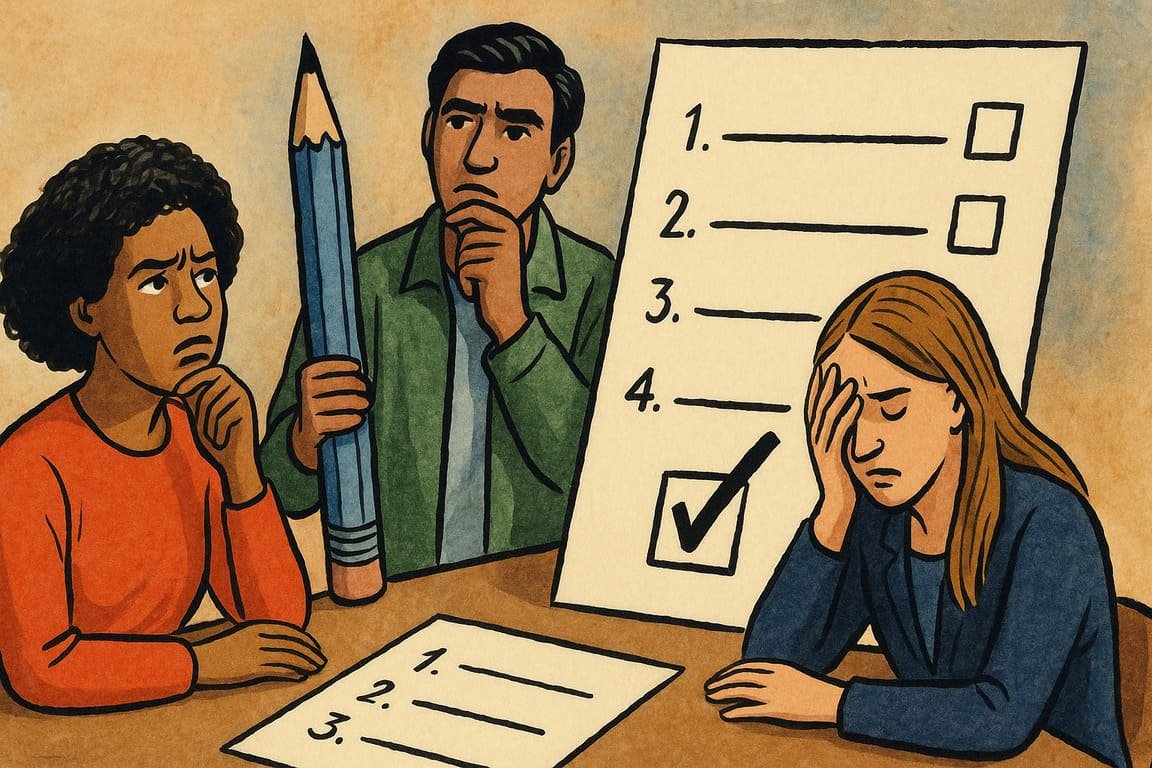
A fluorescent hallway stretches into quiet stillness, interrupted only by the shuffle of papers and the rhythmic clicking of pens. Behind one closed door, a small group leans over a cluster of forms. Tension simmers as every phrase, every checkbox, every stray comma is debated into the night. The team knows a single poorly worded question could derail months of research or send a campaign off-course. In the end, what matters isn’t just the answers but the subtle art of the questions themselves. Tonight, the stakes feel impossibly high: the right question could unlock insight, while the wrong one might bury the truth forever.
You know this pressure. Each time you draft a survey, you’re trying to capture lightning in a bottle. The words must walk a tightrope: clear but not simplistic, unbiased but never bland, open enough to surprise but focused enough to yield action. The wrong choice—a leading phrase or an ambiguous term—invites confusion and invites the wrong conclusions. A global hotel brand once learned this the hard way, losing millions after a feedback survey confused “comfort” with “luxury,” misreading guests’ needs entirely.
Survey design is an invisible power. Companies rise and fall on questions nobody outside their walls ever sees. Consider Southwest Airlines. Their famous turnaround began with one sharp question to staff: “If you could change just one thing about your job, what would it be?” That single invitation to speak changed the culture and revealed priorities executives had missed. True insight often begins with a question that makes someone pause, then answer honestly.
The structure of your questions matters as much as the words. Think of how a local health clinic used short, plain questions in several languages to uncover the real barriers to vaccine uptake. Where a national survey had failed, their simple design let nervous patients share real fears. The right structure builds trust and invites candor. It’s the scaffolding upon which honesty is built.
Context is everything. In market research, timing and delivery can shape the answer as much as the question. A streaming service once sent a feedback form immediately after the finale of a hit series, only to learn that emotion skews memory. The next season, they waited a week. The responses changed, offering deeper, less reactionary insights. When you understand context, your questions stop being static—they become conversations.
Bias is a shadow that haunts every survey. Even seasoned teams fall prey to their own assumptions. A retail startup, convinced their packaging was flawless, asked only for compliments. It took a consultant’s intervention to add the simplest of questions: “What frustrated you about opening your package?” The answers stung—but also pointed to a fix that doubled customer satisfaction in six months.
Language has power. The best survey writers study linguistics and psychology, treating every phrase as an invitation. At IDEO, the design firm, even post-project surveys are prototypes—tested, refined, and reworked after each use. They learned that changing “How satisfied were you?” to “How did this experience fit into your day?” made respondents share richer stories, surfacing problems nobody expected.
Great surveys embrace both science and empathy. It’s a balancing act: statistical reliability meets human feeling. The nonprofit charity: water achieved record-breaking donor retention by asking not just, “How likely are you to give again?” but, “What would inspire you to tell a friend about us?” The difference wasn’t semantic—it was emotional, and it reshaped their approach.
Even multiple-choice questions can be revolutionary when designed with care. The New York Times digital team, facing subscriber churn, swapped rigid categories for “Choose all that apply” questions. They discovered subscribers who valued opinion pieces stayed longer than those who read breaking news. Small changes in survey design can lead to big revelations.
Don’t underestimate visual design, either. A Swedish bank used color-coded scales to help users navigate complex satisfaction surveys. Visual cues made the process intuitive and less intimidating, raising response rates and deepening engagement. The medium often amplifies the message, especially for audiences weary of endless forms.
Iteration is your friend. Google’s product teams launch “micro-surveys,” testing a handful of questions, learning, then revising fast. They see every version as a step closer to truth. Perfection isn’t the goal—progress is. Every round of feedback makes your survey smarter, leaner, and more honest.
Sometimes, the boldest questions are the simplest. Spotify, in its early days, asked just one: “How would you feel if you could no longer use Spotify?” Responses shaped product priorities and turbocharged loyalty. In survey design, courage to ask the fundamental question is what separates mediocrity from magic.
Survey fatigue is real. As the world drowns in forms, every new survey must earn its place. If you respect the respondent’s time, design with empathy, and listen without judgment, your questions become invitations, not obligations. That’s where real data—the kind that changes outcomes—comes from.
As dawn slips down the corridor, the team pushes back from the table, exhausted but hopeful. Their draft survey, scrawled with notes and coffee rings, feels less like paperwork and more like a bridge. Out in the world, strangers will soon encounter these questions, perhaps glancing, perhaps pausing, perhaps finally sharing what they never have before.
In the hush that follows, possibility hangs in the air. The perfect question is always just out of reach, waiting for someone curious enough to chase it, patient enough to listen.
The pen is in your hand. What will you dare to ask the world next?
