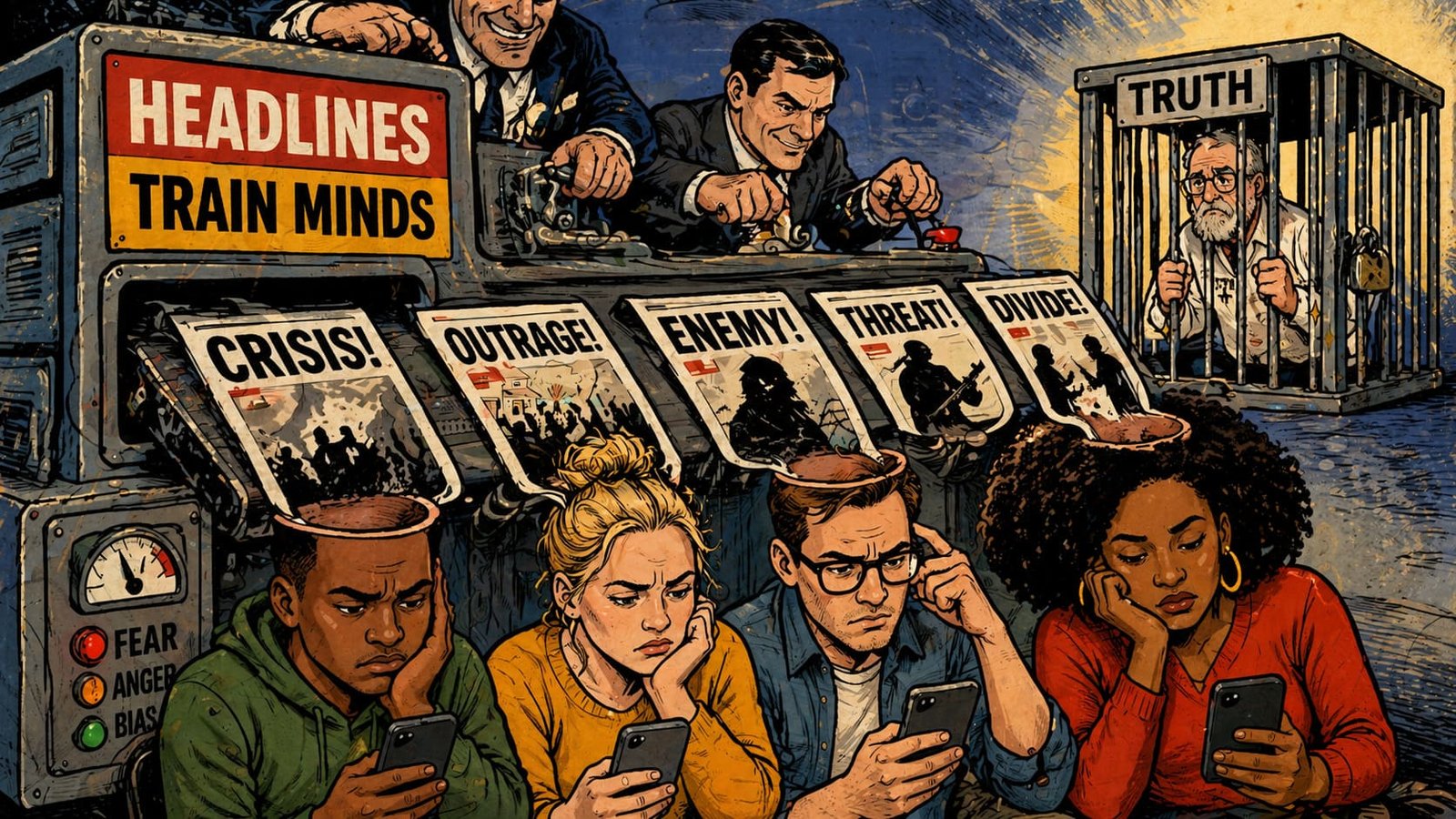
A man stands in a crowded metro carriage, thumb flicking across headlines that flash like warning lights in a dim tunnel. None of them stay long enough to be questioned. Each one lands fast, sharp, and complete, as if the story has already been decided somewhere upstream. The carriage hums with the low static of other screens doing the same quiet work, shaping impressions before facts even have time to assemble. No one speaks, yet a kind of agreement settles in the air, unspoken, invisible, strangely firm.
The headline does not ask for permission. It does not introduce itself as interpretation. It arrives dressed as fact, but it behaves more like a verdict. In the language of media theory, framing determines meaning long before detail enters the room. The economist Daniel Kahneman once noted that the way information is presented can alter judgment even when the underlying data remains unchanged. That insight feels clinical until it is watched in motion. A policy described as a “cut” feels violent. The same policy described as a “reduction” feels measured. The numbers stay still. The perception moves.
This is where the mind begins to bend without noticing. A young consultant named Farah once tracked her own reactions while scanning morning news alerts between meetings. She noticed something unsettling. Her emotional response formed within seconds, long before she opened a single article. By the time she read the details, her interpretation had already been shaped. The reading felt less like discovery and more like confirmation. The headline had done its work. The rest was reinforcement.
The architecture behind this is deceptively simple. Editors compress complexity into a few charged words. Algorithms reward what triggers reaction. Readers, pressed for time, absorb the surface and move on. Each layer trims context, sharpens edges, and accelerates judgment. A newsroom veteran named Tomas described it during a late evening conversation over stale vending machine coffee that tasted faintly metallic. He admitted that the headline often carries more strategic weight than the article itself. It is the gateway, the hook, the filter. If it fails to provoke, the story disappears. If it provokes too well, nuance collapses under its own weight.
There is a quiet violence in this compression. Reality is layered, often contradictory, sometimes unresolved. Headlines demand clarity, speed, and impact. They flatten ambiguity into something clean enough to travel. Consider how financial markets react to news. A single line can trigger waves of buying or selling before deeper analysis emerges. When Warren Buffett speaks about patience, it sounds almost rebellious in a culture trained to react instantly. The market does not always move on truth. It moves on interpretation, and interpretation is often seeded in a headline.
A small media startup in Nairobi once experimented with neutral framing. The founder, Achieng, instructed her team to write headlines that avoided emotional cues. The result was immediate and uncomfortable. Engagement dropped. Readers skimmed past stories that lacked urgency, even when the content was rich and well-researched. Achieng faced a dilemma that felt almost philosophical. Should truth be dressed to survive, or left plain and risk being ignored? The team eventually adjusted, blending clarity with subtle framing. It was not a perfect solution. It was a compromise that revealed how deeply the system rewards distortion over restraint.
Pop culture mirrors this dynamic in ways that feel almost playful until they are not. Trailers, teasers, and viral clips often shape expectations before a full story is experienced. By the time the film begins, the audience already carries a narrative in mind. The same pattern repeats in news consumption. The headline becomes the trailer. The article becomes optional. A producer once joked that modern audiences consume summaries of summaries, each layer drifting further from the original event. The humor landed lightly, but the implication stayed heavy.
The deeper consequence is not just misunderstanding. It is mental conditioning. Over time, the brain learns to trust the first frame it encounters. It becomes efficient at forming quick judgments, less comfortable with uncertainty, less patient with complexity. A policy analyst named Jeroen noticed this shift during a policy workshop in The Hague. Participants reacted strongly to initial summaries, then struggled to revise their views even when presented with detailed evidence. The first impression had settled too deeply. It felt like truth, even when it was not.
Somewhere beyond the noise, a quieter awareness begins to take shape. It does not reject headlines outright. It questions their authority. It pauses before accepting the frame, holding space for alternative interpretations that might not be immediately visible. This awareness feels slow, almost inconvenient, in a culture that prizes speed. Yet it carries a different kind of clarity, one that does not rely on urgency to feel real.
There is a moment, subtle but decisive, when a person notices the gap between what is said and how it is said. The words remain the same. The meaning shifts depending on the angle, the emphasis, the rhythm. That gap becomes a place of choice. Not an easy one, not always comfortable, but real. It introduces a kind of resistance that does not shout. It simply refuses to rush.
In that stillness, a question lingers, quiet but persistent, refusing to dissolve into the next scroll: when the first version of a story feels so complete, what part of the truth never gets the chance to arrive, and what does it cost to keep accepting the first sentence as the final word?
