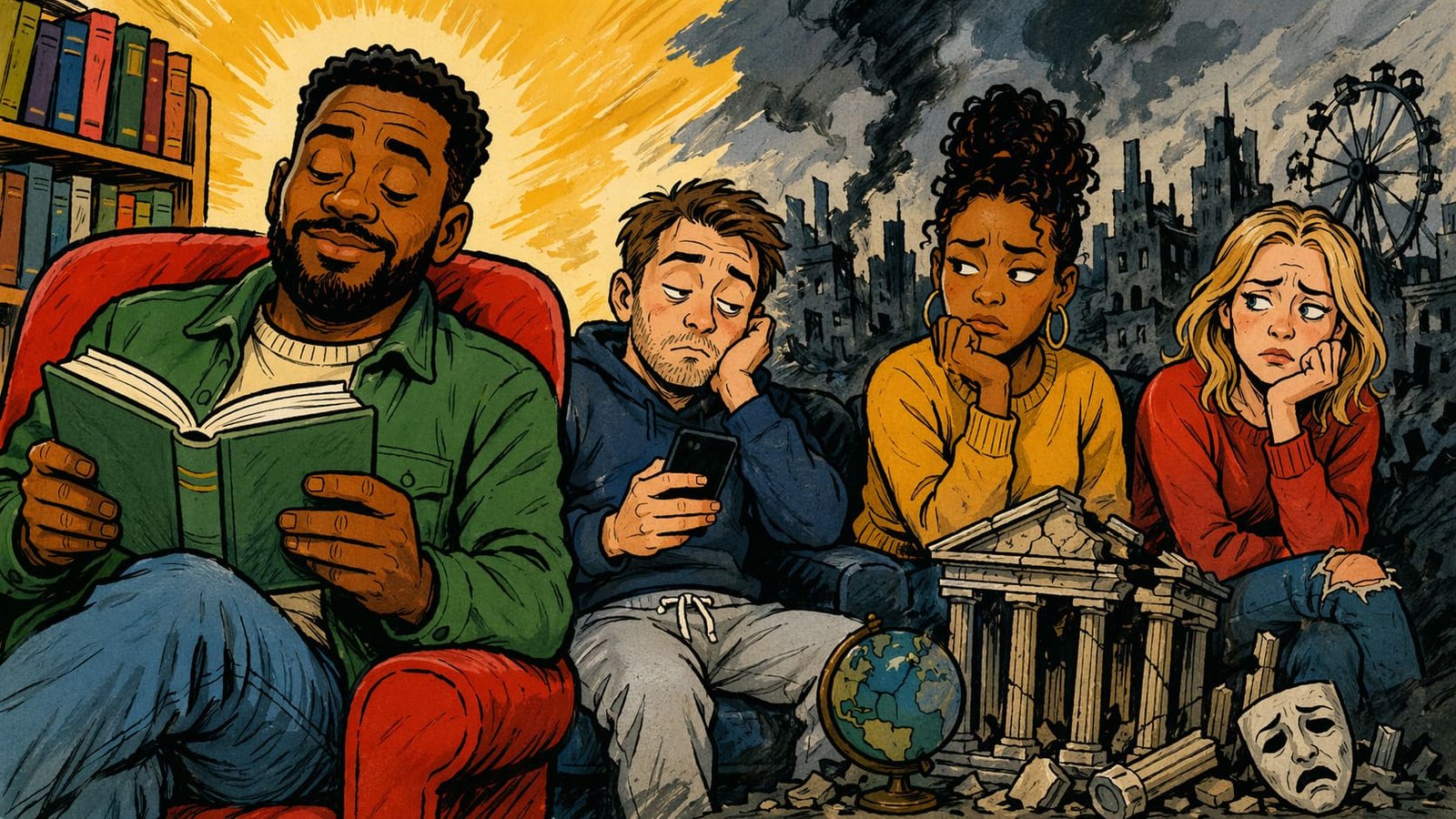
A paperback sits unopened on a bedside table, its spine uncreased, its pages stiff with untouched possibility. Dust gathers slowly, almost respectfully, as if aware it is settling on something once considered essential. Across the room, a screen flickers with endless motion. Words still exist, but they arrive fragmented, shortened, stripped of weight. Somewhere in that quiet shift, attention has been redirected, and something older, slower, more demanding has been left behind.
Reading once carried a certain gravity. It required stillness, patience, a willingness to sit inside another mind without interruption. For generations, it shaped how men understood the world, how they processed conflict, how they developed language for their own internal struggles. It was not just about information. It was about formation. Books did not simply entertain. They refined thought, sharpened judgment, and expanded emotional range.
The decline in sustained reading among men reflects a broader cultural change. Attention has been fragmented by design. Short-form content dominates, optimized for speed and repetition. The brain adapts accordingly, favoring quick hits of stimulation over deep engagement. Reading, in contrast, asks for commitment. It offers no instant reward. It builds slowly, revealing its value over time. In a culture that prioritizes immediacy, that pace begins to feel foreign.
Consider Ibrahim, an engineer who once read extensively during his early career. Books informed his thinking, influenced his decisions, gave him a vocabulary for ideas he could not yet articulate. Over time, his habits shifted. Long hours turned into passive scrolling. Articles replaced chapters. Summaries replaced full arguments. One evening, he attempted to return to a novel he had abandoned months earlier. The experience felt different. His focus drifted. The patience he once had seemed distant. He closed the book, not out of disinterest, but out of discomfort.
The impact of this shift extends beyond individual habits. Reading cultivates a certain kind of thinking, one that values nuance, complexity, and contradiction. Without it, thought becomes more reactive, more surface-level. Ideas are consumed quickly, often without reflection. The ability to hold multiple perspectives weakens. Conversations lose depth. Culture, which depends on shared narratives and layered understanding, begins to thin.
A figure like James Baldwin understood the power of language to confront uncomfortable truths. His work demanded attention, not just to the words, but to the spaces between them. Reading Baldwin is not a passive act. It is an engagement, a challenge. When fewer people engage with such work, the cultural capacity for introspection diminishes. The questions he raised do not disappear. They become harder to articulate.
There is also a shift in how masculinity is expressed and understood. Reading has historically offered men a private space to explore vulnerability, to encounter perspectives that challenge rigid identities. Without that space, expression can become narrower. Emotions that once found language through literature remain unspoken. The result is not a lack of feeling, but a lack of articulation. And what cannot be articulated often becomes difficult to navigate.
A teacher named Samuel once noticed a pattern in his classroom. Male students engaged quickly with visual content, but struggled with longer texts. When asked to interpret a passage, their responses were brief, often literal. Samuel introduced a reading circle, starting with short stories, gradually increasing complexity. At first, resistance was visible. Over time, something shifted. Students began to linger on ideas, to question, to connect. The change was not immediate, but it was real.
The economic and technological environment reinforces this trend. Platforms are designed to capture attention, not to sustain it. Algorithms prioritize engagement metrics that favor brevity and frequency. Reading, especially long-form reading, does not fit easily into this model. It requires stepping outside the stream, choosing depth over flow. That choice becomes harder when the surrounding environment constantly pulls in the opposite direction.
A startup founder named Daniel once described reading as his “competitive advantage.” While others consumed summaries, he immersed himself in full texts, drawing insights that were not immediately obvious. Over time, this habit shaped his decision-making, allowing him to see patterns others missed. He credited books not just for knowledge, but for perspective. Yet he also noted how rare this habit had become among his peers.
The cultural consequences of reduced reading are subtle but significant. Language becomes simpler, but also less precise. Ideas spread quickly, but often without depth. The ability to engage with complex issues weakens. Culture, which relies on shared understanding, becomes more fragmented. The loss is not dramatic. It unfolds gradually, almost quietly, making it harder to recognize until it is deeply embedded.
In a quiet room, a man picks up a book he has avoided for weeks. The first pages feel slow, almost resistant. His mind drifts, pulled by the memory of faster distractions. He persists, turning another page, then another. Something begins to settle. The rhythm returns, faint at first, then stronger. The words start to hold, to connect, to build. It is not immediate. It is not effortless. But it is different from anything else he has experienced that day.
The screen continues to glow nearby, offering easier alternatives, quicker rewards. The choice remains present, constant, almost tempting. Yet the book holds a different kind of promise, one that does not announce itself loudly, but reveals itself over time.
In that quiet space between distraction and attention, a question takes shape, steady and unresolved: if the habit of reading disappears, what happens to the depth of the mind that once depended on it?
