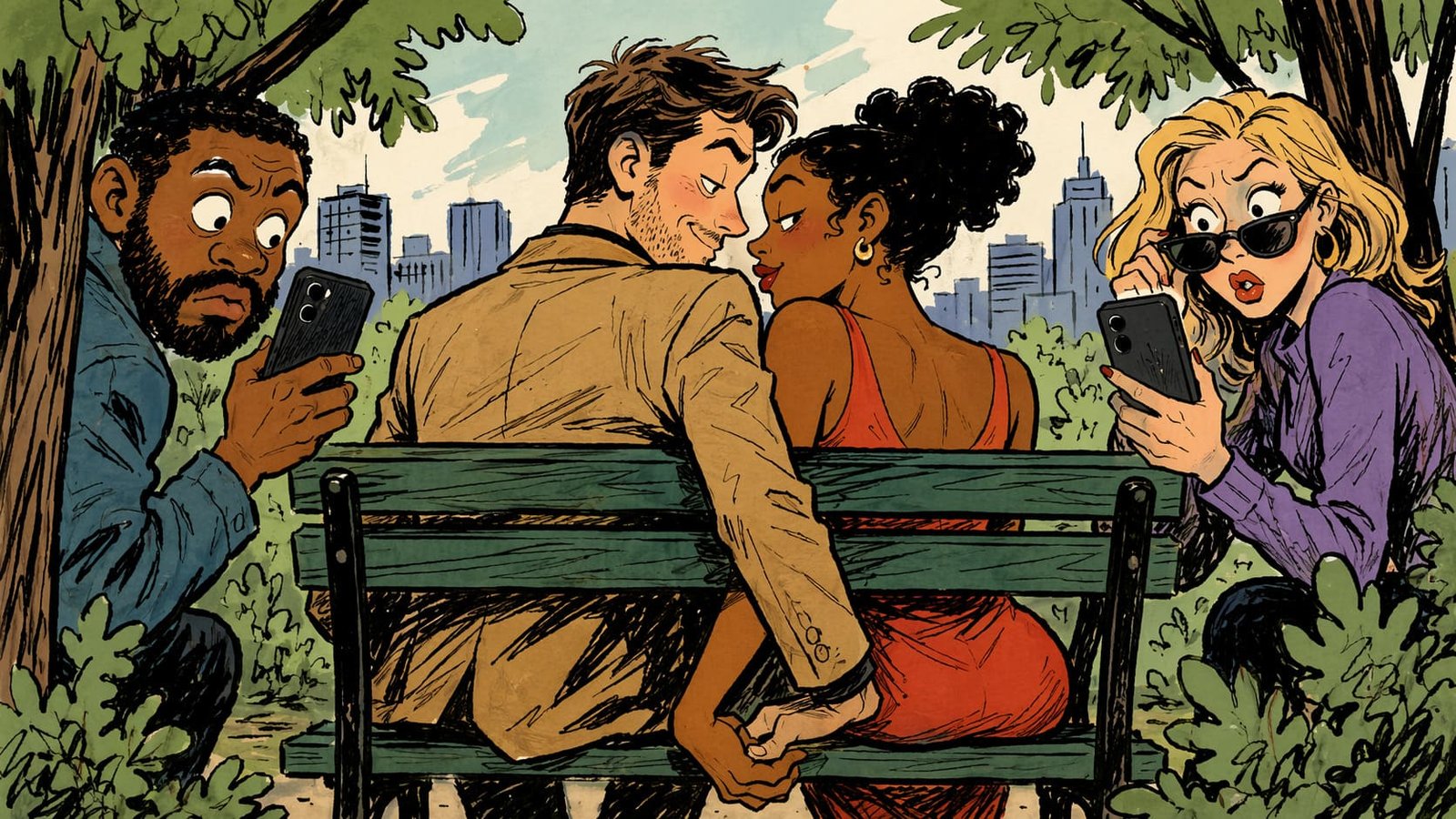
The camera shakes before the truth even has a chance to stand still. A voice cracks, sharp enough to cut through the noise of a crowded street. People turn, then linger, then gather. Phones rise almost instinctively, like a reflex the culture has trained into muscle memory. A confrontation unfolds in fragments, names shouted, accusations thrown, emotions spilling faster than anyone can contain them. Somewhere in that moment, the story stops belonging to the people inside it.
This is how modern exposure works. It does not wait for clarity. It captures chaos and distributes it instantly. Infidelity, once held in private conversations and quiet endings, now travels through feeds with the speed of spectacle. A few seconds of footage become the entire narrative. Context struggles to keep up. By the time it arrives, the audience has already decided what it believes.
Jared, a delivery driver in Phoenix, witnessed one of these moments outside a hotel. A couple argued loudly, tension thick enough to draw attention without effort. Someone nearby began recording, then another, then a small crowd formed with the quiet excitement of people who sensed something viral. Jared stood still, watching the shift happen in real time. “It stopped being about them,” he said later, sitting in his van with the engine off, heat lingering in the air. “It became something everyone else could use.” He drove away without filming, though the moment stayed with him longer than expected.
The transformation from private conflict to public content reveals a deeper instinct. People are not only watching. They are participating. Comments fill with certainty, assigning blame, offering theories, constructing entire narratives from incomplete pieces. The audience becomes a kind of jury, delivering verdicts without ever hearing the full story. The speed of this process leaves little room for doubt, and doubt is rarely rewarded.
Platforms accelerate this dynamic with quiet efficiency. The first version of a story spreads the fastest, shaping perception before alternative perspectives can emerge. A social media analyst in London, Priyanka, once described the phenomenon during a strategy meeting that felt more like a postmortem. “The first clip defines the truth,” she said, scrolling through examples that blurred into each other. “Everything after that just tries to catch up.” By then, the narrative has already settled into place, resistant to correction.
Pop culture did not create this behavior, but it prepared the ground for it. Reality television blurred the line between authenticity and performance long before smartphones turned everyone into a broadcaster. Shows like Keeping Up with the Kardashians normalized the idea that personal relationships could exist as content, edited and consumed in episodes. The transition from staged drama to spontaneous exposure felt seamless, almost inevitable.
There is a quieter psychology beneath the surface. Watching someone else’s betrayal unfold offers a strange sense of distance. It allows people to engage with emotion without being directly involved. A corporate lawyer in Toronto, Elena, noticed this during a lunch conversation with colleagues discussing a viral cheating video. The room filled with analysis, judgment, even humor. Later, she reflected on how quickly the conversation shifted away from the individuals involved. “It gave everyone a way to talk about their own fears without admitting it,” she said, stirring a drink she barely touched. “No one was really talking about them.”
The individuals at the center of these moments rarely control how their stories are told. A relationship, with all its complexity and history, becomes a few seconds of footage. A life is reduced to a headline that travels faster than understanding. The permanence of digital records ensures that the narrative lingers, resurfacing long after the moment has passed. A mistake becomes searchable. A conflict becomes replayable.
There is also an economy built around this exposure. Viral content generates attention, and attention carries value. A content creator in Los Angeles, Marcus, admitted during a podcast interview that capturing raw moments often felt like a race. “If you don’t post it, someone else will,” he said, his tone matter-of-fact, almost detached. The logic is simple, yet it reveals how easily ethical boundaries can blur when visibility becomes currency.
The emotional cost remains uneven. Viewers experience brief engagement, a moment of curiosity or judgment that fades quickly. Those involved carry the weight much longer. Relationships fracture under public scrutiny. Personal growth, which requires privacy and time, becomes difficult when every detail is exposed. A therapist in New York, Dr. Simone Clarke, described the aftermath for clients who found themselves at the center of viral moments. “They are not only processing betrayal,” she explained during a quiet session. “They are processing being watched while they do it.”
The scene shifts to a late-night subway platform where a man scrolls through his phone, watching a confrontation that has already reached millions. The faces on the screen feel distant, almost abstract, yet the emotion remains vivid. Around him, strangers stand in silence, each absorbed in their own version of the same feed. The moment that once belonged to two people now exists everywhere, detached from its origin.
And beneath that endless circulation, a quieter realization begins to form. The spectacle does not simply reveal human behavior. It reshapes it. People begin to anticipate the audience even in private moments, aware that exposure is always a possibility. The boundary between personal and public dissolves gradually, until it becomes difficult to remember where it once stood.
So the question lingers, steady and unsettling: when every private fracture risks becoming public entertainment, what part of intimacy can still exist without an audience, and how much of it have we already given away without noticing?
