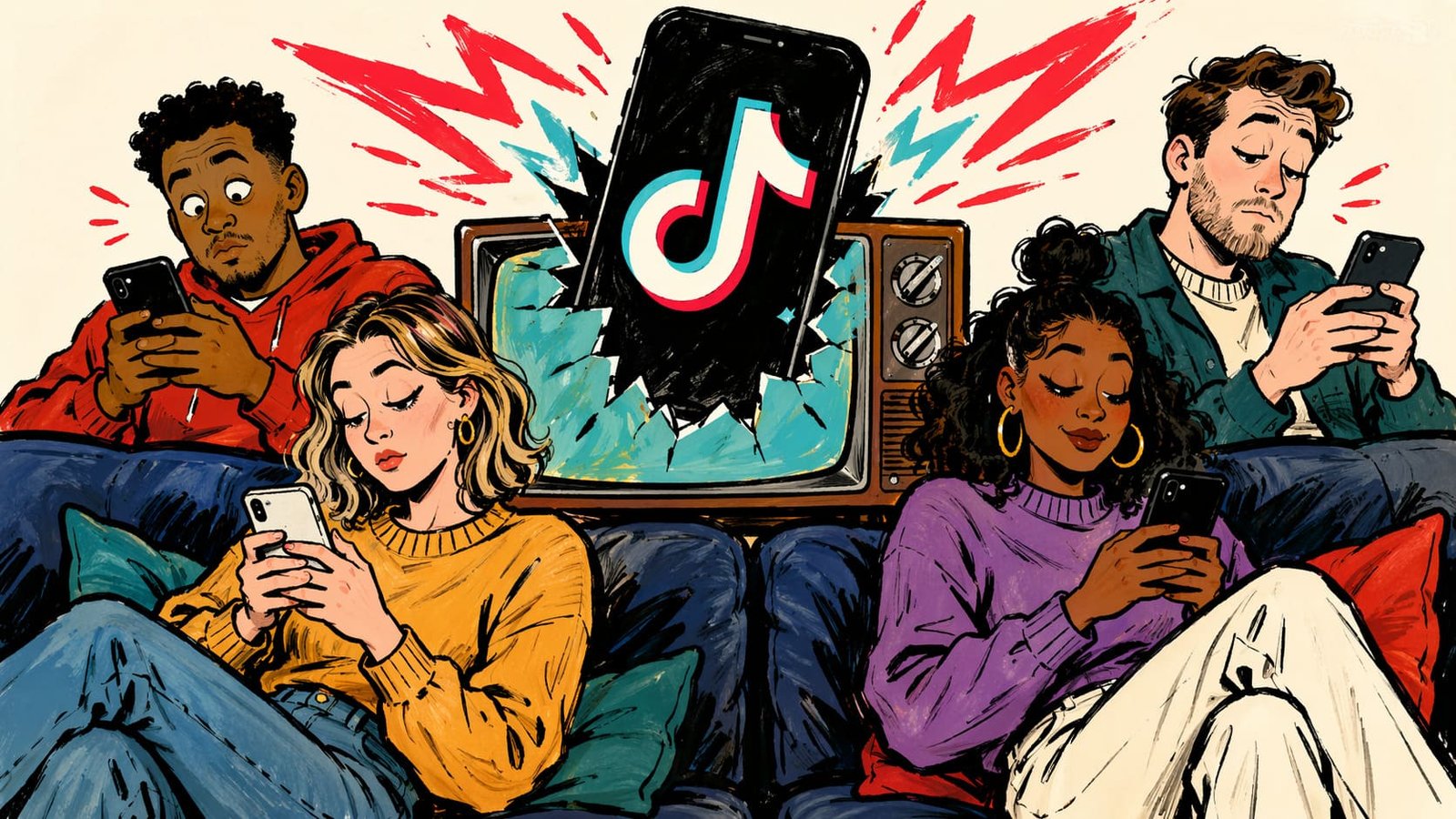
The screen no longer waits. It lunges. Images cut in before thought settles, voices rise before silence has a chance to mean anything. A story begins, then fractures, then restarts in another form, faster, sharper, louder. The rhythm feels familiar now, almost natural, yet something underneath it strains, as if narrative itself is being asked to run at a speed it was never built to sustain.
Television once moved with patience. Episodes unfolded like conversations, not announcements. Characters took time to become legible, their contradictions revealed slowly, their arcs shaped by accumulation rather than immediacy. Viewers stayed because something deeper was forming, something that required attention rather than demanded it.
Then the environment shifted. Platforms like TikTok introduced a different logic, one where attention is captured instantly or lost entirely. The first seconds matter more than the final act. The hook replaces the buildup. The story adapts, not by choice, but by necessity.
This shift did not remain contained. It began to influence how television itself is created. Writers, producers, and editors started to internalize the new rhythm. Scenes shortened. Dialogue sharpened. Moments that once lingered were compressed or removed. The narrative became more efficient, but also more fragile.
You can feel it in the pacing of modern series. Episodes move quickly, often jumping between plot points with little space to breathe. The assumption is clear. The audience might leave at any moment. Retention becomes the priority. Story becomes the vehicle.
A showrunner named Elena once described a meeting that captured this tension. Her team had crafted a slow, character-driven pilot, rich with detail and subtle development. The feedback was immediate. The first five minutes need a stronger hook. The stakes must be clearer. The pacing must accelerate. She revised the script. The show was approved. Something essential had been trimmed.
This reflects a broader transformation in how content is consumed. Attention is no longer given freely. It is competed for, moment by moment, against an endless stream of alternatives. The viewer is not just watching a show. They are choosing not to watch something else.
The economic structure reinforces this behavior. Streaming platforms track engagement with precision, identifying where viewers pause, skip, or abandon. These insights shape future content, creating a feedback loop where data informs creativity. The result is a system that optimizes for retention, often at the expense of depth.
Pop culture reveals the consequences. Shows that once might have taken seasons to develop now compress their arcs into shorter timelines. Characters evolve rapidly, sometimes too rapidly, leaving little room for the subtle shifts that make transformation believable. The emotional impact remains, but it arrives more abruptly.
There are still exceptions. Series like Breaking Bad demonstrated how slow, deliberate storytelling can build tension over time, creating a payoff that feels earned. The show trusted its audience to stay, to invest, to engage deeply. Its success suggests that the appetite for such narratives has not disappeared.
Yet the pressure to adapt remains strong. Creators entering the industry today are often trained within this accelerated framework. They learn to think in hooks, to structure scenes for immediate engagement, to anticipate the viewer’s impatience. These skills are valuable, but they shape the kind of stories that are told.
A young editor working on a streaming series once shared how his approach had changed. He found himself cutting scenes more aggressively, removing pauses, tightening dialogue. The result felt sharper, more dynamic. It also felt less human. Moments that once carried emotional weight were reduced to transitions.
This is where the tension becomes most visible. Attention is finite, but meaning often requires time. When the former dominates, the latter can struggle to emerge. Stories become easier to consume, but harder to remember.
The audience adapts in subtle ways. Viewing habits shift toward shorter sessions, fragmented attention, multitasking. Watching a show becomes one activity among many, not the central focus. This changes how narratives are received, favoring clarity over complexity, immediacy over depth.
A small production team experimenting with long-form storytelling decided to resist this trend. They created a series with extended scenes, minimal cuts, and a slower pace. The initial response was mixed. Some viewers found it challenging. Others described it as refreshing, even immersive. The show did not dominate metrics, but it cultivated a dedicated audience.
This suggests that the issue is not a lack of interest in deeper storytelling, but a lack of space for it within dominant systems. When most content follows a similar accelerated pattern, alternatives become harder to sustain.
The influence of short-form platforms extends beyond pacing. It shapes expectations around narrative structure itself. Stories are expected to deliver value quickly, to provide immediate payoff. This can limit the kinds of narratives that are considered viable, particularly those that rely on ambiguity or gradual development.
A director known for experimental work once remarked that the most important moments in a story are often the ones that feel unnecessary at first. The pauses, the digressions, the quiet scenes that do not advance the plot but deepen understanding. These are the moments most at risk in an attention-driven environment.
The broader cultural impact is still unfolding. As storytelling adapts to new forms of consumption, it also shapes how people process information, how they understand complexity, how they engage with narratives beyond entertainment. The implications extend beyond television.
A quiet living room offers a different perspective. A viewer sits watching an older series, one that unfolds slowly, allowing scenes to linger. There is no rush, no immediate hook demanding attention. The experience feels almost unfamiliar, like stepping into a different rhythm of time.
This contrast highlights what is at stake. Not just the form of storytelling, but the experience of engaging with it. The ability to sit with a narrative, to allow it to unfold, to find meaning in its pace.
The future of television may not require rejecting the influence of short-form platforms, but it does require a more conscious integration. Recognizing when speed enhances a story and when it diminishes it. Creating space for both immediacy and depth.
Somewhere between the rapid scroll and the lingering scene, a balance waits. Not easy to maintain, but essential to preserve.
And in that balance, stories might begin to breathe again, not racing to capture attention, but unfolding in a way that invites it to stay.
