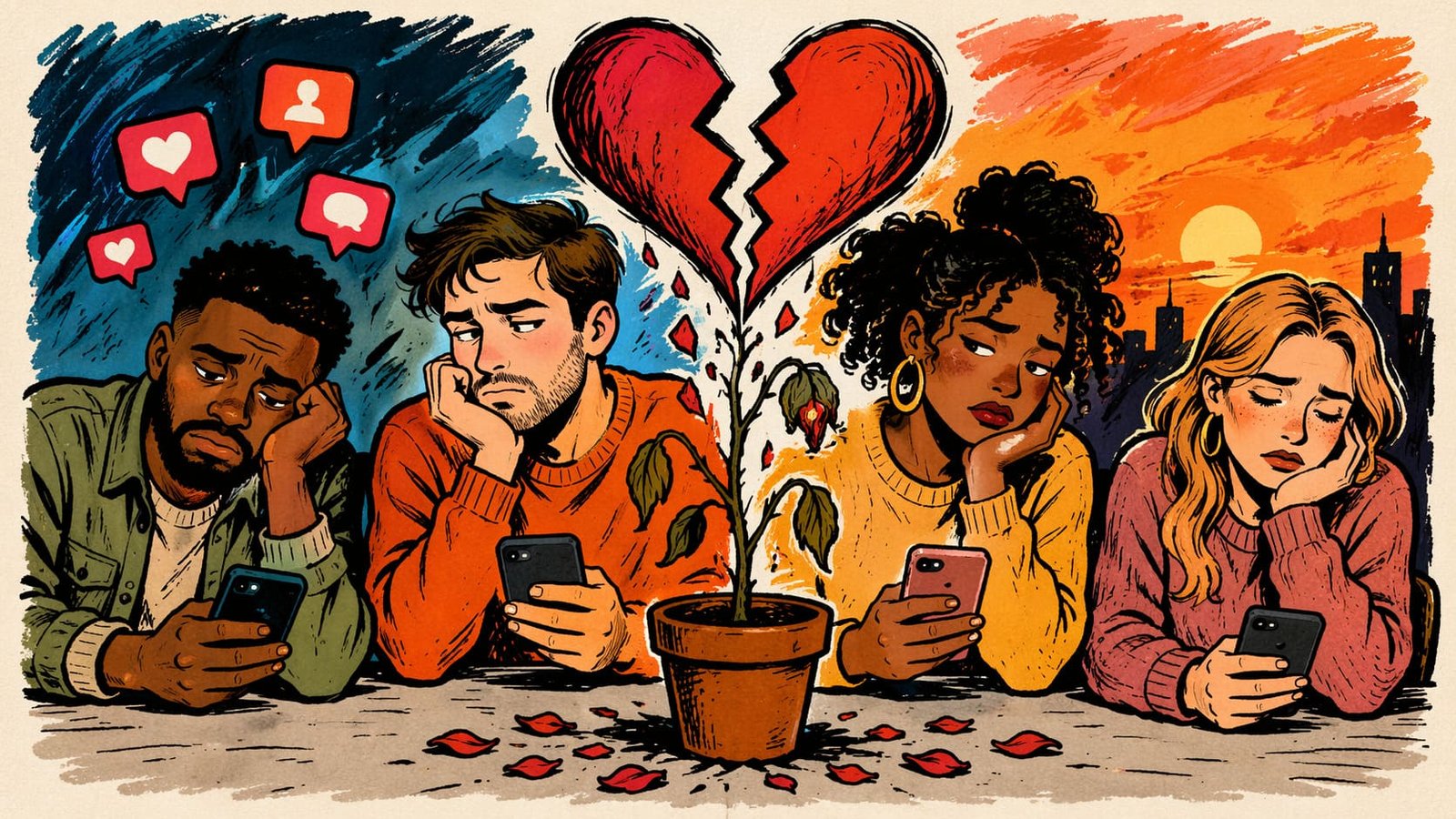
The room hums with soft blue light, a quiet theater of faces lit by screens that never sleep. Conversations flicker, vanish, reappear in fragments that feel urgent yet strangely disposable. A message is typed, deleted, rewritten, then sent into a void that answers with a typing bubble that never quite resolves. Somewhere between connection and performance, something delicate collapses without a sound. It does not feel like loss at first. It feels like progress.
The internet was once a place where people arrived with curiosity and left with something resembling intimacy. Early forums felt like handwritten letters stretched across continents, messy and sincere. Then the architecture shifted. Platforms became stages. Profiles became brands. Love, in its quiet unpredictability, was asked to fit inside metrics. What could not be measured slowly began to disappear.
What makes this shift unsettling is not that connection vanished. It multiplied. Messages increased. Notifications surged. The illusion of closeness became easier to produce and harder to trust. A generation raised on digital promise learned to translate affection into signals that could be optimized. Attention became currency, and relationships quietly adopted its logic.
Consider how modern romance now mirrors product design. Dating apps refine preferences with the precision of a recommendation engine, narrowing desire into categories that feel efficient but oddly incomplete. Swipes replace conversations. Algorithms replace serendipity. A connection is not discovered, it is surfaced. And once surfaced, it competes with thousands of others waiting in the queue.
You can see the effect in the small, human details. A message arrives late at night, crafted with care, then ignored because a better option might appear. A conversation fades not because it lacked meaning, but because it lacked novelty. A relationship ends not with conflict, but with quiet substitution. Love becomes less about presence and more about possibility.
Evan, a product designer in a fast-growing startup, once joked that his dating life felt like running A/B tests on his own personality. He would change photos, rewrite prompts, adjust tone, then wait for results. When matches increased, he felt validated. When conversations stalled, he blamed optimization, not connection. Months passed. The numbers improved. His sense of being known did not. He eventually deleted the app, not out of clarity, but exhaustion.
This pattern echoes far beyond individual experience. Platforms reward visibility, not depth. A carefully staged moment travels further than an honest one. People learn quickly. They curate their lives with the discipline of a brand manager. Vulnerability becomes strategic. Authenticity becomes a performance that must still align with audience expectations. The result is a strange duality, where everyone is visible and no one feels fully seen.
Cultural signals reinforce this shift. Popular shows like Black Mirror have long warned about technology turning human connection into spectacle. Yet the warning now feels less like fiction and more like documentation. Episodes that once felt exaggerated now resemble ordinary behavior, only slightly intensified. The distance between satire and reality has collapsed.
There is also a quieter economic layer beneath this transformation. Tech companies optimize for engagement, not emotional fulfillment. Time spent on a platform is measurable. Genuine connection is not. So the system evolves to keep attention circulating, even if it fragments meaning. The design is not malicious. It is simply aligned with incentives that do not prioritize depth.
You begin to notice it in everyday interactions. Conversations are interrupted by notifications that feel more urgent than the person in front of you. Silence becomes uncomfortable, quickly filled with scrolling. Moments that once carried weight are now documented, edited, and shared before they are fully experienced. Life becomes content, and content demands constant renewal.
Lina, a marketing strategist who built her career helping brands grow online, once described a moment that unsettled her. She was on a date that felt promising. Halfway through dinner, she found herself thinking about how the evening might look in a photo rather than how it actually felt. The realization landed hard. She finished the night, smiled, and never saw the person again. The memory remained, not because of the connection, but because of the distortion.
The shift is not irreversible, but it is deeply embedded. Millennials were the first to experience the internet as both a tool and an environment. They built identities within it while still remembering a world before it. That dual awareness creates tension. There is nostalgia for a slower, less optimized form of connection, and there is dependence on systems that make returning to it difficult.
The language of relationships has also changed. Terms like “ghosting” and “breadcrumbing” describe behaviors that once existed but were not normalized at scale. Now they are common enough to feel expected. Emotional ambiguity becomes a feature, not a flaw. People adapt by lowering expectations or raising defenses. Neither approach restores what was lost.
Even success stories carry this tension. Couples who meet online often describe a sense of luck, as if they navigated a crowded system and found something real. The narrative is framed as a victory against odds that should not exist in a world designed to connect people. The fact that it feels rare reveals something deeper about the system itself.
There is a paradox at the center of all this. The tools designed to bring people closer have made it easier to avoid closeness. Infinite choice reduces commitment. Constant visibility reduces mystery. The friction that once made relationships meaningful is smoothed out, leaving behind interactions that are efficient but thin.
Yet the desire for something deeper has not disappeared. It surfaces in unexpected ways. Long-form conversations return in small pockets. People seek offline spaces where presence is not interrupted. There is a quiet rebellion against the logic of constant optimization, a recognition that some experiences lose value when they are measured too precisely.
A founder in a small creative agency once implemented an unusual rule. No phones during client meetings, no laptops during brainstorming sessions. At first, the team resisted. Productivity seemed to dip. Then something shifted. Ideas became more layered. Conversations lingered. Clients noticed the difference. The work improved, not because of better tools, but because of undivided attention.
This points to a broader insight. The problem is not technology itself. It is the way incentives shape behavior within it. When attention becomes the primary currency, everything else adapts. Relationships begin to mirror the logic of markets. Value is assigned based on visibility, responsiveness, and perceived desirability. What cannot be easily displayed struggles to survive.
The internet did not erase love. It reframed it. It asked people to express something inherently complex through systems built for simplicity and scale. Some aspects translated well. Others did not. The parts that resist quantification, patience, presence, emotional risk, are the ones that feel most diminished.
There is a quiet scene unfolding somewhere, not dramatic enough to trend but significant enough to matter. Two people sit across from each other without reaching for their phones. The conversation moves slowly, occasionally awkward, often sincere. There are pauses that do not need to be filled. Nothing is documented. Nothing is optimized. It feels unfamiliar, almost radical.
The question that lingers is not whether the internet changed love. That is already evident. The deeper question is whether people are willing to reclaim parts of it that cannot be scaled. That requires choosing depth in a system that rewards surface, choosing presence in a culture that celebrates visibility.
A generation that learned to navigate both worlds carries a unique responsibility. It understands what was gained and what was quietly traded away. That awareness can become a form of agency, a way to step outside default behaviors and rebuild something more intentional.
Somewhere in the quiet after another notification fades, a decision waits. Not a dramatic one, just a small refusal to treat connection as content. A willingness to let moments exist without proof. A choice to remain in a conversation long enough for it to become something real.
And perhaps that is where love begins to return, not as a feature of a platform, but as an experience that resists being optimized.
