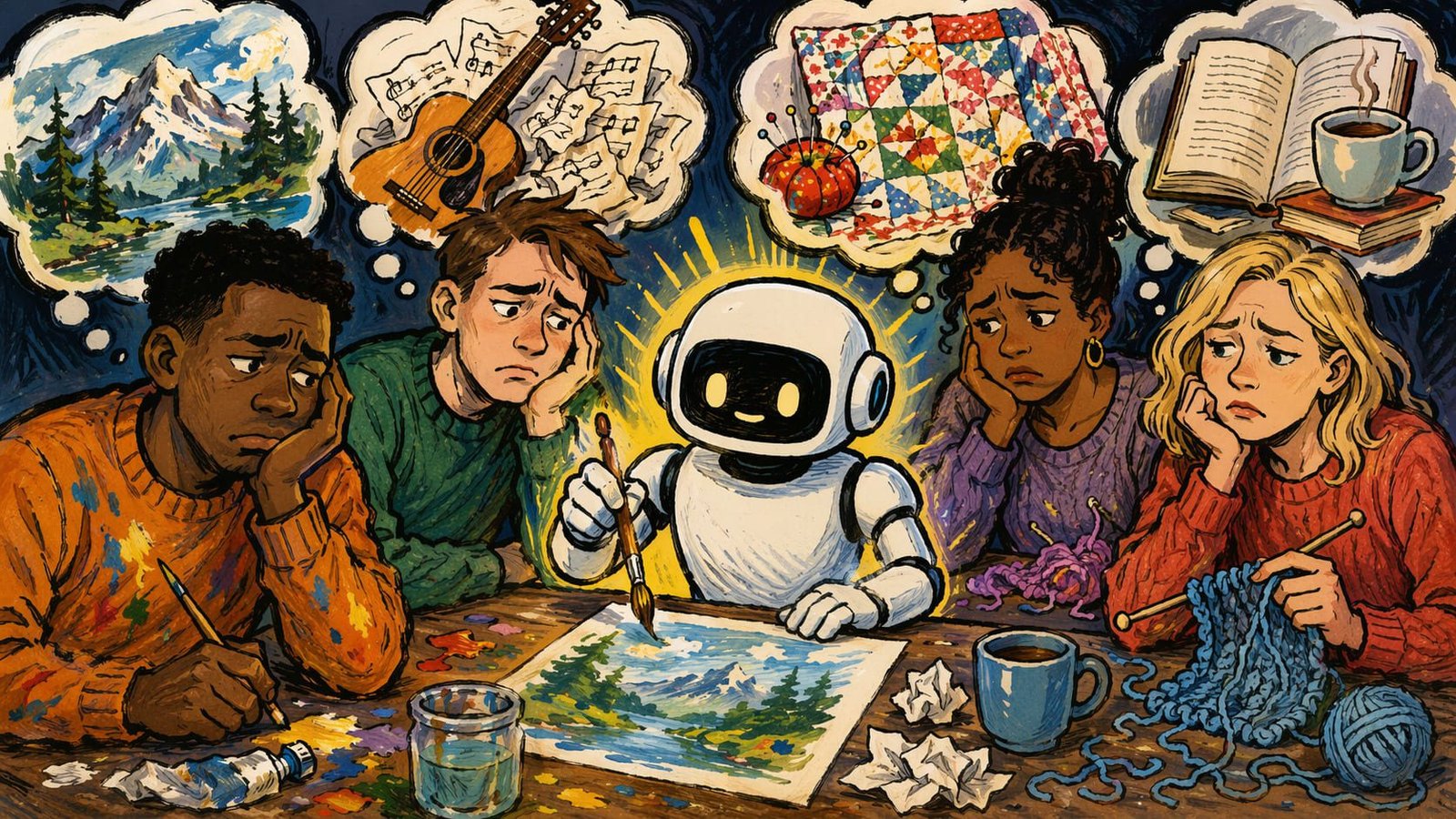
The sketch appears complete before the hand has time to hesitate. A melody forms without the slow search for the right note. Words assemble themselves into paragraphs that feel polished, almost finished. The process that once unfolded slowly, with pauses and missteps, now moves with a kind of effortless precision. It feels impressive. It also feels strangely empty.
Hobbies were never designed for efficiency. They existed in the margins of time, in moments that carried no obligation to produce something valuable. A person painted because it felt good to mix colors, not because the result needed to impress. A musician played for the joy of sound, not for perfection. These activities held space for imperfection, for learning, for quiet satisfaction that did not require an audience.
The arrival of intelligent tools has changed that relationship. Tasks that once required patience can now be completed instantly. A drawing can be generated, a song composed, a story written with minimal effort. The barrier to creation has lowered dramatically. What once took time and practice now feels accessible, even trivial. The result is more output, more content, more visible creativity.
A hobbyist named Ren once spent evenings learning to draw. Progress was slow, often frustrating, yet deeply rewarding. When he began using AI tools, his output improved overnight. The images looked sharper, more refined, closer to what he had imagined. At first, it felt like a breakthrough. Then something shifted. The satisfaction he once felt from small improvements began to fade.
This is where the tension reveals itself. AI enhances capability, yet it can diminish the experience of becoming capable. The journey, with all its imperfections, is compressed into a result that arrives too quickly. The process that once shaped identity becomes optional. Creation shifts from something lived to something executed.
Communities built around hobbies feel this change in subtle ways. Forums that once shared progress and learning now showcase finished results that appear flawless. The gap between beginner and expert narrows visually, but widens emotionally. It becomes harder to distinguish between effort and output. The culture shifts toward what can be shown, rather than what can be experienced.
A small gaming community once thrived on modding, players experimenting, failing, and gradually building something unique. With AI tools, mods became more sophisticated, more polished, more immediate. The creativity remained, yet the shared struggle that bonded the community began to disappear. The conversations changed, focusing less on process and more on results.
The deeper cost is not just about skill, but about meaning. Hobbies offered a space where time could be spent without pressure, where effort was its own reward. When that space becomes optimized, it risks losing its purpose. The act of doing something slowly, imperfectly, becomes harder to justify in a culture that values speed and polish.
And yet, resistance emerges in quiet ways. A painter chooses to work without digital assistance, embracing the unpredictability of the medium. A musician practices an instrument even when software can replicate the sound perfectly. These choices are not about rejecting technology entirely. They are about preserving a relationship with creation that feels personal and grounded.
In a dim room filled with unfinished sketches, a hand pauses over a page that shows every flaw, every hesitation, every attempt that did not quite work. There is no algorithm to smooth it, no system to complete it instantly. The moment feels slower, heavier, yet more alive. And in that pause, a question lingers with quiet insistence, one that reaches beyond tools and into something deeper: if creation becomes effortless, what happens to the part of you that once found meaning in the effort itself?
