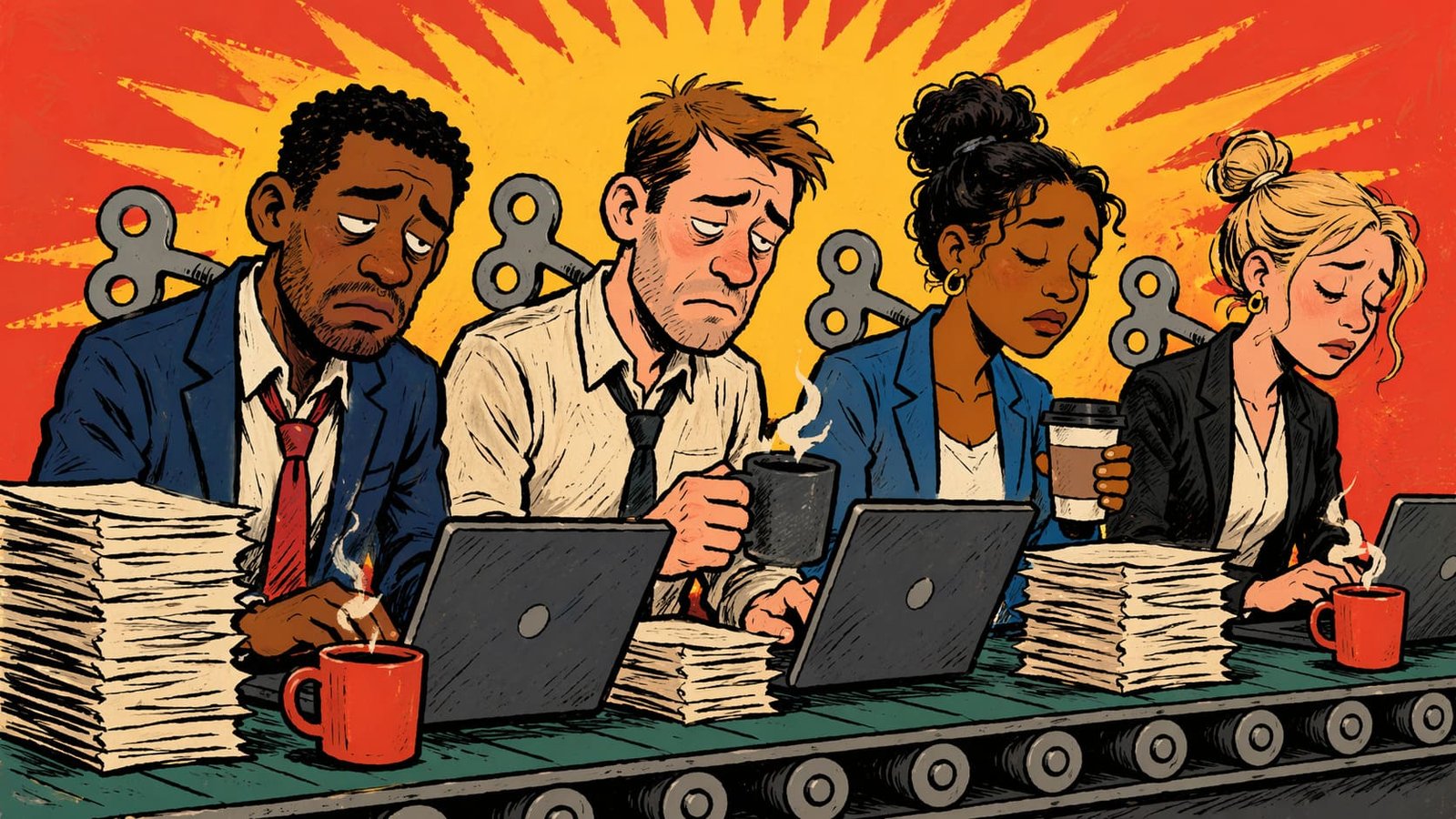
The lights never really go off anymore. Offices may empty, but laptops glow in bedrooms, in taxis, in quiet corners of cafes where conversations fade into the background of muted notifications. Work no longer announces itself with a beginning or an end. It seeps into everything, stretching across hours once reserved for rest, slowly rewriting what it means to be alive.
At first, it felt empowering. The idea that effort could outpace limitation carried a kind of romance. Stories of founders sleeping under desks and creators grinding through the night became modern folklore. Ambition was reframed as endurance. If you wanted more, you simply worked more. The equation felt clean, almost fair, and people embraced it with a kind of hopeful intensity.
The shift happened when effort stopped being a choice and became an expectation. Hustle culture turned from inspiration into atmosphere. It lingered in LinkedIn posts celebrating exhaustion as proof of commitment. It showed up in conversations where rest needed justification. The language changed quietly. Busy became impressive. Tired became admirable. Stillness began to feel like failure.
A consultant named Daniel once tracked his days down to fifteen-minute intervals. His calendar looked like a perfectly engineered machine, each slot filled, each task accounted for. He was praised for his discipline, promoted for his output, admired for his consistency. Yet in private moments, he admitted something strange. He no longer recognized the difference between working hard and simply being unable to stop.
This is where the tension sharpens. Hustle culture promises freedom through effort, yet often delivers a kind of captivity. The more productive you become, the more is expected. The ceiling keeps rising, not as a challenge but as a moving target. Success no longer feels like arrival. It feels like acceleration without a clear destination.
Companies have learned to formalize this rhythm. Productivity tools track performance with precision. Metrics quantify output in ways that feel objective, even scientific. A manager once described their team as “a system that optimizes itself.” The phrase sounded efficient, almost elegant, until you realized it described people as components rather than individuals. The language of machines had quietly replaced the language of humans.
Consider a startup that built its culture around relentless execution. Early employees were energized by the pace, proud of their stamina, bonded by shared sacrifice. Over time, the same intensity became a burden. Creativity narrowed, decisions became reactive, and burnout spread quietly beneath the surface. The company grew, but the people inside it felt smaller, reduced to the functions they performed.
The deeper cost is not just exhaustion. It is the erosion of identity. When life becomes organized around output, everything else begins to feel secondary. Relationships are scheduled, hobbies are optimized, even rest is treated as a tool for better performance. The self becomes a project, something to be managed rather than experienced.
And yet, stepping away feels dangerous. The culture rewards visibility and speed. Slowing down risks falling behind, losing relevance, missing opportunity. A designer named Sofia once took a deliberate break after years of nonstop work. When she returned, she noticed something unsettling. The industry had moved on, not dramatically, but enough to make her feel like an outsider in a space she once understood intimately.
Still, there are moments of resistance, often quiet and personal. A writer closes their laptop before finishing a piece because something in them refuses to continue. A manager cancels a meeting that serves no purpose, reclaiming an hour that cannot be measured. These actions do not appear in performance metrics. They do not scale. Yet they restore something essential, a sense that life is not merely a series of outputs.
Late in the evening, in a room lit only by the soft glow of a screen, a figure pauses, hands hovering over a keyboard that has learned their patterns too well. The system waits, ready to continue, ready to absorb more time, more energy, more attention. Nothing forces the next keystroke. That is what makes the moment heavy. And in that stillness, a question rises with quiet urgency, one that cuts through every metric and expectation: if productivity becomes your identity, what part of you remains when the work finally stops?
