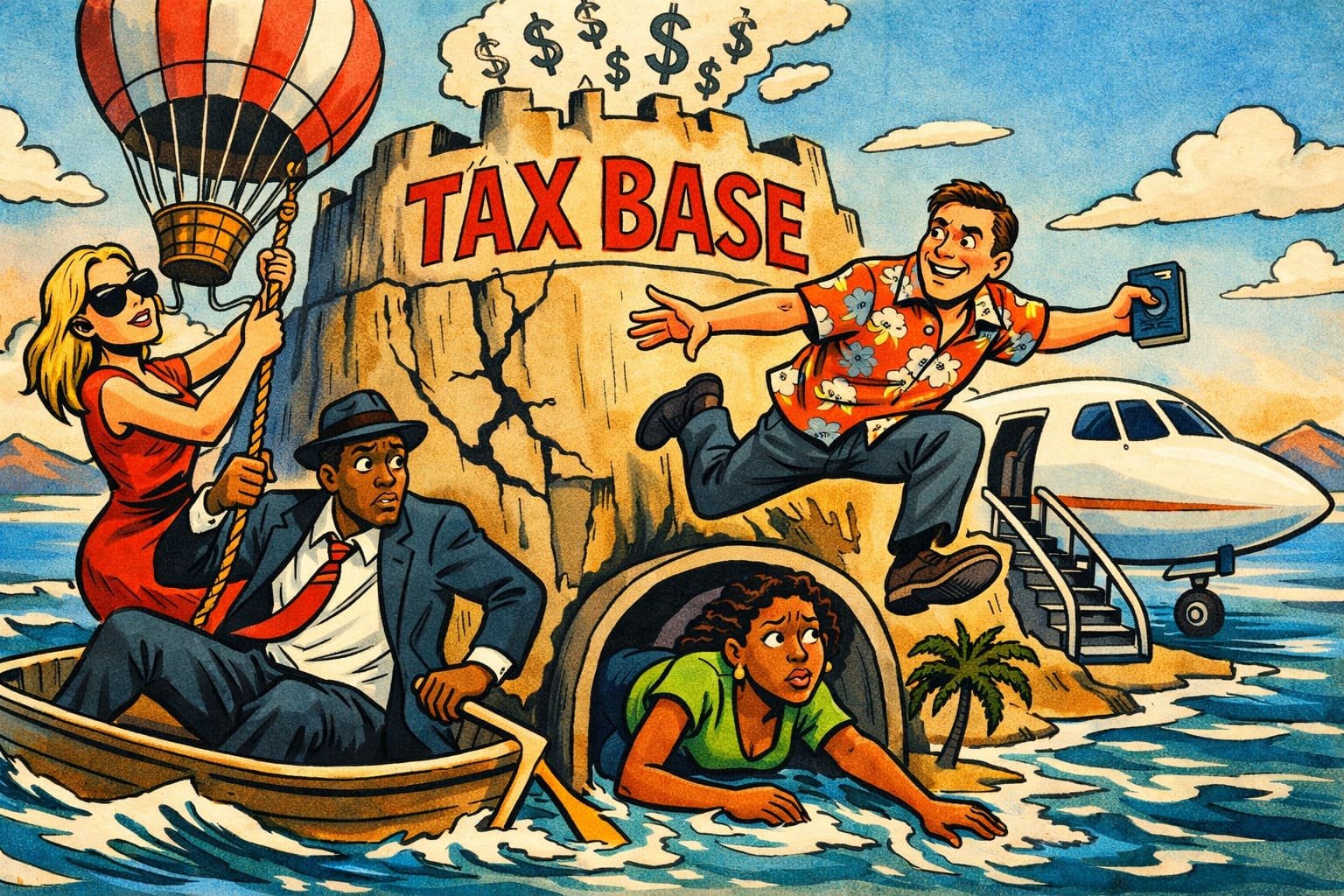
Modern tax systems are haunted by movement. Capital moves. Profits move. Firms move paper faster than goods. Wealth changes costume. Labor becomes more mobile in some places and more informal in others. A digital business can earn from a market without looking anything like the factories and offices tax law once imagined. Governments feel this drift with rising anxiety because the tax base no longer sits obediently where old rules left it. Everyone seems to be seeking escape, and the state, suddenly less sure of its grip, starts taxing what cannot run.
That anxiety explains a great deal of contemporary fiscal behavior. When governments fear losing mobile income, they lean harder on visible consumption, payrolls, property, compliance drives, and administrative pressure. Sometimes that is sensible. Sometimes it is a sign of panic in a suit. The OECD’s work on base erosion and profit shifting makes clear that multinational firms can exploit mismatches and loopholes to shift profits away from where value is created, while IMF analysis has shown that spillovers and avoidance can be especially painful for countries with weaker tax capacity.
The result is a strange politics of resentment. Governments say everyone must pay their fair share. Ordinary workers feel that they already do. Small businesses complain that global firms enjoy cleaner planning and deeper legal arsenals. Investors warn against punitive tax climates. Professionals whisper about relocation. High-net-worth advisers turn tax residence into a travel genre. The tax debate then stops sounding like citizenship and starts sounding like a border game. Whoever can move, optimize, defer, route, or redesign usually tries. Whoever cannot is left under the brighter lamp.
This is not only a story about multinationals. It is also about the social psychology of fairness. A tax system can survive high burdens more easily than it can survive visible asymmetry. People tolerate sacrifice when they believe the rules are broadly shared. They turn corrosive when they suspect the clever, connected, or internationally footloose are playing on a different board. That is why base anxiety is so politically explosive. It is not just about revenue. It is about whether the state still looks sovereign in the face of organized escape.
A family-owned manufacturer in Nairobi once spent weeks untangling tax compliance issues that felt disproportionate to the scale of the business. Its owners were not saints, but they were rooted. Meanwhile large cross-border players seemed to glide through structures that ordinary entrepreneurs could barely pronounce. The owners’ frustration was not ideological. It was visceral. They would pay, but they wanted proof that scale and sophistication had not become legal superpowers. That feeling, more than any technical manual, explains why tax legitimacy can evaporate faster than revenue analysts expect.
Governments respond in several ways. Some chase global coordination, minimum standards, information sharing, and anti-avoidance rules. Some tighten domestic enforcement. Some broaden VAT because consumption is harder to move than profits. Some flirt with wealth taxes, digital taxes, windfall taxes, or special levies that sound righteous in a press conference and complicated in court. Each move reflects the same fear. The old tax base is leaking. Somebody must be made to hold still. The danger is that rushed fixes can create fresh distortions while barely touching the most agile forms of escape.
That is why good tax policy starts with humility. Not every loss in the tax base is evasion. Some of it is structural change. Some of it is competition. Some of it is legal design doing exactly what legislators once allowed. Panic leads governments toward performative crackdowns or messy taxes on whatever is politically available. Serious reform looks different. It broadens bases, trims unjustified exemptions, improves administration, aligns taxation more closely with real economic activity, and communicates fairness with enough clarity that citizens do not need a treaty lawyer to understand the moral logic.
There is also a deeper contradiction at work. Governments want capital, talent, innovation, and investment, yet they also need tax capacity to finance the conditions that make those things possible. So the state ends up in a peculiar courtship dance, welcoming mobility with one hand and fearing it with the other. Too much generosity erodes the base. Too much aggression invites avoidance or exit. The sweet spot exists, but it is politically awkward because it demands design, patience, and institutional competence rather than the instant thrill of a villain-and-victim narrative.
A tax director at a midsized software company in Amsterdam once said the quiet part out loud. “Every country wants us to feel at home until the invoice arrives.” That sentence lands because it captures the modern tax paradox. States compete for activity, then bristle when the activity proves difficult to pin down. Firms, for their part, insist on legality while often treating moral obligation as a branding exercise rather than a governing principle. Neither side is innocent. Both are responding to incentives the system itself produced.
Anxious governments often end up taxing the immobile harder. Property owners, wage earners, consumers, and domestic firms become the easy targets because they cannot vanish into cross-border structures overnight. That may stabilize revenue in the short run, but it can poison trust over time. A tax system that looks increasingly heavy on the rooted and increasingly negotiable for the mobile does not merely feel unfair. It teaches citizens a bleak lesson about modern belonging: the more attached you are to place, the more available you are for extraction.
The OECD-led BEPS process and related IMF work exist because this anxiety is real and widespread, not imaginary. Yet even the best international coordination will not end the basic tension. Tax bases are not only legal constructs. They are social settlements. When everyone seeks escape, the fiscal state must rebuild the case for contribution, not merely tighten the net. That means stronger rules, yes, but also a more convincing answer to the oldest question in tax politics: why should anyone stay and pay?
In the end, tax base anxiety is the sound of a state realizing that sovereignty is easier to declare than to administer. Money slips. Profit blurs. Cleverness scales. The budget waits, demanding something firmer than nostalgia for a slower economy. A durable tax system will not emerge from panic or from punishing whoever is easiest to catch. It will emerge only when the public believes that belonging, contribution, and fairness still mean something in a world where escape has become both a strategy and a status symbol.
