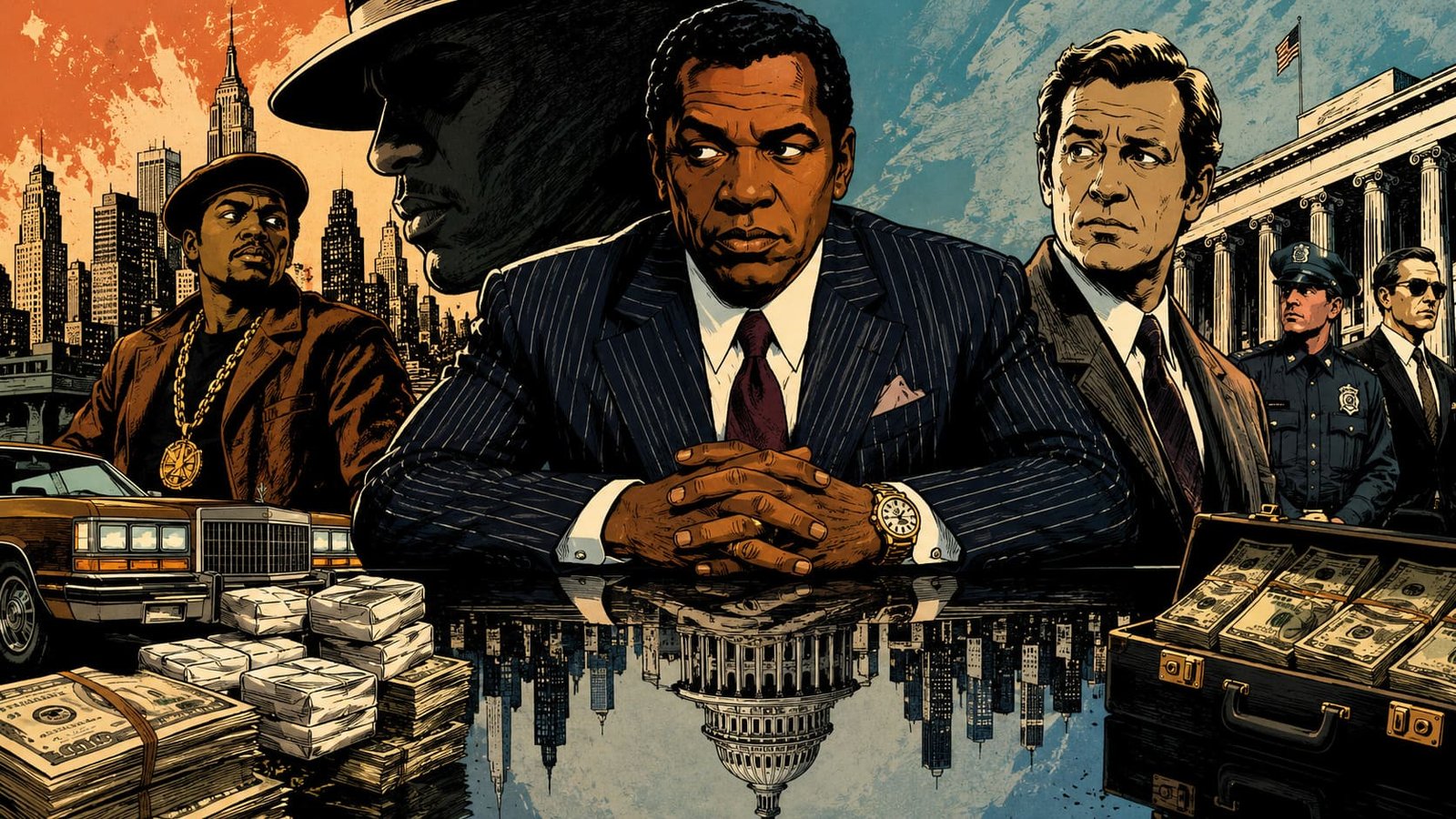
Harlem moved with the rhythm of a marketplace built beside a battlefield. Fur coats brushed against rain-soaked sidewalks while Cadillac engines purred outside crowded clubs leaking jazz and cigarette smoke into the night. Churchgoers filled pews on Sunday mornings beside men carrying envelopes thick with cash earned through quieter forms of violence. Somewhere behind the gold watches and polished smiles, entire neighborhoods survived inside economic systems the government publicly condemned while privately feeding. The city looked alive. Underneath, it was starving.
American Gangster enters that landscape with the cold precision of a boardroom thriller wearing the clothes of a crime epic. Directed by Ridley Scott and anchored by towering performances from Denzel Washington and Russell Crowe, the film follows Frank Lucas, a heroin kingpin who transforms criminal distribution into an empire run with corporate discipline. Most gangster stories glamorize chaos. This one studies structure. Frank succeeds not because he behaves wildly, but because he understands systems better than the people supposedly policing them.
That insight cuts deeper than many audiences expect. Frank Lucas treats the drug trade like a multinational enterprise. Supply chains matter. Product quality matters. Branding matters. Loyalty matters. He studies inefficiency the way elite consultants study market gaps. Competitors waste money performing status. Frank invests in logistics. The film quietly reveals an uncomfortable truth about capitalism itself: society often admires strategic brilliance before questioning what the strategy actually serves. Criminality becomes easier to tolerate when wrapped in competence and tailored suits.
A shipping executive in Marseille named Thierry once recalled attending an exclusive networking dinner where CEOs praised “ethical leadership” beneath chandeliers imported from Italy. Hours later, one logistics magnate casually bragged about exploiting legal loopholes to avoid worker protections in several ports. Nobody challenged him directly. Instead, guests admired his ingenuity with the same energy sports fans reserve for championship athletes. Thierry left disturbed by how easily ruthless behavior became respectable once translated into business language. “People forgive almost anything if the margins look impressive,” he admitted during a train ride years later. American Gangster understands that psychological mechanism perfectly.
Frank Lucas fascinates because he embodies the dark side of meritocracy. He emerges from poverty carrying sharp observational intelligence into a world already corrupted long before he arrived. Existing power structures in the film are hardly moral alternatives. Law enforcement contains corruption. Political institutions look compromised. Wealthy elites consume the very narcotics destroying poorer communities. Frank notices the hypocrisy immediately. That recognition fuels his rise. The movie never excuses his violence, yet it forces viewers to confront how systems create environments where criminal entrepreneurship starts resembling distorted capitalism rather than rebellion against it.
The relationship between Frank and detective Richie Roberts, played by Russell Crowe, sharpens the film’s moral complexity. Richie appears almost alien inside a culture drowning in compromise because he refuses easy corruption. Yet even his integrity isolates him socially. Colleagues distrust him. Family relationships strain under the weight of his principles. The film suggests something quietly devastating about institutions: ethical behavior often becomes disruptive inside systems optimized around mutual compromise. Honest people threaten the emotional agreements holding corrupt environments together.
One nightclub sequence pulses with psychological electricity. Music floods the room while gangsters, celebrities, politicians, and athletes occupy the same glowing ecosystem. The atmosphere feels glamorous until the audience realizes everyone is participating in overlapping economies of denial. That tension mirrors broader society beautifully. Modern culture constantly separates wealth from consequence. Consumers enjoy products without confronting labor conditions. Investors chase returns without examining social costs. Comfort depends upon selective blindness. Frank Lucas merely weaponizes the logic more directly than respectable society prefers to admit.
A healthcare entrepreneur from Dubai named Noor once built a rapidly growing pharmaceutical distribution company praised for efficiency across several regions. Investors celebrated her aggressive expansion strategy until journalists uncovered exploitative supplier arrangements hidden beneath the operation. During a crisis meeting, one board member defended the practices calmly by arguing that “everyone in the sector bends rules somewhere.” Noor later described that sentence as the moment she realized entire industries survive through normalized moral erosion. American Gangster carries that exact emotional DNA. Corruption becomes dangerous precisely because it rarely feels shocking internally.
The film also dissects masculinity with remarkable subtlety. Frank performs control obsessively because vulnerability would threaten his authority. Luxury becomes armor. Silence becomes strategy. Even family gatherings carry undertones of surveillance and hierarchy. Many ambitious men recognize pieces of themselves here uncomfortably. Society trains them to equate emotional restraint with strength while rewarding domination disguised as leadership. The tragedy is that power acquired through fear eventually isolates the person wielding it. Frank builds an empire sophisticated enough to impress Wall Street, yet emotionally he drifts further into loneliness with every victory.
As the story moves toward its final stretch, New York itself begins feeling haunted. Flashing cameras crowd courthouse steps. Expensive coats rustle through cold air thick with scandal and exhaustion. Somewhere another young hustler studies the streets believing intelligence alone can outmaneuver consequence. American Gangster leaves behind a realization more unsettling than violence itself: societies often condemn criminal empires publicly while privately admiring the strategic instincts that built them. And once a culture starts confusing ruthless efficiency with greatness, the line separating executive from outlaw becomes frighteningly thin.
Editorial Disclaimer: Whether a film is rooted in fiction or inspired by real events, the actions, decisions, and behaviors portrayed within are not intended to be encouraged, replicated, or endorsed in real-world settings. This review exists solely to analyze the storytelling, characters, themes, and business dynamics presented in the film for educational, analytical, and entertainment purposes. Any ethical or unethical conduct depicted in the film does not reflect the views, values, or endorsements of ESYRITE.
