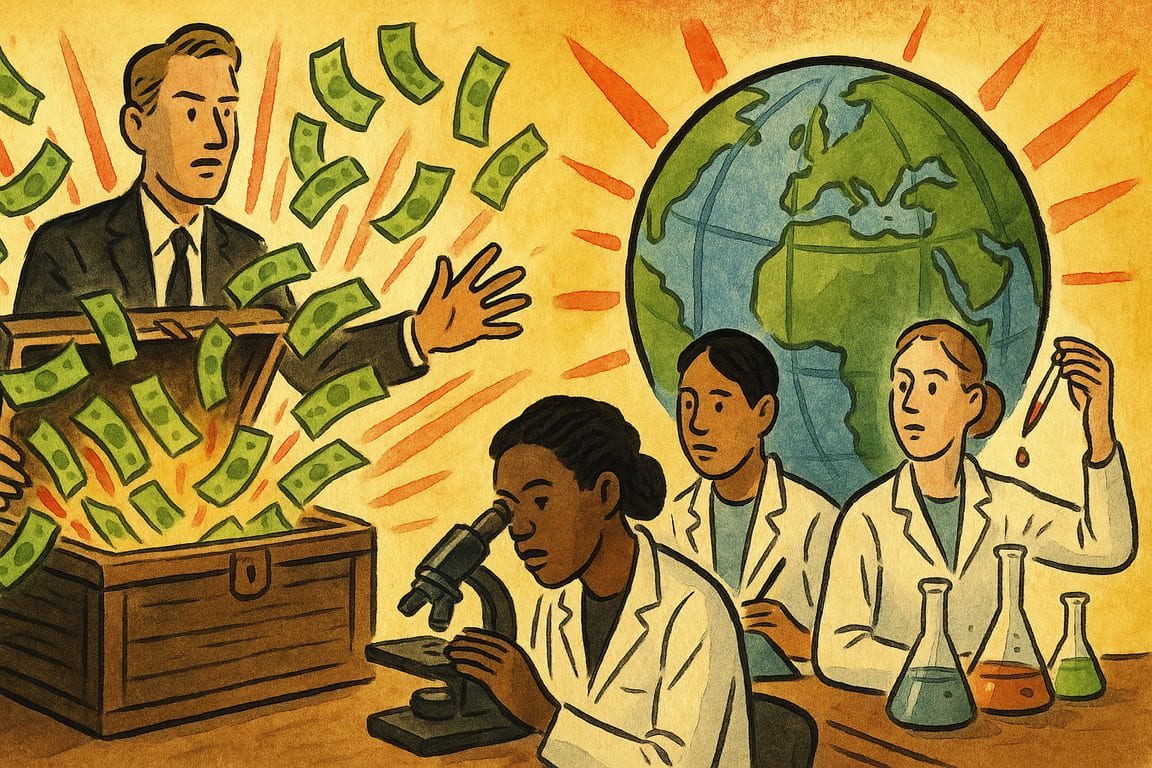
Rain pelts the glass of a high-rise window somewhere above a neon city. Inside, executives gather around a walnut table, each face caught between shadows and glowing phone screens. They’re not trading stocks, not tonight. This gathering pulses with urgency—a new kind of ambition, the kind that has nothing to do with quarterly profits. Down on the street, a child waits outside a crowded clinic, mother’s hand clutching his, hopeful for a breakthrough. In this world of relentless contrast, a strange alliance forms: the billionaire with his restless fortune, the scientist with her mud-stained notebook, the village elder who’s seen three generations outlast epidemics. The air crackles with the sense that something is shifting—money isn’t just chasing the next unicorn. Tonight, it’s chasing a cure.
The philanthropic surge in global health has never looked quite like this. Where once charity arrived in careful drips, today it roars in, refashioning research itself. Medical breakthroughs, once hostage to underfunded laboratories, now ride a wave of private generosity. Tech moguls, athletes, and even pop icons invest more than headlines—they invest belief that health is no longer a privilege, but a birthright. In one corner of the room, a former Wall Street analyst turned charity CEO remarks, “This isn’t a side project for the rich. It’s the world’s insurance policy.” Those who dismissed philanthropy as vanity projects find themselves outpaced by nimble collaborations and laboratories newly alive with purpose.
You might have scrolled past those viral donation campaigns and wondered if the money ever leaves the velvet rope. But walk the halls of the Global Virus Response Center, and you’ll hear stories that make algorithms seem bland. Dr. Nina Arora, for example, once stitched together research grants with the desperation of a gambler. Now, she coordinates teams across four continents, using capital unleashed by a foundation started by a retired soccer star. “Suddenly, our pipeline for vaccines isn’t starved,” she says. “We’re thinking about prevention, not just firefighting.” The timeline from idea to lifesaving protocol has shrunk, not because governments moved faster, but because philanthropists said, “Why not now?”
It’s easy to romanticize the benevolence of billionaires, yet the reality on the ground is far more intricate. Private funding brings agility and daring, but also fierce debates about power. You’re not just watching a game of chess between the public and private. You’re part of an evolving drama where philanthropists sometimes act as kingmakers, tipping research toward glamorous diseases or overlooked crises. The Bill & Melinda Gates Foundation is often cited for transforming malaria research from a footnote to a global priority. But it’s the smaller, lesser-known trusts that sometimes make the most daring bets—backing risky, innovative ideas too raw for public funds.
If you run a business, this boom might feel remote. Yet it’s reshaping the talent pool and knowledge networks everywhere. Labs and startups jostle for scientists once lost to brain drain, luring them home with competitive grants and promises of impact. That’s how Kenyan-born epidemiologist David Odhiambo returned from London to launch a diagnostics startup in Nairobi, now powering real-time disease tracking across East Africa. “The old model of waiting for foreign aid is finished,” he jokes, over bitter coffee and stacks of field reports. The philanthropic surge hasn’t just rewritten research priorities—it’s built bridges where bureaucracy left only fences.
For the everyday reader, this may sound lofty. But it’s closer to your life than you think. The next mRNA vaccine, the water filtration breakthrough, the tuberculosis test that fits in a pocket—all began as side projects, pet ideas, or passion projects funded not by governments, but by restless donors looking for something more permanent than their own legacy. In the words of Dr. Ana Mercado, head of a Colombian health foundation, “We’re only as healthy as the furthest village from the capital.” Philanthropy’s boom doesn’t just light up labs; it electrifies communities who once felt abandoned by global systems.
Stories from the field reveal a new breed of researcher—part scientist, part fundraiser, part social architect. Take the story of Ayaan, a community nurse in rural Pakistan, who helped develop a mobile health app after her small clinic received a digital grant from an international philanthropy group. Before, she’d lose hours to paperwork and miscommunication. Now, she coordinates maternal care through her phone, linking villages with urban hospitals in ways she once called “science fiction.” Philanthropy, in her story, isn’t a check—it’s a chance to rewrite the rules.
The impact ripples out into culture. Documentaries streaming on global platforms now follow philanthropists as closely as pop stars. High-profile fundraisers trend on social media. But the true transformation happens away from the limelight: in policy shifts, in local schools training the next generation of health workers, in the subtle shift of power from distant capitals to bustling local centers. When the Wellcome Trust backed a new malaria center in Ghana, it wasn’t about branding. It was about empowering scientists who understood local context better than any imported team.
Yet, there’s an edge to this new world. Philanthropy doesn’t always answer to voters or taxpayers. Sometimes, priorities reflect the donor’s vision, not the community’s need. When tech entrepreneur Jacob Lin launched a major initiative on AI-driven pandemic prediction, some wondered if resources would have been better spent on clean water or frontline training. The debate echoes in boardrooms and village meetings alike. As philanthropies shape global health priorities, questions of equity, ownership, and accountability grow sharper. The very speed that accelerates innovation also outpaces oversight.
You might wonder: What happens if the money dries up? Will the health breakthroughs vanish as quickly as they arrived? History offers some cautionary tales. The Green Revolution, fueled in part by philanthropy, lifted millions but left mixed legacies of environmental strain and inequality. Today’s new breed of philanthropist faces the challenge of building systems that endure, not just quick wins that photograph well. Collaboration is becoming the new gold standard—private donors, governments, and local leaders learning to trust, co-design, and measure together.
For business leaders, there’s a fresh set of lessons. You don’t have to run a foundation to be part of this story. Supply chain companies that pivoted to produce low-cost ventilators, design firms that volunteered branding for rural clinics, tech startups offering logistics for vaccine delivery—each found a way to transform philanthropic capital into sustainable models. In a world where reputation is as fragile as a tweet, brands that partner with authentic causes build trust that no ad budget can buy.
The trend also inspires a new generation of professionals. In business schools from Mumbai to Boston, philanthropy fellowships and health innovation labs are outpacing interest in traditional finance tracks. Students ask not just how to earn, but how to matter. They want roles that combine profit with purpose, science with storytelling. It’s not idealism—it’s market sense. The coming workforce expects more than a paycheck. They want legacy baked into the business model.
Cynics may dismiss this as another passing wave. But take the story of Maya Rodrigues, a pharmaceutical executive who left a Fortune 500 post to head a nonprofit tackling drug-resistant tuberculosis in Brazil. “It wasn’t about giving up business,” she explains, “It was about making business accountable to life.” Her team’s hybrid model—part research lab, part public health campaign—now serves as a blueprint for public-private partnerships worldwide. It’s this synthesis, not purity, that’s changing the landscape.
When the boardroom lights finally dim, and the city below returns to its quiet pulse, a different kind of legacy stirs. The philanthropy boom in global health isn’t just a chapter in business innovation—it’s a test of what markets, technology, and restless ambition can build together. The next page? Still unwritten. But every lab, every clinic, every late-night meeting under the glare of a laptop has brought humanity a little closer to the cure it seeks, not just for disease, but for indifference.
Somewhere in a hospital’s silent corridor, the janitor wipes the floor beneath a new wing funded by anonymous donors. Nearby, a researcher reviews patient charts by the blue glow of a monitor, while an old man clutches a bottle of pills he couldn’t afford last year. The transformation isn’t thunderous. It’s steady as a heartbeat, invisible in moments, unmistakable in the lives it reshapes. Outside, under flickering streetlights, the world spins on, hungry for another breakthrough.
On the edge of that transformation, the only question that lingers is yours: Will you be the one who waits, or the one who changes what’s possible?
