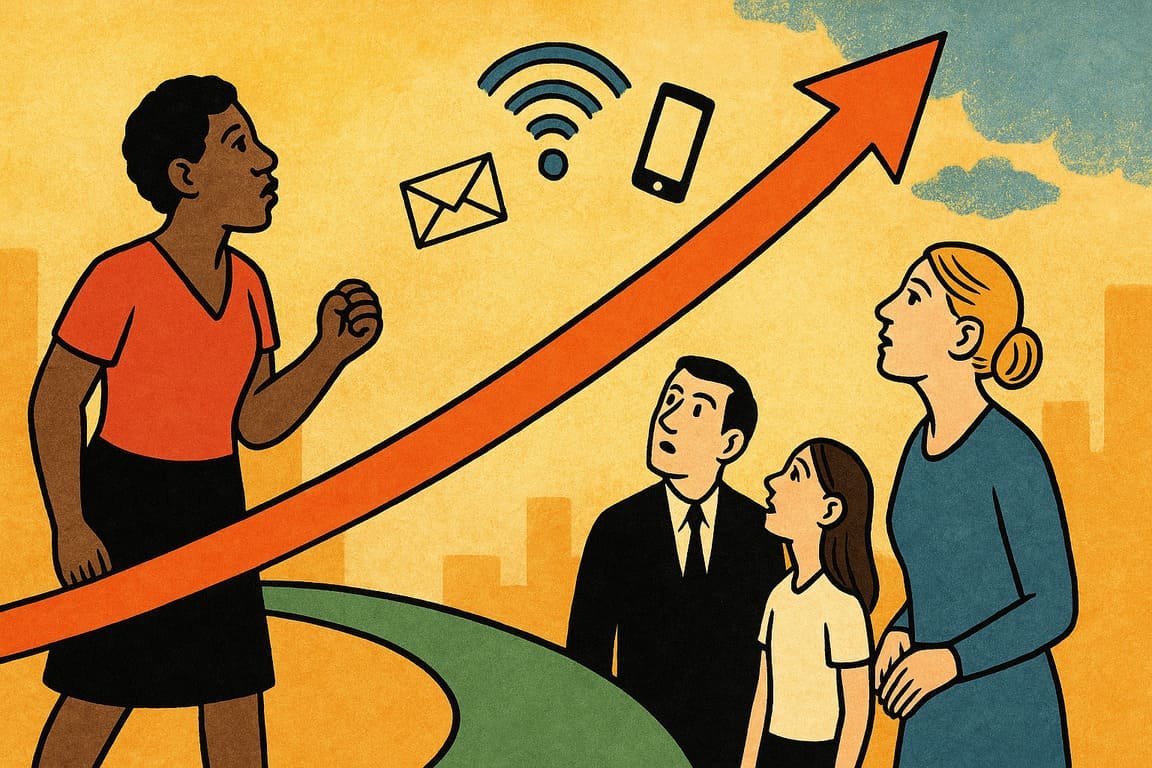
Neon rain slicked the pavement as midnight traffic glided through a city whose real heartbeat thrummed far above the streets. Laptops glowed in glass towers, streaming meetings, movies, and memories at speeds that could split atoms, yet no one looked up to notice. In the back room of a struggling bodega, a mother FaceTimed her son across oceans, compressing longing into shimmering pixels, while at a rooftop bar, entrepreneurs whispered about the next app poised to conquer continents before sunrise. Beneath the surface, invisible networks coiled and pulsed, tunneling through brick and steel, rewriting how humans touch, love, sell, argue, and hope—an unending race where the finish line vanishes each morning. Fast connections had become the city’s phantom currency, traded with the same hungry hope as futures in Wall Street’s shadowy after-hours.
Somewhere between a viral dance challenge and a midnight panic order from a warehouse the size of a small country, something fundamental about connection had shifted. It was not just the speed—although that alone could make the world feel weightless—but the way faster networks slipped under the skin of daily routines, rewiring expectations and possibility itself. Inside the headquarters of a startup called GlideLoop, founder Asha Okeke stared at her whiteboard, mapping out a logistics chain so seamless it left her team breathless, except for one moment: when the network hiccuped, her empire nearly vanished. Outside, delivery bikes zigzagged, guided by signals so fast the couriers seemed to ride wind instead of tarmac. Everyone was chasing seconds, shaving them off interactions, transactions, even their own emotions, trying to outpace the drag of yesterday’s lag.
Not long ago, a grizzled cab driver named Malik grumbled as passengers lost patience with any pause in their digital lives, demanding flawless GPS, frictionless payment, and streaming music that never stuttered. “Faster, faster, always faster,” he’d mutter, though he still carried a tattered road map in his glove compartment, a relic from when speed meant wheels and grit. Somewhere in that gulf—between the human and the hyperconnected—a new power quietly surged, unnoticed but relentless, ready to turn whole cities, companies, and relationships inside out. The question is not if this new velocity changes people, but how deeply it is already shaping the stories they tell about progress, trust, and what it means to belong.
Quick Notes
- Speed is the New Oxygen: Life now runs on invisible highways that move faster than thought. When connections slow, everything—business, friendship, hope—pauses or crumbles.
- Invisible Winners, Silent Losers: As networks grow faster, those who ride the wave win quietly, while the left-behind fade into digital shadows no one wants to admit exist.
- Trust Has Changed Forever: Algorithms, not just people, now decide who you meet, what you buy, and even how you love. Networks subtly rewire what feels trustworthy, and you hardly notice until it’s gone.
- Real Life is Blurred: The line between the digital and the physical has become a fog. Businesses, families, and cultures morph in ways nobody predicted—sometimes with consequences that hurt.
- Your Next Decision Will Be Instant: Every big choice you make is now shaped by instant information, social pressure, and FOMO. The real challenge: staying human in a world that keeps speeding up.
Speed Is the Silent Sculptor—How Faster Networks Become the Unseen Artist of Modern Life
Network speed now plays the role of sculptor, quietly carving new shapes into daily life. Every swipe, click, or video call rides on the back of this invisible artist, whose handiwork often escapes notice. For families separated by continents, streaming a grandchild’s birthday party has become more real than any letter or phone call from the past. Businesses like Midnight Eats, a food startup in Seoul, have built entire empires on the promise that an order placed at 2:59 a.m. will hit the doorstep before 3:15, rewriting expectations about time itself. A study group in Nairobi, prepping for exams, found their entire sense of group trust rested on a shared Google Doc that never froze—until it did, and a missed deadline almost shattered months of teamwork.
Trust in digital pace replaces old rituals, and speed becomes the silent authority. Where once people waited for mail, for news, for a slow answer, now impatience grows the moment a message blue-ticks but receives no reply. “Speed is oxygen now,” says Ravi Jha, a network engineer whose team once saved a hospital’s surgery livestream by rerouting traffic through a forgotten satellite, proving that the new heroes are not always in scrubs. Even the way cities sleep has changed, as late-night freelancers and global teams work with the expectation that ideas and files will circle the globe while the rest of the world dreams.
Everyday choices, from what to binge-watch to how quickly to switch jobs, are now shaped by a culture that rewards instant access and penalizes hesitation. This new tempo is addictive, both thrilling and exhausting, drawing people into a rhythm they rarely question. Even small glitches—a frozen payment screen, a lagging call, an online game that stutters at the wrong moment—suddenly feel like personal betrayals, not just technical hiccups. Speed quietly raises the bar for what is possible, but also for what feels fair, fun, and even meaningful.
That invisible hand—the network—keeps tightening its grip, sometimes gently, sometimes with the ruthless urgency of a flash sale countdown. Stories of transformation now circulate online at warp speed: a baker in Buenos Aires who shifted to live-streamed baking classes during lockdown found her tiny kitchen trending worldwide in minutes, thanks to a perfect Wi-Fi surge. Yet these stories mask the slow erosion of patience and the art of waiting, skills that once defined adulthood. The network sculpts lives quietly, chipping away at habits, beliefs, and the notion that slower ever meant better.
Winners and Ghosts—Who Thrives and Who Disappears on the Fast Lane
Not everyone enjoys the same ride on this digital speedway. For every entrepreneur who spins viral fame out of an instant tweet, there’s a worker left blinking in confusion as automated scheduling apps erase his shifts without warning. In the neon-lit backroom of an online retailer, project manager Tara saw her career take off when a warehouse bot named Benny reduced her team’s error rate to nearly zero, letting her scale the operation overnight. Her friend Abdul, a craftsman selling handmade guitars, found himself swamped by customer complaints as shipping delays knocked his five-star rating into the dust, all because his rural village lagged behind the connectivity curve.
Network velocity separates winners and ghosts, and the divide deepens daily. Take the case of Maria, a single mom in Mexico City, who juggles two jobs and depends on a flawless phone signal to check her kids’ schoolwork between shifts. When the local network stumbled for days, she missed an urgent school alert, nearly losing her spot in subsidized childcare—a near disaster that went unseen by those in faster lanes. The invisible divide is less about money than about presence; the connected feel hyperreal, the rest become digital ghosts, unseen and unheard.
Fast networks create silent advantages that pile up over time, invisible yet devastating. Corporate recruiters now prioritize candidates who can join video calls at a moment’s notice, leaving those in lagging regions perpetually on the outside looking in. In Paris, a boutique marketing firm watched its fortunes soar after investing in next-gen connectivity, while a rival firm across town bled clients as lag times crept in and competitors snapped up business in seconds. “It’s not just about speed; it’s about survival,” quipped Julie, a senior strategist, whose team toasted their record profits with champagne delivered via drone—a flex that left their analog rivals choking on envy.
Every so often, a glitch exposes the fragility underneath the glitter. One evening, a live auction platform collapsed mid-bid, sending would-be buyers into a frenzy and erasing thousands in potential revenue. The company’s social media was flooded with outrage, but the technical team, led by quietly brilliant engineer Osama Malik, worked through the night to patch the breach, saving the brand’s reputation and proving once again that the fastest hands win the game—while those left buffering may as well not exist.
Speed not only sorts the ambitious from the obsolete but also stirs uncomfortable questions about fairness, access, and the nature of success. Who gets to thrive in this new world? Who fades into the digital mist, their struggles hidden behind spinning wheels and endless loading bars? The answers, and the stakes, grow sharper every day.
Trust on Trial—Algorithms, Relationships, and the Quiet Takeover of the Network
A decade ago, trust meant a handshake or an honest face. Now, it’s filtered through algorithms, two-factor authentication, and a jittery bar of network strength in the corner of every device. In this brave new world, even love gets a performance review by network latency. Couples separated by continents time their video calls to chase the best signal, holding digital hands in a ritual that feels intimate but relies entirely on speed. When networks hiccup, relationships stall, and suspicion creeps in. The algorithms have become silent referees in arguments, business deals, and even bedtime stories, deciding what appears, who gets heard, and which truths stick.
Consider the saga of FlexMart, a global supermarket chain that used network data to optimize every shelf, staffing level, and sales pitch. A surge in connectivity let its managers predict buying trends hours before rivals, boosting profits and winning industry awards. Yet a junior analyst, Saira, discovered the same system quietly penalized small suppliers whose updates lagged, freezing out family farms and shrinking their dreams. Trust became a currency measured in milliseconds; if you’re not fast, you’re not believed.
Humans adapt to trust machines faster than to each other, turning “the network is down” into the modern equivalent of “the dog ate my homework.” A New York chef named Juno once lost half her patrons overnight after a food delivery platform’s algorithm misflagged her menu as out of date during a connectivity blackout. The real pain wasn’t the lost sales, but the way loyal customers vanished instantly, their trust gone before she even realized there was a problem. Trust had become a moving target, shifting at the speed of the latest software patch or network upgrade.
Faster networks do more than deliver content—they judge, select, and shape what’s real. In political campaigns, slick live streams and viral soundbites win over slow, considered arguments. In job interviews, applicants with spotty connections get dismissed before they can utter a word. Algorithms push the bold, the beautiful, and the always-on to the front row, while those who stutter or pause slip into the margins. Trust is now a performance, an endless audition, where even the briefest lag can turn you from star to stand-in.
Beneath the glamour of instant feedback and real-time metrics, something quieter has shifted. People have started to believe in speed itself as the ultimate proof of competence and value. The result is a world where slow equals suspicious, and fast is always right—until the next blackout reveals the lie.
Life in Blur Mode—Where Digital and Physical Collide Without Warning
The old boundaries separating online from offline have dissolved into a persistent, twitchy blur. On a crowded subway, teenagers flip between memes and homework, while elderly commuters video chat with grandkids in real time, dissolving loneliness into bursts of laughter. At Popcorn Studios, a team of indie game designers built an overnight cult following for their new title by dropping surprise updates in the middle of the night, their fans responding instantly as if summoned by a secret signal. This blur isn’t always bliss: a retail worker named Zoe found herself juggling five customer chats, three apps, and a nervous manager demanding updates—all before her first coffee.
Physical space, once a buffer against overload, has become just another window to the network. In Mumbai, yoga instructor Priya live-streams sunrise classes from her rooftop, teaching students from every continent without leaving her mat. On the streets of San Francisco, a delivery robot zipped past a couple arguing over dinner plans, dodging trash cans and potholes with a grace that seemed almost mocking. Human life spills into the network and the network leaks back into every moment, until it’s impossible to tell which world is more real.
This merging creates new kinds of anxiety and opportunity. Doctors at Harmony Hospital coordinate surgeries and consultations with global experts over lag-free connections, saving lives that would once have slipped away. At the same time, digital fatigue sends office workers out for “offline walks,” desperate to escape the drone of notifications that never sleep. Even grief changes: at a memorial service in Lagos, family members wept over a live stream, sharing loss across thousands of miles but longing for the warmth of an actual shoulder.
Culture itself is reshaped in the blur. Global fandoms erupt for K-pop idols or soccer teams, fueled by instant translations and viral fan cams. Yet, local dialects, quirky slang, and neighborhood traditions risk fading as the world’s stories compress into shareable clips and hashtags. Some thrive in this blur, inventing new ways to connect and create, while others mourn the slow, messy, precious moments that speed leaves behind.
Amid the blur, a single buffering symbol can still trigger frustration, rage, or even despair. The line between liberation and burnout grows thinner, and everyone feels the tension—caught in a world that rewards always-on hustle but rarely offers a pause.
The Instant Decision—Why Your Next Move is Already a Race
No matter your job or dreams, every big decision now unfolds at warp speed. The old days of mulling things over are relics, replaced by pop-up alerts, push notifications, and the constant hum of crowd-sourced advice. In the glittering offices of SparkVision, a London fintech startup, analysts chase trading signals so fast that by the time you blink, fortunes are won and lost. At the other end, teenagers decide their identity, their values, and even their love lives with a swipe, each choice tracked and shaped by the instant consensus of a digital mob.
Pressure to keep pace builds from the moment the alarm buzzes. You wake to breaking news, team messages, and a half-dozen offers that seem too good to refuse—all demanding instant answers. In this rush, the winners are not always the wisest, but the quickest: a Seattle artist named Lane saw his online store explode in popularity after he answered a fan’s question within seconds, riding a surge of momentum that changed his life overnight. Those who hesitate risk being swept away by the flood of newer, faster voices.
Every instant choice is magnified by network power. Your opinions are shaped by the first hot take you see; your career may hinge on a DM replied to in the blink of an eye. “The fastest wins, but sometimes the best gets trampled,” admits digital strategist Gloria Kim, who once lost a dream client after her phone died in a subway tunnel. Each decision now comes with an invisible countdown clock, and the fear of missing out becomes not just a buzzword but a daily reality.
Yet the instant culture brings real danger. Hasty choices driven by viral outrage or trending topics can backfire, leaving lives and brands in ruins. A family-run bookstore in Dublin lost its beloved reputation when an employee responded angrily to a troll online, not realizing the world was watching and judging in real time. Recovery was possible, but only after a thoughtful public apology—and the painful lesson that speed can turn even kindness into chaos.
Some resist the pressure, slowing down their decisions, cultivating reflection, and daring to unplug, even briefly. The real revolution may be learning not just to race, but to rest. Yet for most, the instant world is here to stay, and every next move, whether bold or reckless, is already in play before you realize you’ve made it.
When Silence Becomes Louder Than Speed
On the rooftop of a restless city, just as dawn stretches across the skyline, a programmer named Daniel sits with his coffee, watching the wireless routers blink like distant stars. In the quiet, the hum of a network pulses through concrete and sky, holding together boardrooms, bedrooms, dreams, and secrets. The city’s tempo never really stops, not even in these early hours, but there is a rare stillness in this moment—an invitation to notice the cost of chasing speed.
A battered delivery bike glides through narrow alleys below, its rider following a digital map that never slows, trusting each signal as if it were a promise. A teenage gamer, exhausted from a night of streaming, stares at her ceiling, wondering if the friends she made on a lightning-fast server will remember her once the power fades. In the lobby of a silent hotel, a lonely entrepreneur refreshes his inbox, waiting for a message that might change everything, unaware that the next great story is unfolding on a bandwidth he cannot see.
Beneath the network’s steady rush, the most haunting truth emerges in the hush that follows every surge. Speed has become both a blessing and a burden, a ticket to greatness and a trap of ceaseless longing. What you seek in the rush might only be found in the pause.
You now face a question most never dare to ask: Will you let the current carry you endlessly, or will you claim a moment of quiet and shape your own signal before it’s gone?