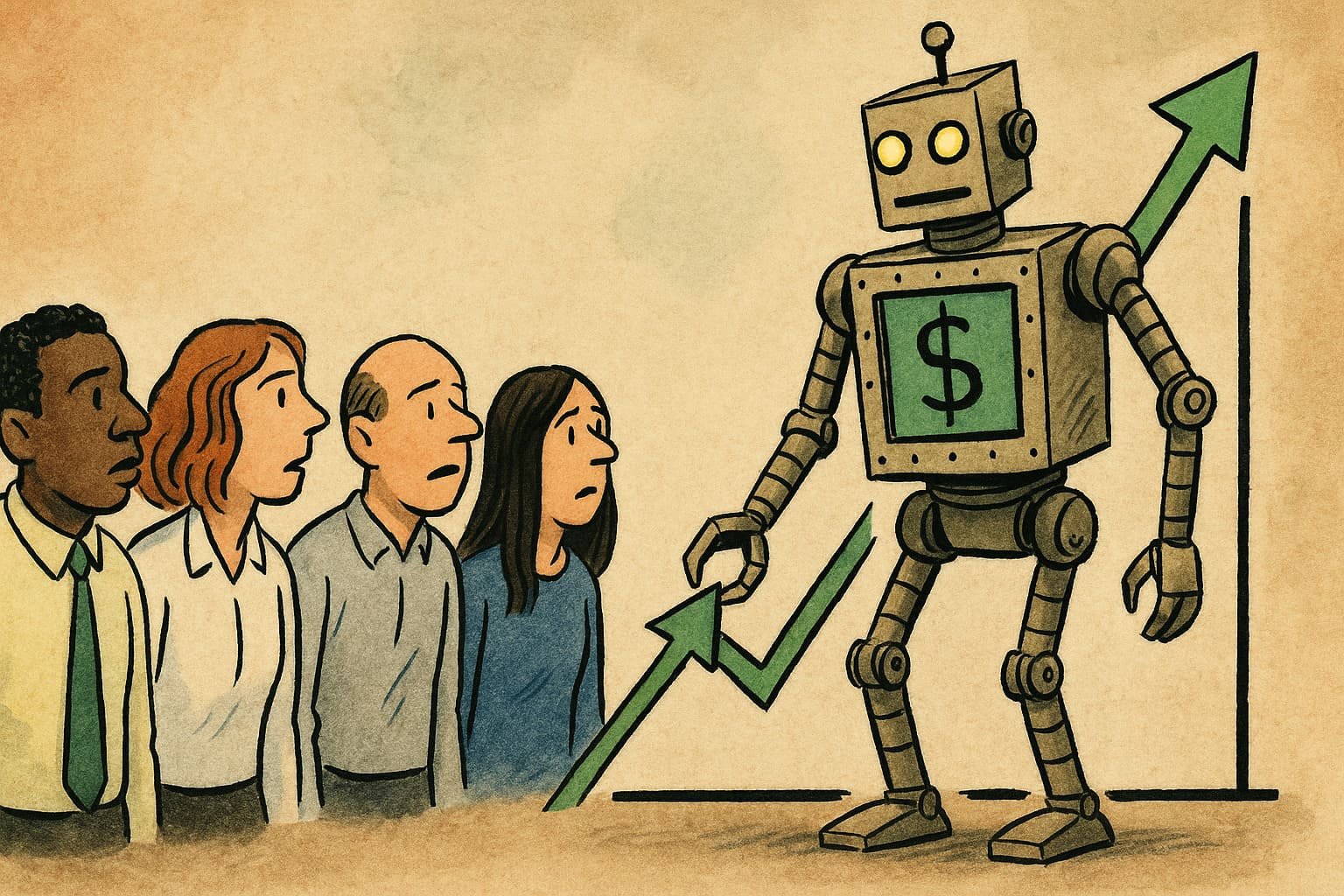
A storm coils over the glass towers, their reflections shivering on wet asphalt as dawn smears color across the city’s edge. Inside, the factory floor glows with automated precision, a ballet of steel arms spinning, welding, and assembling in perfect, tireless harmony. Gone are the sweat and shouts that once echoed off concrete walls. What remains is a silent rhythm—machines humming, data pulsing, digital eyes watching every detail. In this new cathedral of commerce, flesh and fatigue have been replaced by algorithms and uptime, leaving behind the ghosts of hands that once built the world.
An executive’s office sits above the factory, overlooking progress through tempered glass. Her desk is clean, screens alive with profit dashboards and workflow graphs. The only sound is the gentle click of a notification, whispering another milestone reached, another target crushed. Down below, the break room stays empty. Coffee cools in untouched mugs. The badge reader blinks, unneeded. Outside, a young man in a faded work jacket leans on the fence, staring at his own reflection in the rain-slicked metal. His father worked here. He grew up believing in the dignity of a shift’s honest sweat. Now, the world spins too fast for knuckles and callouses to keep up.
A corporate recruiter sips overpriced coffee in a sterile airport lounge, scrolling through endless lists of applicants. Each resume is a hope, a plea. Most will never touch the machines that now do the hiring, firing, and scheduling. The real decision-makers work at lightning speed, invisible in the code. Somewhere, in the cold blue glow of a server rack, a profit line jumps. No one cheers. The machines never sleep.
In the shimmering haze of a late-night gas station, a tired cashier swipes through job boards on her phone. Openings vanish before she can apply, filled by software, replaced by kiosks, rewritten by cost-saving measures. She wonders if she’ll ever get ahead. At the end of every shift, she hears the silent laughter of efficiency, echoing in the empty aisles.
A faded union banner hangs in a boarded-up warehouse, battered by time and indifference. The people who once gathered beneath it have scattered. Some sell code now, others drive for apps, a few disappear into the cracks. The banner reads “Power to the People.” Now, the real power belongs to profit—cold, relentless, and inhuman.
Quick Notes
- Profit Overtakes Labor: Automation and relentless efficiency outpace every human worker. Machines never call in sick or ask for raises.
- Jobs Evaporate, Hope Shrinks: Career paths built over generations collapse as companies cut costs with digital tools. People struggle to stay relevant.
- The Human Touch Becomes Rare: Skills once treasured are now expendable, leading to a crisis of dignity and purpose for millions.
- Economic Winners Grow Fewer: Wealth flows to owners, coders, and shareholders while the working class watches from the sidelines.
- The Value of Work Is Questioned: The meaning of contribution, reward, and self-worth is upended by the relentless logic of profit.
The Machine Awakens—Profit’s Cold March
Assembly lines used to be stories in motion. Gears turning, sparks flying, voices rising above the roar. Now, lights flicker over silent floors, where machines glide on polished tracks, unhurried and precise. A century ago, workers built the American dream, one shift at a time. Today, that dream gets outsourced to robots who never need breaks, benefits, or sleep.
At the heart of this new world stands people like Jasper Tran, a plant manager turned project lead for a multinational’s AI rollout. Jasper spent twenty years on the floor, learning every click and clang. He watched the first automation wave with hope, believing it would ease his crew’s burden. Instead, he supervised the transition as dozens of friends took severance. The last time Jasper toured the line, he walked alone, his footsteps echoing. “It’s all so… quiet now,” he said, standing by the control panel.
Efficiency is a siren song. Executives chase lower costs and higher returns, promising shareholders miracles each quarter. The relentless pursuit of profit rewards speed, not sweat. Each new upgrade erases another job, often without warning or regret. A factory in Ohio went dark for a week, reopening with half its staff gone. Machines did the work twice as fast, at a fraction of the cost.
Profit is not sentimental. It does not pause for birthdays, funerals, or fatigue. It asks only one question: how much can you deliver, and how little will it cost? Workers who once trained apprentices now update their resumes, competing against their own creations. The badge of honor becomes a pink slip.
Legacy is replaced by disruption. The “job for life” has vanished, replaced by “tasks for today.” Companies announce record profits as local diners close, main streets empty, and small towns wither. What remains is a cold logic—machines deliver, and people are left to wonder where they fit in.
Vanishing Middle—The Death of Dignity
Middle management, once the backbone of every company, is now a vanishing species. The spreadsheets they mastered have learned to outthink them, rendering entire roles obsolete. Administrative assistants, once indispensable, are replaced by virtual agents who never take lunch. The ladder of opportunity grows steeper and slicker.
Sofia, a payroll supervisor at a logistics giant, prided herself on solving problems that software missed. She caught errors, calmed tempers, and found lost checks in tangled systems. When automation swept through, she was asked to train her replacement—an app. Her office emptied out, replaced by tablets and silent screens. Sofia’s stories echo in empty cubicles.
The promise of technology was a world where people are free from drudgery. What few expected was the sense of meaning that work brings. Tasks that once gave pride now feel transactional or simply vanish. Skills honed over decades become irrelevant, with no warning or farewell party. Retirement dreams get deferred or deleted.
Gig work fills the gap, but with it comes uncertainty. Ride-share drivers, delivery couriers, and remote freelancers float from job to job, chasing apps that change the rules overnight. A driver named Malik remembers when gig work meant independence. Now, it means anxiety, with each day’s algorithm reshuffling his chances of earning enough to pay rent.
Without stable work, community erodes. Friendships formed on factory floors or in office break rooms are harder to find. The sense of belonging—of mattering—becomes fragile. People turn to online groups, seeking connection in the digital dust. The promise of freedom becomes a struggle to survive.
Wealth Rises, Workers Fall—Who Gets the Spoils?
Shareholders toast record earnings in glass towers, their glasses clinking over video calls. Profit soars, but paychecks do not. The gains flow upwards, bypassing those who built the foundation. Owners and coders shape the new order, while the rest wait for crumbs. Inequality becomes the defining feature of the modern economy.
Alexei, a coder in a startup accelerator, wrote the algorithm that saved his company millions. He earned a bonus and a new title. The workers his code replaced received a handshake and best wishes. Alexei feels pride, but sometimes wonders who really won. “It’s progress,” his boss tells him, “not personal.”
Across the world, investors bet on companies that shed workers fastest. The best-performing stocks are often those that automate most aggressively. People celebrate the winners, forgetting the losses behind each leap. When profits become untethered from employment, the social contract frays.
Even professionals feel the squeeze. Accountants, lawyers, and designers now compete with software that underbids, outspeeds, and outlasts. New graduates wonder what careers will exist by the time they retire. The future belongs to those who own, build, or manage the machines. The rest adapt or get left behind.
Old promises die quietly. The dream of “work hard and get ahead” rings hollow for millions. Even as GDP rises, so do debts, doubts, and divisions. Economic growth becomes a spectator sport, with most watching from the cheap seats.
The Last Human Skill—Creativity or Desperation?
In a world obsessed with metrics, what value remains for human hands? Creativity, empathy, and judgment are celebrated as the last defenses against automation. Companies host hackathons and “innovation days,” hoping to unlock something machines cannot replicate. Yet, the pressure is intense, and the clock is always ticking.
Clara, an art director at a digital agency, leads brainstorming sessions filled with bright minds and whiteboards. She watches her team chase original ideas, only to see AI tools suggest similar solutions seconds later. Clara still believes in the magic of the human touch, but she knows the lines are blurring. “You have to stand out,” she tells her team, “or you’ll get replaced.”
Education shifts to meet the moment. Coding camps and creative bootcamps promise the keys to survival. Students learn to pivot, adapt, and rebrand themselves endlessly. Yet, not everyone can become a “creative,” and not every job can be saved by design thinking. The safety net wears thin.
Desperation breeds ingenuity. Laid-off workers launch micro-businesses, sell handmade crafts, or offer hyperlocal services. Some succeed, some struggle, all hustle. The gig economy rewards risk, punishes hesitation, and rarely forgives mistakes. Security is for those at the top.
Even as people innovate, the race against the machines is relentless. Each new breakthrough brings new anxieties. The world tells people to “be flexible” while offering little certainty. The real currency is not money, but relevance.
Rewriting Value—Toward a New Social Contract
The tension between profit and people reaches a breaking point. Protests rise, demanding fairness, dignity, and a share in the future. Some governments experiment with new ideas: guaranteed incomes, digital taxes, public ownership of algorithms. The conversation shifts from “how much can we save?” to “what do we owe each other?”
Luca, a mayor in a mid-sized city, faces shuttered factories and rising unemployment. She pilots a program to retrain workers for tech roles and invests in local startups. The transition is hard, full of setbacks, but hope flickers in small successes. One former machinist launches a robotics repair business, hiring neighbors who once stood in layoff lines.
Some companies choose a different path, sharing profits with employees or letting workers own part of the code. A bakery in Portland rewards its staff with shares, not just shifts, and finds loyalty rising. The owner, Jessie, says, “We win together, or not at all.”
The fight is not just for jobs, but for meaning. People demand work that matters, work that supports families, work that shapes the world. The question is not whether profit matters, but whether people do. The answer is being written, one story at a time.
Society faces a fork in the road. Will it chase profit until humanity is a footnote, or will it redefine success to include every hand, every voice, every dream? The stakes could not be higher.
Echoes in the Empty Cathedral
An old workshop stands empty beneath the whir of distant drones, its walls lined with dusty tools and silent stories. Rain leaks through the roof, puddling on a faded workbench where a child’s drawing lies forgotten. A single light flickers as dusk creeps in, painting long shadows across the idle machines. The air is thick with longing, regret, and a question that gnaws at the bones.
Somewhere, a siren blares and an automated truck glides by, indifferent to the lives erased in the name of progress. In a quiet kitchen, a mother presses her hand to her son’s head, wondering what future he’ll inherit if the race for profit never ends. In boardrooms and back alleys, people whisper about fairness, dignity, and what it means to belong.
The cathedral of industry stands, not empty but haunted. Every empty seat is a challenge, every lost job a story unfinished, every unchecked box a reminder that profit without people is a hollow victory. Tomorrow’s legends will not be written by machines alone.
You face a world spinning faster than any worker can run. What story will you write in the silence left behind?
Why scroll… When you can rocket into Adventure?
Ready to ditch the boring side of Life? Blast off with ESYRITE, a Premier Management Journal & Professional Services Haus—where every click is an adventure and every experience is enchanting. The ESYRITE Journal fuels your curiosity to another dimension. Need life upgrades? ESYRITE Services are basically superpowers in disguise. Crave epic sagas? ESYRITE Stories are so wild, your grandkids will meme them. Want star power? ESYRITE Promoted turns your brand cosmic among the stars. Tired of surface-level noise? ESYRITE Insights delivers mind-bending ideas, and galactic-level clarity straight to your inbox. Cruise the galaxy with the ESYRITE Store —a treasure chest for interstellar dreamers. Join now and let curiosity guide your course.