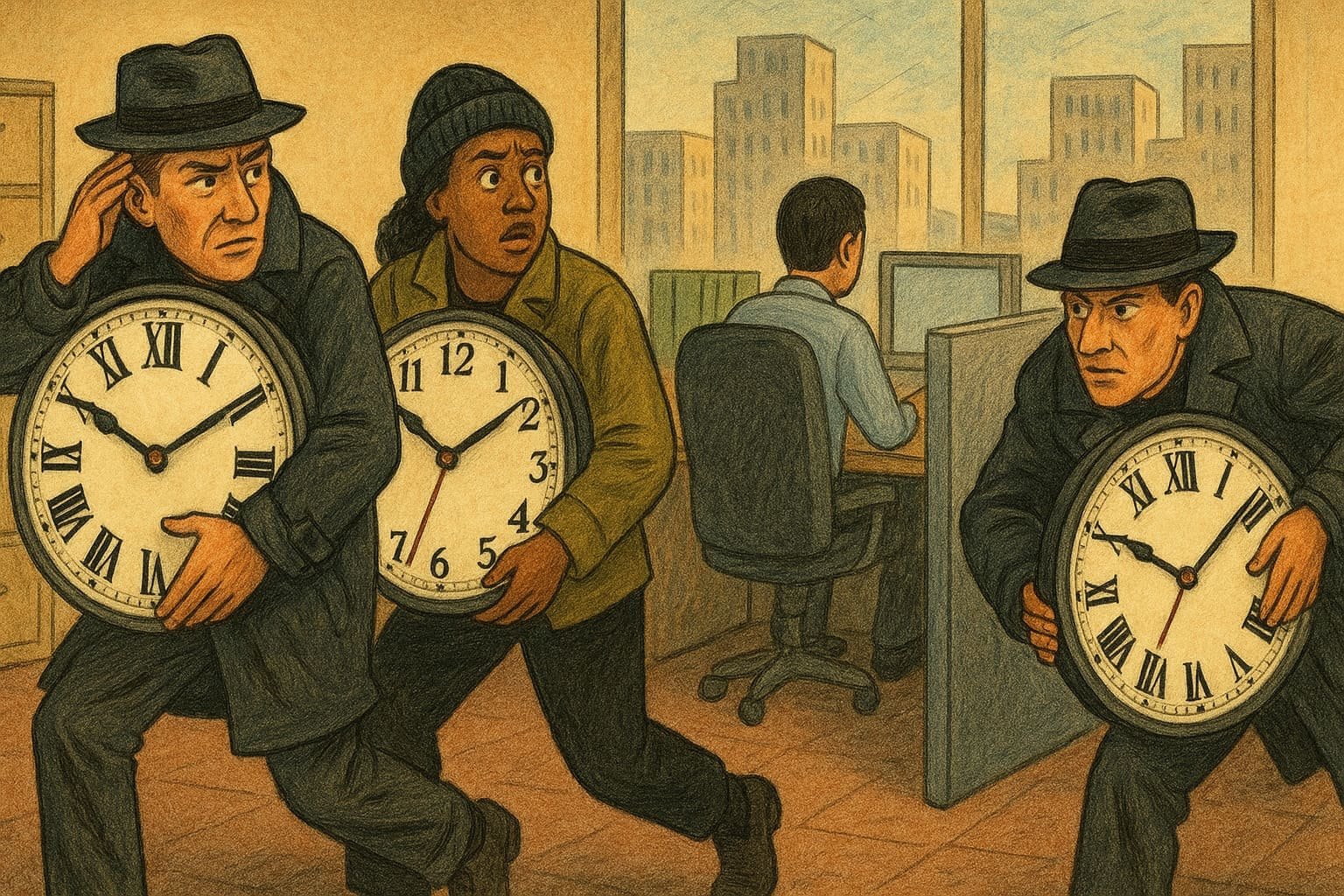
Nobody steals time with a ski mask and getaway vehicle anymore. The theft is cleaner now. Calendar invitations. Pointless approvals. Meetings with no agenda. Follow-up meetings created to clarify the first meeting. Email chains with the emotional urgency of emergency medicine and the strategic value of wet cardboard. Corporate life has normalized astonishing forms of time destruction while preserving the fiction that busyness equals contribution. The uncomfortable twist is that this crime is rarely committed only by leadership. Ordinary professionals participate enthusiastically. The victim and the perpetrator often share the same employee badge. Time theft has become a collaborative enterprise disguised as productivity.
Every organization loses time, yet the greatest theft rarely comes from competitors or unexpected crises. It happens quietly inside ordinary workdays. A meeting that should have lasted fifteen minutes stretches into an hour. An email chain grows longer than the problem it was meant to solve. A manager demands another report that nobody will ever read. The office remains busy from morning until evening, but meaningful progress barely moves. The real thief is not laziness. It is the culture that mistakes activity for achievement.
Modern workplaces have become experts at rewarding visible busyness. Full calendars are worn like medals of honor. Employees rush between meetings, answer messages during lunch, and celebrate working late as though exhaustion were proof of commitment. The irony is difficult to ignore. Many professionals spend entire days managing work instead of actually doing it. Productivity declines, creativity fades, and decision quality suffers because constant interruption leaves little room for deep thinking.
The healthiest organizations challenge this assumption. They recognize that time is a strategic asset rather than an unlimited resource. Effective leaders protect uninterrupted work, simplify decision-making, and eliminate unnecessary processes before asking employees to work harder. Every unnecessary approval, duplicated task, or poorly planned meeting quietly drains momentum. Removing those obstacles often creates greater performance gains than hiring additional staff or investing in expensive productivity software.
Amazon has long embraced the principle of reducing wasted time in decision-making. Jeff Bezos famously encouraged smaller meetings through the “two-pizza rule,” arguing that teams should remain small enough to be fed with two pizzas. The idea was never about food. It was about keeping discussions focused, encouraging accountability, and avoiding the slow decision-making that often accompanies oversized groups. Simpler conversations frequently produce faster and better outcomes.
A regional healthcare provider experienced this lesson during an internal review. Its operations director, Grace, noticed employees frequently complained about overwhelming workloads despite reasonable staffing levels. After mapping daily activities, the leadership team uncovered dozens of repetitive reports, overlapping meetings, and manual approval steps that added little value. Many disappeared within weeks. Staff members suddenly found more time for patient care, collaboration improved, and workplace morale rose because people finally spent their energy where it mattered most.
Management thinking has consistently emphasized that effectiveness depends as much on eliminating unnecessary work as completing important work. Peter Drucker observed that nothing wastes more effort than doing efficiently what should not be done at all. That insight remains remarkably relevant. Organizations obsessed with optimization often overlook the simpler opportunity of subtraction. Every process deserves an occasional question. Does this genuinely create value, or has habit quietly replaced purpose?
The same pattern appears in everyday life. Individuals often fill schedules so completely that reflection disappears. Constant notifications fragment attention. Endless multitasking creates the illusion of accomplishment while reducing concentration. The busiest people are not always the most productive. Those who deliberately protect time for thoughtful work, meaningful conversations, and careful planning often achieve more with less stress. Success rarely belongs to the person doing everything. It belongs to the one doing the right things exceptionally well.
Time is the only resource no business can replace once it disappears. Money can be earned again. Markets recover. Technology evolves. Lost hours never return. The organizations that thrive tomorrow will not simply move faster than everyone else. They will stop wasting precious moments on work that never deserved attention in the first place. Every unnecessary task quietly steals a piece of the future. The wisest leaders become guardians of time before they become managers of people.
