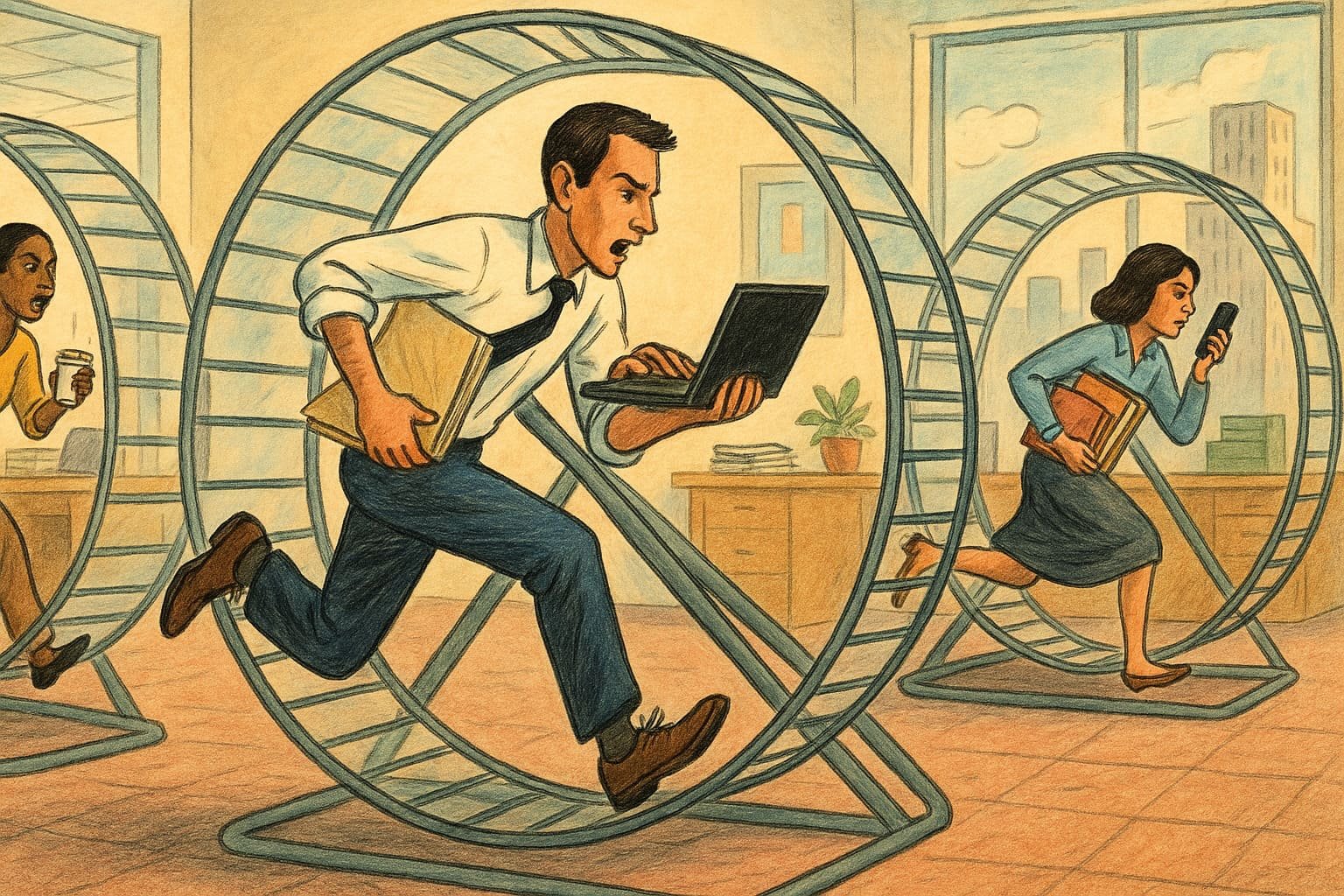
A single fluorescent bulb flickers inside a windowless office where clocks seem to lie. Desks are covered with neon sticky notes and digital reminders, like the feathers of some strange bird building a nest from fragments of ambition. Outside, city lights blink in binary code, a silent orchestra playing overtime. People hustle past glass walls, clutching lattes and urgent to-dos, as if life itself might evaporate unless tethered to another meeting. Somewhere in this hush, the hum of productivity becomes a heartbeat—steady, anxious, omnipresent. Everyone is moving, but nobody looks alive.
Behind each screen, a silent drama unfolds. Targets multiply, managers broadcast urgent slogans, and team chat notifications sing lullabies of panic. Human resource directors pen policies for “well-being,” but the unwritten rule echoes: busy means worthy. An intern named Kemi, eyes red from another night chasing spreadsheet perfection, wonders if there’s a prize for the one who collapses last. Her story blends with millions—each soul measured not by joy or purpose, but by how many boxes they can tick before sleep claims them.
The modern workplace transforms into a theater, where the script demands ceaseless motion. Industry icons tweet about “crushing it,” gurus sell hustle as salvation, and tired parents edit presentations during family dinners. Productivity becomes a badge and a burden, both status symbol and silent curse. The air grows heavy with the scent of burnt coffee and invisible dreams deferred.
A strange irony lingers in the air. The more we chase “doing more,” the less we recognize ourselves in the mirror. The lines between work and worth blur, until people forget which came first: the task or the life that once yearned for something beyond a calendar alert. Inside this labyrinth of achievement, few dare to ask the forbidden question: does all this doing actually keep us alive—or just keep us busy until we forget how to live?
This is the world’s grandest illusion, dressed in corporate casual and cheered on by algorithms. And as the curtain lifts, the real performance begins.
Quick Notes
- The Mirage of Busyness: Everyone acts as if staying occupied is proof of value, yet most frantic activity only hides a lack of real progress. Endless to-do lists and digital pings can become a mask for insecurity and confusion.
- The True Cost of “More”: Sacrificing sleep, relationships, and creativity at the altar of productivity often destroys the very joy and meaning we hope to find in our work. Leaders are waking up to the burnout epidemic, but few admit their own complicity.
- Who Benefits from Overwork? Systems, not individuals, often profit most when employees are too busy to question, innovate, or resist. Some of the most “productive” companies in history—like Enron and Theranos—ran on a toxic cocktail of endless motion and hollow purpose.
- Rewiring Success: A handful of organizations are rewriting the script, rewarding focused effort, reflection, and purpose instead of perpetual activity. Netflix, Basecamp, and even Toyota once turned away from the “always-on” culture to rediscover the value of real results over appearances.
- Your Transformation Starts with Doubt: Challenging the productivity illusion requires uncomfortable honesty, courageous rest, and a new story about what it means to be alive at work. Maybe real achievement begins not with more tasks, but with fewer—done deeply, with meaning, and for the right reasons.
The Busyness Mirage—How Being Busy Became a Status Symbol
The open office buzzes like a hive, but the sweetness is missing. People fill their days with activity, convinced that motion equals progress. The world celebrates the appearance of effort, not the substance of outcomes. Apps track every minute, as if a life’s meaning could be downloaded and measured in ticks and taps. The badge of busyness sparkles in status updates and late-night emails.
A young project manager named Noah once joked that sleep was his biggest competitor. He never missed a stand-up meeting and learned to reply to Slack messages from the bathroom. His team called him “the machine” until one day, Noah stopped laughing—and started forgetting why he cared about any of it. His decline went unnoticed, because his digital presence never wavered.
Productivity has become the new luxury item, sold by influencers and CEOs alike. If you aren’t busy, people suspect you lack ambition, or worse, relevance. Social media feeds reward those who show off their packed schedules, morning routines, and color-coded planners. It’s a competitive sport, but nobody keeps score in happiness.
Irony reigns supreme: while productivity tools promise to save time, they often multiply it—generating more tasks, more reminders, and more anxiety about falling behind. The harder people work to keep up, the more the horizon recedes. True focus and satisfaction become rare, like rain in a drought.
Companies fuel the cycle by equating output with loyalty. Performance reviews and promotions go to the “hardest workers,” not the smartest or happiest. This mindset trickles down, infecting even the youngest employees with a fear of stillness. The busyness illusion becomes a collective trance, difficult to break without risking judgment or exclusion.
The Hidden Costs—What We Lose While Doing More
Behind every late-night spreadsheet and “urgent” email, something fragile gets lost. The drive to always do more erodes health, relationships, and self-worth. Sleep is the first casualty; creativity and empathy soon follow. People forget how to listen, or laugh, or care. The soul’s appetite is quietly starved in a world obsessed with filling every moment.
Take the story of Lila, a senior designer at a hip tech startup, who once dreamed of making art that mattered. Her days now overflow with client calls, fire drills, and “quick fixes.” She still wins praise at quarterly reviews, but her sketchbook gathers dust. Lila’s friends notice the change: she no longer shows up for book club, her laugh sounds thinner, and her phone is always within reach—just in case.
Work cultures that glorify doing more leave no room for rest or reflection. As meetings stretch into evenings and weekends blur with workdays, burnout quietly blooms. Entire teams unravel, projects stall, and morale sinks. Employees start to ask: Is this what success is supposed to feel like?
Even the most celebrated organizations face this reckoning. Google, lauded for its creative perks, once discovered that constant collaboration killed innovation. The company pivoted, creating space for “20 percent time”—a radical invitation to do less, but with more heart. Suddenly, the best ideas emerged in the cracks between assignments, not the overcrowded calendar blocks.
Medical experts, like Dr. Saundra Dalton-Smith, warn that chronic busyness mimics addiction. Dopamine surges from checking off tasks keep people hooked, but satisfaction is fleeting. Real rest—the kind that restores mind and spirit—becomes a rare luxury. The cost of doing more is invisible at first, but devastating in the long run.
Who Profits from the Illusion?—The Systems That Feed on Busyness
Somewhere behind the scenes, the system smiles. Every ping, deadline, and status update fuels the engine of “more.” Organizations and platforms thrive when people are too distracted to rebel. Productivity culture creates obedient workers, less likely to question, create, or challenge the status quo. The illusion serves its architects far more than its actors.
Classic business disasters reveal the danger of unchecked busyness. At Enron, a relentless pursuit of targets masked ethical rot beneath the surface. Nobody dared to slow down or challenge the frantic pace, and by the time the truth emerged, the collapse had already begun. Elizabeth Holmes sold Theranos as a miracle, using the aura of tireless hustle to distract from reality. The lesson repeats: speed without substance breeds catastrophe.
Modern tech companies design systems that keep users chasing carrots. Notification loops, endless email threads, and reward badges hook people into compulsive work. These tools claim to empower, but often enslave instead. Deep work, real learning, and meaningful connection fall away, crowded out by the tyranny of the urgent.
It’s not just corporations. The entire HR industry sometimes buys into the illusion. Employee wellness initiatives are rolled out as glossy cover-ups, while the real expectation is “do more with less.” Even labor unions struggle to counter the narrative. The logic is circular: being busy proves worth, so everyone must be busy, forever.
A rare few dare to rebel. Jason Fried, CEO of Basecamp, banned after-hours email and saw morale soar. His gamble paid off—profits rose as stress fell. Fried later wrote, “You don’t have to outwork the competition if you outthink them.” His message? Stop performing for an invisible audience. Start living for yourself and those who matter.
The Rebel Script—Companies and People Breaking Free
Once in a while, someone rips up the script. Leaders and teams experiment with a slower, saner approach to work. These outliers ignore the “hustle harder” gospel, chasing purpose over noise. Their offices ring with laughter, not alarms. People feel seen, not measured.
Netflix’s famous “Freedom and Responsibility” policy shook Silicon Valley. Employees gained autonomy over their schedules—and suddenly, trust replaced micromanagement. Fewer rules sparked higher creativity and better results. Instead of measuring activity, Netflix rewarded impact. Its model became a beacon for those suffocating under busyness.
Toyota’s legendary “stop the line” rule empowers workers at every level to halt production if something seems off. Pausing to fix problems, even if it means slowing down, prevents future disaster. The practice transformed Toyota into a global force, proving that progress requires permission to breathe.
Small businesses often lead the quiet revolution. In Copenhagen, a café called Slow Brew closes for a full day each week. The owner, Mikkel, believes that rest makes room for kindness and innovation. Employees return with fresh ideas, loyal customers notice the difference, and nobody misses the old scramble.
Even within large corporations, change is possible. Microsoft Japan shocked the world by slashing its workweek—and productivity soared. Skeptics mocked the idea, but the results spoke for themselves. Less became more, and employee satisfaction skyrocketed. The story spread like wildfire, inspiring copycats around the world.
These stories share a common thread: real productivity is a side effect of meaning, not motion. Leaders who value focus and reflection cultivate teams that thrive. The bravest ask: What if the answer isn’t doing more, but doing less—and doing it better?
Your Turning Point—A New Philosophy for Work and Life
Everything changes the moment doubt creeps in. When a worker stops, mid-keystroke, and wonders, “Why am I really doing this?” The spell of busyness begins to crack. Reflection follows, then a radical new freedom: the right to choose what matters, and what doesn’t.
For every Kemi, Lila, or Noah, the turning point comes differently. Some people rediscover joy by stepping away from their screens for a walk. Others reclaim their evenings, learning to say “no” to meetings that serve nobody. A few even leave their jobs to start something slower, smaller, more human. Their lives do not shrink; they deepen.
Organizations can change, but only when people demand a new story. When managers encourage “deep work” and reward results, not just attendance, cultures shift. Teams bond over trust, not trauma. HR departments reinvent themselves as allies, not enforcers. The myth of infinite productivity loses its grip.
Real transformation is messy. There are setbacks, awkward pauses, and moments of fear. People who resist the old script are sometimes mocked or dismissed. Yet, each act of courage makes the path wider for others. Over time, the rebel stories become legends—proof that a better way is possible.
A final word from author and management thinker Oliver Burkeman, whose advice lands like a wake-up call: “The world is not waiting for you to get to inbox zero.” What matters isn’t how much you do, but what you do with care and conviction. When you stop chasing the illusion, you discover the life that was hiding underneath.
When Silence Means Freedom
A dimly lit boardroom sits silent, papers stacked like fragile memories on a forgotten stage. The hum of old projectors fades into the night, as chairs—once filled with nervous energy—wait for someone to notice their stillness. Shadows stretch across glass walls, where once the glow of productivity never dimmed. A clock, ignored for years, suddenly feels loud in its honesty. Here, in this breathless pause, the true cost of chasing “more” stands revealed.
A lone worker—tired eyes, calloused hands, hope flickering—pauses before the door. There is no applause, no leaderboard, no inbox waiting. Only the steady thrum of a heart, asking for permission to slow down. The old scripts crumble. The urge to rush dissolves into something softer, more human.
On the street below, life stirs beyond the calendar. A child’s laughter floats through the air, the smell of fresh rain washes away the dust of sleepless nights. Far from the office, a once-anxious soul stands still and listens. The illusion has lifted. The world is quieter, yet infinitely more alive.
This was never about the number of tasks finished, or the endless chase for more. This was always about finding enough. The most courageous act is often to stop, to listen, and to reclaim the time lost to busyness. You may find that real life, with all its mess and beauty, was waiting just beyond the next unchecked box.
You are not alive by doing more. You are alive by daring to do less—on purpose, with purpose, and for the sake of your one wild and precious life. So ask yourself: When the busyness ends, what will you hear in the silence?
Why scroll… When you can rocket into Adventure?
Ready to ditch the boring side of Life? Blast off with ESYRITE, a Premier Management Journal & Professional Services Haus—where every click is an adventure and every experience is enchanting. The ESYRITE Journal fuels your curiosity to another dimension. Need life upgrades? ESYRITE Services are basically superpowers in disguise. Crave epic sagas? ESYRITE Stories are so wild, your grandkids will meme them. Want star power? ESYRITE Promoted turns your brand cosmic among the stars. Tired of surface-level noise? ESYRITE Insights delivers mind-bending ideas, and galactic-level clarity straight to your inbox. Cruise the galaxy with the ESYRITE Store —a treasure chest for interstellar dreamers. Join now and let curiosity guide your course.