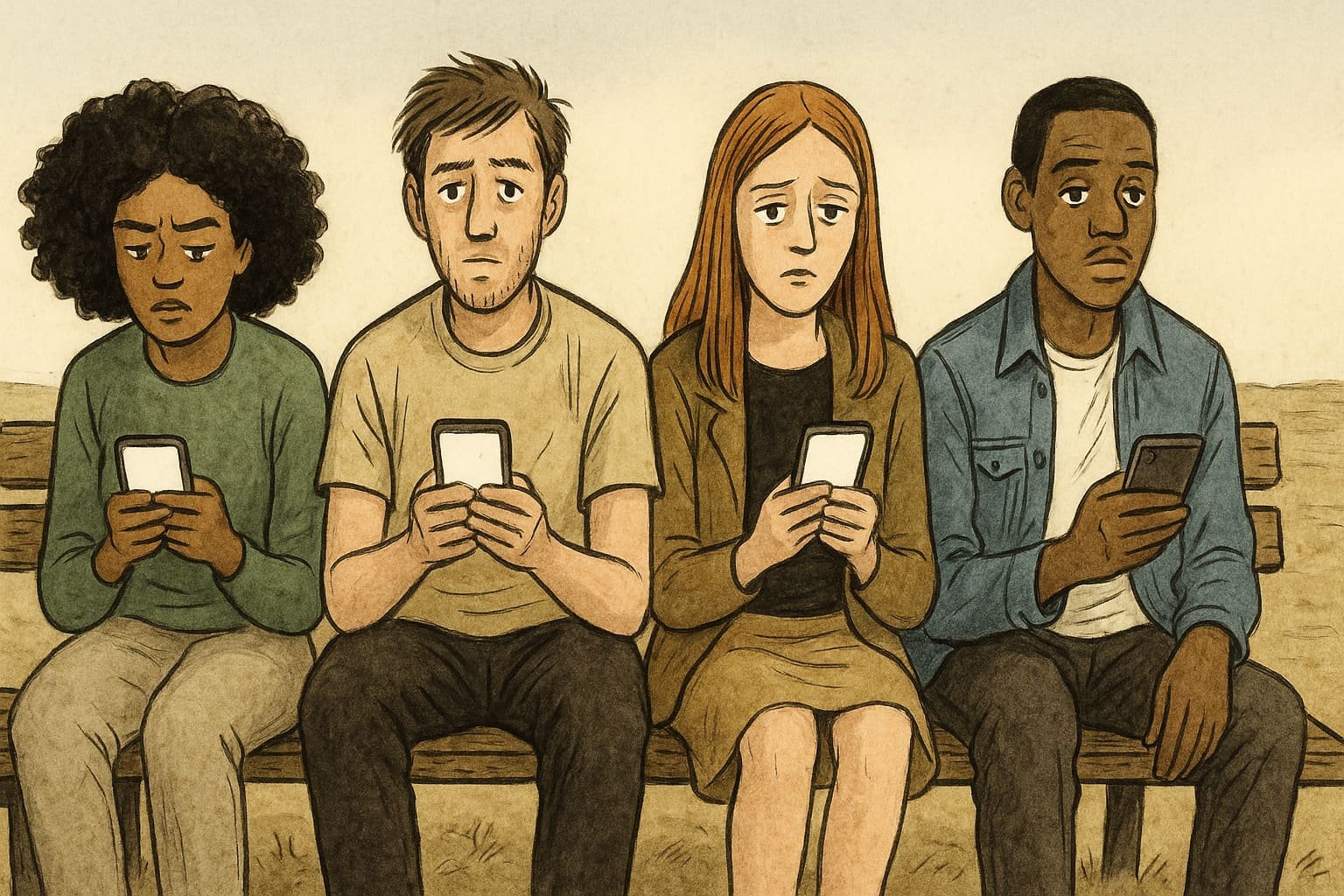
The old mall sits hollow, a shell of glass and steel humming with the ghosts of past crowds. Flickering LED billboards spill colors onto silent floors, promising meaning that never quite arrives. Outside, a teenager hunches over a glowing phone, scrolling endlessly through a universe where every story belongs to someone else. There is no sound except the soft click of digital keys and the heartbeat rush of potential likes, each a tiny spark in the night. Here, in the glare of a thousand options, choice itself has become a shadow, and freedom tastes less like adventure and more like confusion.
A woman in her thirties sips cold coffee at a co-working desk, eyeing a Slack message about “finding her purpose” while the same recycled playlist loops overhead. She’s free; at least on paper. No boss breathing down her neck, no dress code or nine-to-five. Yet her calendar blurs, each day another blank space waiting to be filled. Deep down, a question lingers: when everything is possible, why does it feel like nothing truly matters?
In a nearby apartment, a startup founder rewrites his pitch deck, searching for a hook that will finally make investors lean forward. He’s liberated from cubicles, but now each morning greets him with the weight of uncertainty. The grind promises fulfillment, but the finish line keeps shifting. In his head, he hears the advice of mentors and Twitter (X) threads, all variations on the same promise: “If you build your dream, meaning will follow.” Yet night after night, that meaning drifts just out of reach, like fog sliding across a mirror.
A retired teacher posts old photos to a family group chat, hoping for a spark of conversation. She’s lived through wars, protests, and new beginnings, but never a time where so many felt so disconnected. Even the young, gifted with freedoms she never imagined, seem lost in an endless buffet of choices. There are no wrong doors; just hallways leading to more hallways. She wonders if freedom, stretched too thin, becomes the very thing that erases us.
The city’s pulse never stops, but the rhythm has changed. People move quickly, chasing possibilities. Yet every crowded train, every buzzing café, feels touched by the same quiet ache: an abundance of options, a famine of meaning. Freedom, it seems, has delivered us to an age of endless beginnings with no true story to call our own.
Quick Notes
1. The Price of Infinite Choice: Modern life is a playground with no rules, and the cost is a nagging sense of emptiness. Too much freedom can dilute meaning, making every option feel equally hollow.
2. The Myth of the Blank Slate: Chasing originality leaves many paralyzed, fearing mistakes or missing out. The quest to be utterly unique often turns into an exhausting loop of mimicry and regret.
3. Digital Overload and Identity Fog: Social media, streaming, and always-on connectivity fragment our sense of self. It’s hard to build real purpose in a world where everyone is watching and copying everyone else.
4. The Stoic Dilemma: Action vs. Reflection: Endless reflection without commitment traps us in indecision. True meaning demands risk, discomfort, and accepting that no path comes with guarantees.
5. A Call for Courageous Belonging: Meaning grows from community, shared struggle, and limits that shape us. Freedom isn’t enough; it’s what you choose to do with it, and who you choose to do it with, that writes your real story.
Playground Without Fences: When Freedom Feels Like Failure
Everywhere you look, the signs of progress shout for attention. The gig economy hands out careers like candy, universities promise “do what you love,” and technology puts the world in your pocket. There’s a hypnotic allure to this era of limitless freedom. Nobody stands in your way. But as psychologist Barry Schwartz warns, when everything is possible, nothing feels urgent or precious. The result is paralysis, not power.
Tommy Nguyen, a young marketing manager in Singapore, told a reporter, “I could be anything. That’s the problem. Every day I feel like I’m behind, even though nobody’s chasing me.” His story echoes across continents. The pressure to “craft your own path” leaves people spinning. Every decision can feel like a missed opportunity, a door forever closed in favor of another that may disappoint.
Freedom can be a double-edged sword. With every extra choice, regret sharpens. This is the paradox that stores like IKEA quietly exploit: Too many sofa colors, and suddenly the shopper wishes someone would just tell them which one is best. Real freedom without guidance quickly sours into self-doubt. Philosopher Søren Kierkegaard called this the “dizziness of freedom” an anxiety born from too many possible lives, none of which feel like home.
Micro-story: Nia, a freelance designer, spent weeks agonizing over which city to move to next. Her remote job let her go anywhere, but she ended up staying put, paralyzed by the fear of missing the best choice. The world had opened up, and all she wanted was a reason to stay.
The irony bites: In escaping the fences that used to define us, we now find ourselves longing for boundaries that offer meaning. As comedian Bo Burnham joked in a viral Netflix special, “You can do anything. Please don’t do everything.” If freedom is the air we breathe, maybe we need a little gravity to feel the shape of our lives.
The Myth of the Blank Slate: Originality’s Hidden Trap
Culture worships the idea of the “blank slate” the chance to write a brand-new story without rules, baggage, or tradition. Social media influencers preach authenticity while mimicking each other’s moves. Artists claim they crave total freedom, yet struggle to create when nothing is forbidden. Originality, paradoxically, is a product of boundaries.
Emma, a recent art school grad, painted wild, abstract works that drew attention online. “The only rule is that there are no rules,” she’d declare. Over time, her feed became a mosaic of disconnected experiments, each more desperate for likes than the last. In a candid podcast interview, she admitted, “I started to lose my voice. The more I tried to be different, the more I sounded like everyone else.”
The creative world is full of copycat crises. In tech, startups chase “disruptive innovation” but end up building endless clones of yesterday’s unicorns. The fashion industry runs in cycles, pretending each recycled trend is revolutionary. Even personal brands are carefully crafted performances, tweaked for maximum engagement but often empty of real conviction.
Case in point: Remember Vine? The short-form video app launched countless viral stars, all chasing that perfect, quirky originality. But after a while, every joke, dance, and meme blurred together, and the platform collapsed under the weight of its own sameness. Freedom to create led not to masterpieces, but to an avalanche of the familiar.
The myth of the blank slate says you can start over at any time. The truth is, you can’t escape the need for roots, rules, and some resistance. True originality blooms not in the vacuum of endless freedom, but in the challenge of limitation. Without edges, even the brightest colors bleed into gray.
Identity Overload: Digital Mirrors, Fragmented Selves
The average person stares into more digital mirrors in a day than ancient royalty did in a lifetime. Selfies, bios, status updates; every app is a stage, and every screen is a hall of mirrors. It’s never been easier to reinvent yourself, yet never harder to know who you really are.
Jasper, a college sophomore in Atlanta, kept three Instagram profiles: one for friends, one for family, one just for strangers. He described it as “personal branding,” but it left him split into pieces, never sure which version was real. The problem isn’t the platforms. It’s the pressure to curate a “self” that fits every audience, every moment.
This constant shape-shifting wears people down. The Stoics spoke of the danger in chasing the crowd’s approval; today’s algorithms make that warning even more urgent. A friend’s viral tweet becomes a goalpost, a stranger’s highlight reel sparks envy, and before you know it, your own story feels too boring to share. Meaning slips away, replaced by performance.
Tech giants sell the dream of “connection” but profit from our anxiety. Streaming services drop content by the truckload, each show a potential obsession, but none truly satisfying. It’s a feast that leaves everyone starving for something real, something lasting. In the words of novelist David Foster Wallace, “We’re all lonely for something we don’t even know we’re missing.”
Micro-case: During lockdown, the musician Mitski deleted her social media, calling it a “flood of mirrors.” She told Rolling Stone, “I needed time alone with my own thoughts, away from the need to perform.” Her absence made headlines; proof that stepping out of the digital glare is now a radical act.
Without anchors, identity floats. With too many mirrors, reflection turns to distortion. In this age of curated selfhood, the hardest thing is not to be free, but to be whole.
Stoic Paradox: The Trap of Infinite Reflection
Modern advice glorifies self-discovery: Find your passion, build your brand, optimize every waking hour. Stoic philosophers, however, knew that too much reflection can be a trap. The endless search for meaning can become its own form of avoidance, a spiral that keeps action at bay.
Case story: Arjun, a management consultant, found himself reading stacks of self-help books after quitting his job. He joined online forums, attended webinars, and journaled religiously. The more he searched for his “why,” the less he actually did. Days slipped into weeks, and his sense of progress faded into static.
Reflection is powerful, but without commitment it loses its edge. Action, even if messy, is what transforms philosophy into meaning. Seneca wrote, “It is not that we have a short time to live, but that we waste much of it.” The modern twist is that wasting time can look productive; scrolling, planning, optimizing, all in the name of purpose.
The gig economy, with its promise of autonomy, often delivers a new kind of hamster wheel. Each project, each side hustle, feels disconnected from the last. There’s no thread, no arc, only a collection of tasks that never quite add up to a legacy.
Even big names aren’t immune. Sheryl Sandberg famously urged professionals to “lean in.” Yet many who tried found themselves burnt out, still seeking meaning in a workplace that rewards speed over substance. The lesson is clear: reflection without risk is just another way to stand still.
Real meaning requires leaping, failing, trying again. Stoicism teaches acceptance, not endless analysis. The stories worth telling are forged in action, not in waiting for the perfect answer.
Meaning Grows Where Roots Hold: Reclaiming Community and Courage
For all its promise, freedom alone cannot fill the hunger for meaning. History shows that purpose emerges in the spaces where limits and belonging intersect. Shared struggles, not solo victories, shape the stories that endure.
Story: During a blackout in New York City, neighbors who’d barely spoken gathered in dim hallways to share candles, stories, and food. What began as inconvenience became the start of new friendships. People laughed about their frantic Googling for “how to make coffee without electricity.” For a few hours, stripped of options, they built something together. Later, those same neighbors kept meeting for potlucks long after the lights returned.
Research into addiction, depression, and burnout often points to the same antidote: community. Johann Hari, author of “Lost Connections,” argues that loneliness; not lack of freedom is the real epidemic. Organizations like Alcoholics Anonymous thrive not because they offer solutions, but because they offer belonging. Boundaries, rituals, and shared language turn scattered lives into a chorus.
Limits are not the enemy of meaning. They are the frame that makes the picture possible. Parents set bedtimes, managers establish rules, coaches demand discipline not to suffocate freedom, but to cultivate growth. The myth of the self-made individual ignores the messy, vital role of teams, mentors, and shared sacrifice.
Brands that endure; think Patagonia or LEGO root themselves in causes greater than profit. Employees stay not just for perks, but for values that tether their work to something beyond the quarterly report. In the end, the only freedom that lasts is the freedom to commit.
As Maya Angelou said, “You only are free when you realize you belong no place; you belong every place; no place at all.” The challenge is not to find meaning in escape, but to build it where you stand, with those beside you.
When the Lights Go Out
A lone figure wanders an empty stadium as the last echoes of a concert fade into darkness. Seats, once bursting with the energy of a crowd, now stare back in silent rows. Neon flyers litter the ground, each one a promise of experiences, now expired. Above, the screens blink out, one by one, until only the hum of the city’s heartbeat remains. Here, beneath the vast emptiness, the shape of meaning reveals itself not in what could have been, but in the moments that were shared.
A janitor, sweeping confetti into a battered dustpan, pauses by a forgotten backpack. Inside, he finds a photo; three friends, arms draped across shoulders, laughing beneath the floodlights. Their faces beam with the wild joy of having chosen each other, if only for one night. The image lingers, more powerful than any digital scroll, proof that belonging cannot be downloaded or hacked.
Somewhere in a quiet room, a child draws on the back of a takeout menu, filling the page with stick figures and crooked hearts. She does not worry if her art will go viral, or if her colors are original. She is too busy creating a world that feels like home, boundaries and all.
In the city below, people drift through endless options, searching for the thing that will finally make them feel whole. Freedom glimmers on every corner, yet meaning waits in the places where choices are made, risks are taken, and stories are written together.
You will not find yourself by adding more options. You will find yourself when you finally choose; imperfectly, bravely, and for reasons only your heart can explain.
Partnered. Provocative. Worth Your Scroll.
This is a Promoted Post by ESYRITE—yes, it’s paid, but never filtered. Our voice stays raw, real, and razor-sharp. We team up with bold ideas, game-changers, and stories that spark something real. If it’s here, it earned its place—no fluff, just impact. We don’t just promote—we provoke. Stay sharp. Dive deeper.
