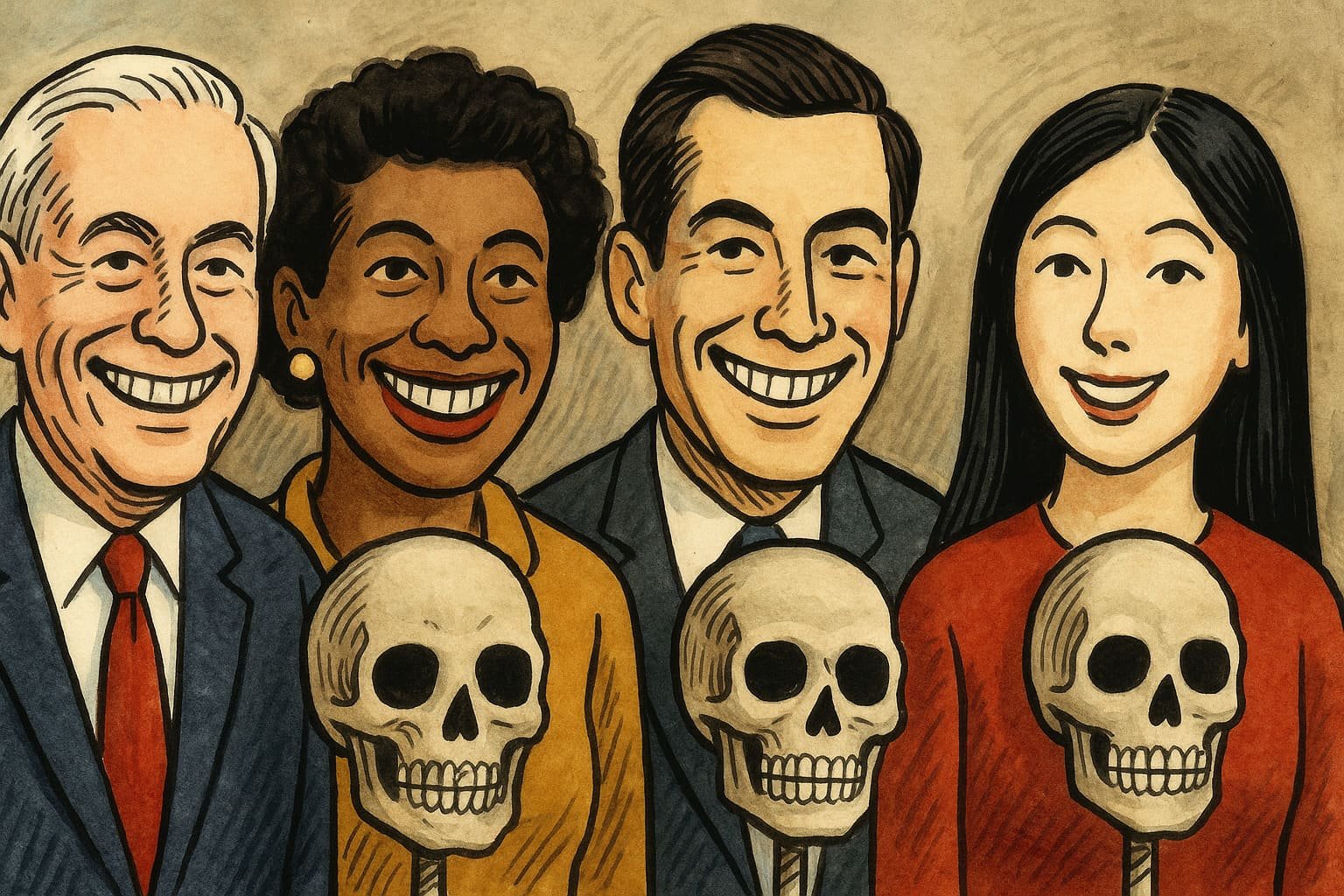
The conference room, polished to a blinding gleam, sits empty except for a line of gleaming coffee cups and the residue of yesterday’s ambition. The air smells of burnt sugar and static, humming with anticipation. On the wall, a collage of headshots beams down; a grid of perfect teeth and curated optimism, frozen in pixelated solidarity. Each portrait promises unity, trust, progress. Yet beneath the surface, a different current crackles: hidden agendas coil in the silence, resentments pass like whispered notes, and every smile seems stitched together with a thread of uncertainty. Somewhere, just out of frame, a nervous laugh floats above the polished table, paper-thin but brittle as glass. It’s a scene familiar to anyone who’s ever sat beneath flickering office lights, wondering which version of reality they’ve been sold today.
For anyone chasing the illusion of perfect teamwork, this is the real game: every handshake is a gamble, every meeting a chessboard, every group chat a masquerade. As the camera pans across the room, a sense of theatrical tension lingers. Who’s really steering this ship? Who’s keeping secrets? And what’s the true cost of all those rehearsed “yeses”? On this stage, trust is currency, but the exchange rate changes with every new rumor. Teams promise the world, but so often deliver drama behind a velvet curtain of professionalism.
Peel back the glossy company culture, and the script gets complicated. In every workplace, a dozen stories simmer beneath the slogans; stories of deals made in parking lots, alliances forged over lukewarm lattes, betrayals disguised as harmless banter. Here, even silence is a character. There’s always that one person who holds the room hostage with their grin, who orchestrates the mood, who turns a simple lunch into a labyrinth of loyalties. Think you know your colleagues? Maybe. Or maybe you just know the version they want you to see.
The greatest deception is rarely loud. It’s the quiet moments: the forced chuckle after a boss’s awkward joke, the exchange of glances after a tense email, the “How are you?” that means “Are you with me?” Under the bright lights, every team looks synchronized, every company claims harmony. Step into the shadows and you’ll find a different playbook. Teams aren’t families; they’re tribes, and every tribe has its secrets.
Just ask Maya Chen, a product lead whose “open-door” policy became the talk of the industry after her team imploded spectacularly over a string of missed deadlines and finger-pointing Slack threads. “We all smiled at the all-hands,” Maya later told FastCompany, “but in private, no one trusted anyone. The moment something went wrong, the knives came out.” Her confession went viral, not because it was rare, but because everyone recognized it: a secret language spoken in side-eyes and Slack DMs, a choreography of survival masked by rehearsed positivity.
Quick Notes
- Beneath Every Smile Lies a Strategy: Every team meeting is a stage where trust is a prop, not a guarantee. Sometimes the loudest laughter hides the sharpest intentions. Watch for the unsaid; it’s often louder than the room.
- Team Spirit or Survival Game? Culture decks sell harmony, but teams often run on FOMO, fear, and fragile alliances. The “one team, one dream” mantra is often recited by those who most need the illusion. Real unity gets built in the mess, not the mission statement.
- Micro-Conflicts Fuel Mega-Results: It’s rarely the big fights that tear teams apart, but the micro-cuts: the shrugged-off ideas, credit theft, and backchannel whispers. Every group has its own Game of Thrones, complete with secret alliances and quiet coups.
- Your Best Ally Is a Wild Card: The quietest person in the room often knows the real score. Alliances shift, favorites fall, and today’s hero becomes tomorrow’s scapegoat. Never trust the first act; the plot always thickens.
- Endings Are Just New Masks: Teams don’t dissolve; they rebrand. After every blow-up, new roles emerge and old ones vanish. The real lesson? Every “team” is a living paradox: necessary, impossible, endlessly fascinating.
Savage Camaraderie: When Trust Is a Transaction
You step into that open-plan office, and the air vibrates with hidden signals. Smiles flash across the desks like coded messages. Behind every “Hey, great job on that presentation,” there’s a silent calculus; who gets ahead, who gets left behind, who owes what favor. You already know not all teamwork is created equal.
The reality: Teams are built as much on mutual suspicion as they are on shared goals. A sense of camaraderie often comes packaged with competition, even among friends. In every organization, from scrappy startups to blue-chip giants, the unspoken rulebook shapes more outcomes than the official playbook. Office politics is not a bug; it’s the system.
Think about that new-hire orientation when everyone promises open feedback. How quickly does that melt away when a project tanks and everyone scrambles to rewrite history? Real power doesn’t live in org charts; it lives in whispered alliances and subtle power plays. Every “team win” can hide a dozen individual losses, and every failure gets rewritten by the loudest voice in the room.
Case in point: Look at the saga of BrightTech, a tech darling that rocketed to fame with a “no-ego” team culture. Their weekly “transparency hours” quickly turned toxic as feedback became ammunition, not support. “The team that overshares becomes the team that overshoots boundaries,” quipped a former employee. Trust became transactional; people performed emotional labor, trading honesty for safety. The result? Massive turnover and a cautionary tale for every HR leader who thinks vulnerability is always a virtue.
Social psychologist Amy Edmondson wrote about “psychological safety” as the holy grail of team performance, but here’s the twist: Safety means different things depending on who holds the power. In tough times, loyalty is a myth and survival is the real team sport. There’s no such thing as a purely selfless teammate; just degrees of ambition, carefully disguised.
The Mirage of Team Unity: Smiles as Survival Skills
You see the “dream team” in every industry: perfect LinkedIn headshots, seamless panel appearances, endless praise in quarterly reports. But you’ve watched those “perfect” teams unravel. Smiles are sometimes just survival skills, masking deeper fractures. The best performers aren’t always the loudest cheerleaders; they’re the ones reading between the lines.
The myth of the “unified team” is one of business’s stickiest illusions. Startups love to plaster their walls with slogans like “We win together,” but every founder knows the reality: Unity is fragile, forged in fire, not happy hours. Cohesion isn’t the absence of conflict; it’s the art of managing it in real time.
Think about that time you got left off the email chain, or the brainstorming session that turned into a gladiator pit. Every team member brings invisible baggage, from family feuds to unresolved professional jealousies. The surface stays calm while the undercurrent swirls, waiting for a moment of weakness. That’s when the real faces emerge.
Take the story of Tessa Green, a marketing VP at a luxury brand, whose “all-for-one” attitude masked a cutthroat instinct for power. Colleagues praised her generosity, yet she was the first to vanish when a project threatened her position. Tessa’s lesson: In the corporate jungle, everyone smiles until there’s blood in the water. Loyalty lasts until the next big promotion.
In truth, office harmony can be dangerous. Teams that avoid honest friction breed resentment. The healthiest groups embrace disagreement; loud, awkward, honest. Psychological safety isn’t the absence of risk, but the ability to survive it. Those “savage secrets” aren’t always sabotage; sometimes, they’re just the messy truth of working with other human beings.
Office Mythology: The Cult of “Teamwork Makes the Dream Work”
You’ve heard it a thousand times: “Teamwork makes the dream work.” But does it? The slogan gets repeated like a magic spell in boardrooms and on billboards, but every employee knows better. The reality is messier. Teamwork is less about unity and more about managing the tension between self-interest and group survival.
Corporate mythology turns average teams into legends, masking the awkward reality that most projects succeed in spite of, not because of, the group. Look at the endless parade of “team-building” exercises, from zip-lining retreats to trust falls in suburban conference centers. How many of those really create lasting change? True transformation comes not from artificial bonding, but from surviving tough times together.
Cultural anthropologist Clifford Geertz once said, “Man is an animal suspended in webs of significance he himself has spun.” The same goes for teams: every group spins its own web, and sometimes, it catches more lies than truths. The hero in the team narrative is often the best storyteller, not the best performer. Recognition doesn’t always reward the most deserving.
One startup, PixelSpark, became famous for their viral “team love” posts, only for the public to discover later that their biggest wins came from the most unlikely, solitary rebels. A junior designer, ignored in meetings, saved a crucial deal with a late-night pitch to a skeptical client. The post-mortem: Teams celebrate unity in public, but it’s lone wolves and outsiders who drive real change.
Team rituals, mascots, and hashtags make for great optics. But as every manager knows, the most vital work happens after hours, in hushed phone calls, and over drinks with the competition. The “dream” isn’t teamwork; it’s surviving the contradictions, thriving in the chaos, and refusing to believe every shiny slogan taped to the glass door.
Secret Agendas: Power, Betrayal, and the True Cost of Success
Every team harbors secrets: from innocent white lies to Machiavellian schemes, survival depends on who holds the most information. The real agenda is rarely printed in the meeting notes. It moves through whispers, body language, and shared glances across the table.
Ambition, not malice, drives most office betrayals. You see it when someone volunteers for a doomed project, quietly angling for a chance to stand out. Or when a teammate offers help, only to trade it for a favor later. Every gesture has an ulterior motive. Navigating these waters requires skill, empathy, and a willingness to accept imperfection.
The fall of Greenway Partners, a boutique consulting firm, became a cautionary tale after an internal scandal revealed that a junior analyst, frustrated by being sidelined, leaked sensitive data to a competitor. The aftermath: firings, lawsuits, and the realization that no amount of corporate jargon could mask the reality that teams, like families, can implode from within.
Beneath every well-run team lies a messy web of compromises. The “best teams” aren’t those that avoid secrets, but those that manage them transparently. Vulnerability is powerful, but it comes at a cost. People protect themselves first, especially when the stakes get high. The most resilient organizations admit this reality, cultivating a culture that rewards honesty but prepares for betrayal.
If you look closely at every big win, there’s often a trail of bruised egos, misread intentions, and half-kept promises. The greatest leaders learn to read these signals, not by demanding loyalty, but by rewarding truth. True power doesn’t come from controlling secrets, but from knowing when to reveal them.
Redemption, Regret, and Reinvention: Building Trust After the Fallout
When the truth comes out and it always does; teams face a reckoning. Some fall apart. Others rebuild, stronger and wiser. Redemption rarely looks like a group hug; more often, it’s a slow, awkward rebuilding of trust. It begins in private apologies, honest conversations, and small acts of vulnerability.
The tale of Horizon Media shows how teams can rise from ashes. After a catastrophic product launch and a wave of public finger-pointing, the leadership ditched all-hands meetings for open forums where grievances got aired, not glossed over. Over time, performance soared, not because everyone liked each other, but because they learned to fight clean and forgive fast.
Trust is not a fixed state, but a process; like rebuilding a ship while sailing in a storm. The first step is admitting the cracks, not patching them with empty words. The most successful teams embrace their scars, turning setbacks into stories of growth, not defeat.
What makes a team unforgettable isn’t perfection, but resilience. In the end, unity comes not from hiding secrets, but from surviving them. If you want a high-performing team, start with honest conversations and accept that sometimes, the mess is the magic.
The real heroes of every business aren’t the flawless, smiling faces on the website. They’re the ones who can look back, acknowledge the damage, and still choose to build something worth believing in, together.
When All the Smiles Fade
The office lights have gone dim, the echoes of laughter fading into memory. On the glass, only a faint outline remains where posters once promised unity. The last one to leave is not the loudest voice, but the quiet observer; watching, reflecting, hoping for something better. Their hand hovers over the switch, uncertain. Outside, rain blurs the city, washing away the stories that will never make it into the annual report.
There’s a moment where the facade shatters, and what’s left isn’t scandal, but truth: teams are made of broken people trying their best. The lessons sting but also heal. The future belongs to those who risk honesty, who accept the darkness behind every grin, and who build something real out of the mess.
Somewhere, a team starts over, not as strangers, but as survivors who have seen each other’s worst and still show up. The office will fill again with smiles, some real, some stitched together with hope. Trust is a choice, not a guarantee. The bravest leaders are not those who hide secrets, but those who invite the light in, even when it hurts.
The final lesson is not written in handbooks or corporate manifestos. It lives in the space between meetings, in the glances that say, “I see you.” Every team wears masks, but some learn to take them off, if only for a moment. That’s where the real story begins.
Now ask yourself: When the smiles fade and the masks drop, will you be remembered for your secrets or your courage?