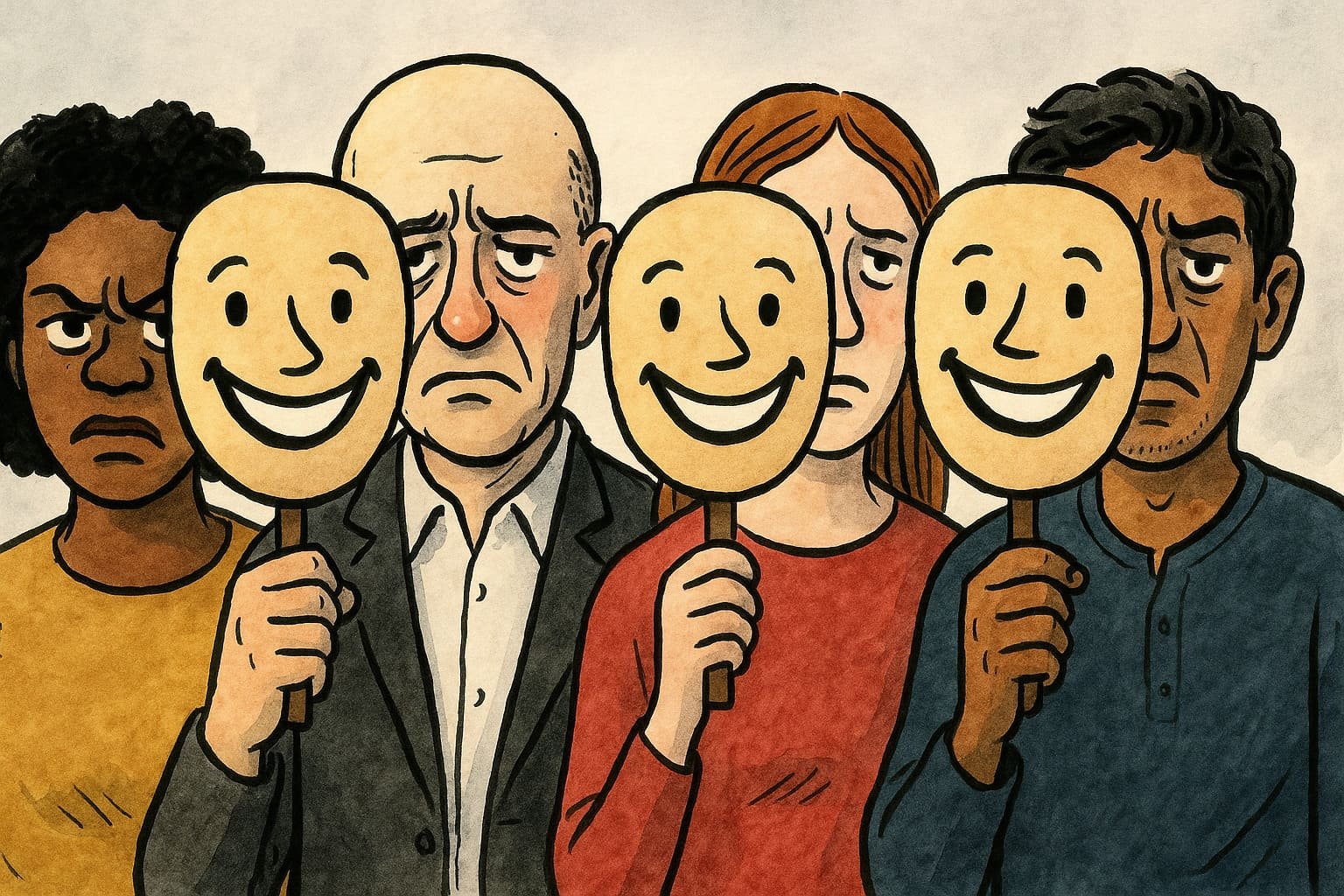
Fluorescent lights flicker over polished glass, casting hard reflections that never blink. Every chair is filled, yet the real show happens in the moments between laughter and applause. Here, in the pulse of modern business, a dozen executives share jokes, trade compliments, and exchange promises with smiles stretched wide enough to shatter. Each grin is a performance, a careful calculation, a strategy written not in numbers, but in nerves. This room, for all its open-concept transparency, might as well be a masquerade ball where the costliest secret is the one hidden just behind the teeth.
At first glance, the boardroom seems like the safest place to trust a handshake or a shared vision. Yet behind the veneer, invisible games are played with the precision of a chess grandmaster plotting twelve moves ahead. Power drifts in the air, subtle and sticky, like the smell of burnt coffee after an all-nighter. Deals are brokered as much by whispered anxieties as by bullet points on the agenda. And the grins; oh, the grins; mask exhaustion, envy, quiet fear of becoming irrelevant, or the raw hope that one day, finally, someone might notice the effort hiding in the quietest corners.
Take Jamie, an operations lead whose smile lights up any meeting, yet whose workload devours weekends and whose loyalty is measured only by how quietly she carries her disappointments. Or consider Raj, the rising star, who trades small talk about cricket for small betrayals, masking every win with self-deprecation sharp enough to cut rivals. Their stories echo across every industry, immortalized in corporate legend, but rarely named. The tension, thick as velvet, builds until the truth slips out; not in words, but in silent glances, clenched jaws, or the slight stiffening of a colleague’s shoulders when numbers are off.
The business world loves a smile. It turns optimism into currency, trust into leverage, and fear into a brand asset. But beneath the surface, the real economy hums with secrets; quiet deals, bruised egos, ethical compromises, and the whispered calculus of whose career will rise or fall next. There’s a reason why business thrillers and startup scandals never go out of style: they reflect the drama that plays out daily, just beyond the reach of the next quarterly report.
Every company tells itself that culture is about collaboration, positivity, and collective victory. But in practice, the biggest deals hinge not on shared vision, but on who can keep their secrets longest and smile the brightest while doing so. The real competition is not for market share, but for who controls the story; the one told to investors, to employees, and most dangerously, to themselves. The question isn’t whether secrets exist behind those smiles, but whether you have the vision to see what really matters beneath them.
Quick Notes
- Smiles Hide Survival Instincts: What looks like teamwork is often a dance for self-preservation, where every grin covers private anxieties, ambitions, and plans.
- Office Heroes Are Human Too: Even the friendliest coworker fights invisible battles, juggles career risks, and sometimes bends the truth for survival or respect.
- Trust Is a Moving Target: True loyalty isn’t found in words or gestures but in patterns of action over time, shaped by fear, hope, and strategy.
- Transparency Is a Myth: No matter how open the culture claims to be, every organization runs on hidden motives, unsaid tensions, and backstage deals.
- The Most Powerful Tool Is Perception: Success in business often belongs not to the most skilled, but to those who can read, shape, and sometimes disrupt the narrative behind every smile.
Beneath the Veneer – Why Every Grin Has a Backstory
Everyone knows the employee who always brings the best doughnuts to the Monday meeting. What most don’t realize is that the act hides a restless hunger for approval, the kind that can’t be satisfied by another box of glazed perfection. The true cost of those sweet gestures is measured not in calories, but in the calories burned worrying about whether you’re still wanted. The warmest greetings can cloak the cold calculations of office politics, where “How are you?” is less a question and more a coded inquiry about your status. In many offices, small talk acts as both glue and camouflage, sticking the team together while disguising the fault lines underneath.
One startup founder, Melissa Tran, became famous in her circle for her endless optimism and relentless praise of her staff. Yet, in her private notes, she tracked every minor error, every slight, every potential threat to her carefully curated culture. The result was a team that felt inspired, but also wary, always waiting for the other shoe to drop. Real trust, it turns out, was a reward earned in silence, not applause. Tran’s brand grew, her company expanded, but the attrition rate remained a secret she never shared at happy hour.
The difference between a winning culture and a toxic one is rarely obvious in the break room. It often comes down to how well leaders can balance brutal honesty with the emotional intelligence required to keep morale from collapsing. Veteran executive coach Alan Becker recalls a team offsite where a leader’s forced laughter almost derailed the session, until an intern broke the spell by asking, “Are you okay?” That single moment of vulnerability exposed a crack in the culture and soon, honest conversation flowed like water breaking through a dam.
Every major brand touts its transparency, but the true power moves happen out of sight. A project manager at a global tech giant described how a single smile from the CFO could calm a room or signal that heads were about to roll. The weight of these micro-expressions, invisible to outsiders, shapes the fate of departments and careers more than any press release. Over time, employees learn to read the smallest cues, decoding facial expressions the way traders parse market data, hoping to get ahead of the next shift.
The brutal truth behind every smile isn’t cynicism, but survival. Organizations run on unspoken codes, subtle alliances, and a shared agreement to keep some realities off the record. The companies that win are the ones that accept this messiness, using it to foster resilience, humor, and genuine loyalty; not the ones that pretend everything is always fine.
The Double Life of the “Culture Champion” – When Positivity Becomes Pressure
Corporate culture often turns positivity into a full-time job. There’s always that one person whose energy seems boundless, who leads icebreakers with relentless cheer, and whose “can-do” attitude is so intense it could melt steel. What’s less visible is the burden this person carries: the expectation to be endlessly upbeat, even when their own world is unraveling. Smiles become armor, wielded against cynicism and burnout, but also as a mask for self-doubt.
Meet Kevin, the HR manager at a growing e-commerce firm, whose calendar was filled with employee birthdays, anniversary notes, and spontaneous team-building activities. Colleagues envied his ability to stay positive, but few knew about the late nights spent second-guessing every word, worried that any slip might ruin the fragile mood. The weight of being the company’s “emotional thermostat” left Kevin exhausted, privately questioning whether authenticity had a place in the relentless positivity parade.
Sometimes, the drive to maintain culture creates unintended casualties. At a high-profile consulting firm, internal surveys praised their “family-like” atmosphere. Yet, when an employee raised concerns about workload, the response was swift but superficial: pizza parties instead of real change. The pressure to maintain the facade of happiness turned minor grievances into major secrets, as employees learned that true honesty could threaten the image they all worked so hard to sustain.
Culture champions often find themselves negotiating impossible choices. Should they risk breaking the mood with tough feedback, or protect team harmony by hiding hard truths? Veteran consultant Samira Bashir recalls leading a workshop where a new hire confessed they felt “trapped by good vibes,” unable to share genuine struggles for fear of shattering the illusion. The lesson: when positivity becomes performance, culture suffers.
The paradox is that the healthiest cultures are those that allow for contradiction. They make room for both the high-fives and the hard talks, for the tears as well as the toasts. The most successful teams are not the ones who smile the most, but the ones who know when to take off the mask and be real, even if it means risking discomfort. That’s where true connection, and lasting success, can actually begin.
The Secret Wars of Ambition – Who Wins When Everyone Plays Nice?
Ambition doesn’t announce itself with fangs and claws. In most offices, it arrives with firm handshakes, clever jokes, and polite offers to help. The danger isn’t that people compete; it’s that they compete while pretending not to. The real battles happen quietly, fought with calendar invites, credit for ideas, and knowing who to cc on every email.
Consider Olivia, a rising analyst at a global finance firm, whose reputation for collaboration hid a fierce drive to get ahead. She became a master at supporting colleagues in public while quietly lobbying for solo credit behind the scenes. When she finally landed a promotion, the team celebrated, but trust cracked as whispers spread about who really deserved the win. Olivia’s story isn’t unique: modern business rewards those who play the long game, disguising power plays in the language of teamwork.
Leadership guru Daniel Cortez tells of a sales team whose internal Slack channel became a battleground for subtle one-upmanship. Praise was doled out in public, but real critiques and alliances happened in private chats. The pressure to “play nice” forced every team member to become an actor, never sure if they were in a drama or a farce. When real conflict eventually erupted, it was more explosive because no one knew how to argue without smiles.
Research on organizational politics points to a simple truth: every system breeds its own form of subterfuge. Sometimes it’s innocent; like working late to impress a manager who values “hustle.” Other times, it’s toxic, fueling rivalries that undermine both performance and morale. In both cases, the refusal to acknowledge ambition as a natural force turns ordinary office life into a war of hidden motives.
It’s tempting to wish for a world where every ambition is declared openly, but real life rarely works that way. People hold back to protect their prospects, avoid conflict, or simply fit in. The irony is that this secrecy doesn’t prevent conflict; it just delays it, making the eventual reckoning all the more brutal. Ambition, when repressed, doesn’t die; it simmers, feeding the gap between smiles and secrets.
The healthiest organizations learn to manage ambition, not stifle it. They build structures where competition is acknowledged, channeled, and balanced by shared purpose. The goal isn’t to eliminate secrets, but to ensure that they serve progress, not sabotage. In this kind of culture, ambition fuels innovation instead of breeding resentment, and every victory is sweeter because it’s earned out in the open.
Smiles as Strategy – How Leaders Weaponize Positivity
Behind every dazzling launch event, every inspiring “all-hands” speech, and every carefully curated LinkedIn post lies a strategic intent. Leaders know that optimism is a tool, as powerful as any algorithm or quarterly report. Smiles aren’t just for show; they’re currency, wielded to influence morale, attract talent, and steer markets. The most effective executives wield this tool with surgical precision, knowing when to flash a grin and when to withdraw it for maximum impact.
Take Maya, CEO of a celebrated tech startup, whose Instagram feed overflowed with laughter, team hikes, and motivational quotes. Inside the company, she cultivated an aura of approachability, always smiling, always available until it was time for layoffs. Then, the smiles vanished, replaced by brisk efficiency and impersonal memos. Employees felt whiplash, realizing too late that the positivity had been a strategic asset, not an unconditional promise.
Strategic positivity is not unique to Silicon Valley. In the retail world, store managers are often trained to project cheerfulness even during chaotic shifts. One well-known brand famously required employees to smile at every customer, regardless of mood or circumstance. While some staff thrived, others confessed to feeling “emotionally bankrupt,” forced to perform happiness even when their real lives were falling apart. The result: high turnover, and a culture where true feelings became just another line in the employee handbook.
Leadership communication expert Jayson Reed argues that smiles, like any form of rhetoric, must be wielded with care. Too much optimism creates suspicion; too little breeds fear. The art lies in knowing when to drop the performance and share the truth, even when it stings. Reed recalls a CEO who broke the usual pattern by admitting, “I’m scared, too,” during a crisis. The moment landed harder than any motivational slogan because it was real.
The risk of weaponizing positivity is that it erodes trust, turning every interaction into a negotiation. Employees stop believing in good news, bracing for the “gotcha” behind every grin. Over time, the company becomes a stage, and everyone an actor, performing a version of themselves they no longer recognize. The cost isn’t just emotional burnout; it’s the loss of real innovation, as people hide their best ideas behind polite smiles, waiting for a safer stage.
The secret is not to banish positivity, but to anchor it in truth. The best leaders use smiles to invite conversation, not shut it down. They create space for contradiction, celebrating wins while also acknowledging fears. This kind of authenticity doesn’t make everyone happy all the time but it does build cultures where people can risk showing up as themselves, and where the smiles that remain are worth far more than gold.
The Mirror Crack’d – When Secrets Break and Cultures Transform
Every organization reaches a moment of reckoning, when the gap between public smiles and private truths becomes impossible to ignore. Sometimes it’s a whistleblower, sometimes a viral Glassdoor review, or even a simple question at a town hall that lands like a grenade. When secrets surface, the culture cracks; not always to collapse, but to let in air, light, and the chance to rebuild something stronger.
A famous case at a European fintech firm began with an anonymous survey that exposed widespread burnout and resentment. Leaders, who prided themselves on an “open door” policy, were shocked to discover that employees felt unheard, unseen, and unprotected. The revelation led to a months-long reckoning, with tough conversations, new policies, and some uncomfortable exits. Yet from the ashes, a more resilient culture emerged; one where vulnerability was finally safe and trust could be rebuilt.
Not all transformations are so dramatic. Sometimes, change comes in quiet moments: a manager admits they’re struggling, a team confesses to missing a deadline, or a founder publicly acknowledges a mistake. Each act of honesty chips away at the armor, inviting others to show their own scars. In these moments, the organization becomes not just a place to work, but a place to grow.
Social psychologist Dr. Louise Ellis suggests that secrets act like “organizational cholesterol” invisible, sometimes harmless, but potentially lethal if left unchecked. The healthiest cultures are those that develop rituals for truth-telling: regular retrospectives, honest feedback sessions, and, most importantly, leaders who model the courage to be real. These rituals don’t eliminate secrets, but they make space for them to be aired, metabolized, and transformed into wisdom.
The process isn’t easy. Culture change is messy, full of false starts and bruised egos. Yet the reward is worth the pain. The companies that endure aren’t those that hide their flaws, but those that learn from them, inviting both success and failure into the open. In the end, the real strength of an organization is measured not by how well it hides its secrets, but by how bravely it faces them.
The greatest legacy any leader can leave isn’t a string of wins, but a culture where the brutal truth is welcomed, not feared. Where the gap between smiles and secrets is narrow enough to cross in a single, honest conversation. That’s how trust becomes more than a brand promise; it becomes the lived experience of everyone, every day.
When the Mask Drops, Who Remains?
In the gentle hush after the applause fades, the masks rest quietly on the table. A leader stands by the window, eyes tracing the city’s distant lights, their reflection mingling with memories of every meeting, every promise, every almost-fall from grace. Colleagues linger in the hallway, laughter drifting away as the weight of the day finally lands. This is the moment where the real story begins: not with a smile, but with what remains after the mask drops.
The journey from secrecy to truth is not a straight line, but a looping dance; two steps forward, one step back, always circling the heart of what matters most. Every revelation is a risk; every confession, a tiny act of rebellion against the culture of perfection. Those who survive, and thrive, are the ones who choose honesty over harmony, courage over comfort, and substance over show.
Somewhere, a founder walks the quiet corridors after everyone’s gone, replaying old jokes and half-meant compliments, haunted by both triumph and regret. They know that their real power lies not in how many smiles they can muster, but in how many truths they can bear to face. The final victory belongs to those who dare to build trust, not just brand equity.
As the night deepens, the company’s story shifts from fiction to fact, from legend to legacy. Here, in the afterglow, real culture grows: strong, strange, unfinished, and fiercely alive. The mask is gone. The work begins.
So, ask yourself: When the mask falls and the lights come up, will the culture you helped build still recognize you and will you still recognize yourself?
Why scroll… When you can rocket into Adventure?
Ready to ditch the boring side of Life? Blast off with ESYRITE, a Premier Management Journal & Professional Services Haus—where every click is an adventure and every experience is enchanting. The ESYRITE Journal fuels your curiosity to another dimension. Need life upgrades? ESYRITE Services are basically superpowers in disguise. Crave epic sagas? ESYRITE Stories are so wild, your grandkids will meme them. Want star power? ESYRITE Promoted turns your brand cosmic among the stars. Tired of surface-level noise? ESYRITE Insights delivers mind-bending ideas, and galactic-level clarity straight to your inbox. Cruise the galaxy with the ESYRITE Store —a treasure chest for interstellar dreamers. Join now and let curiosity guide your course.