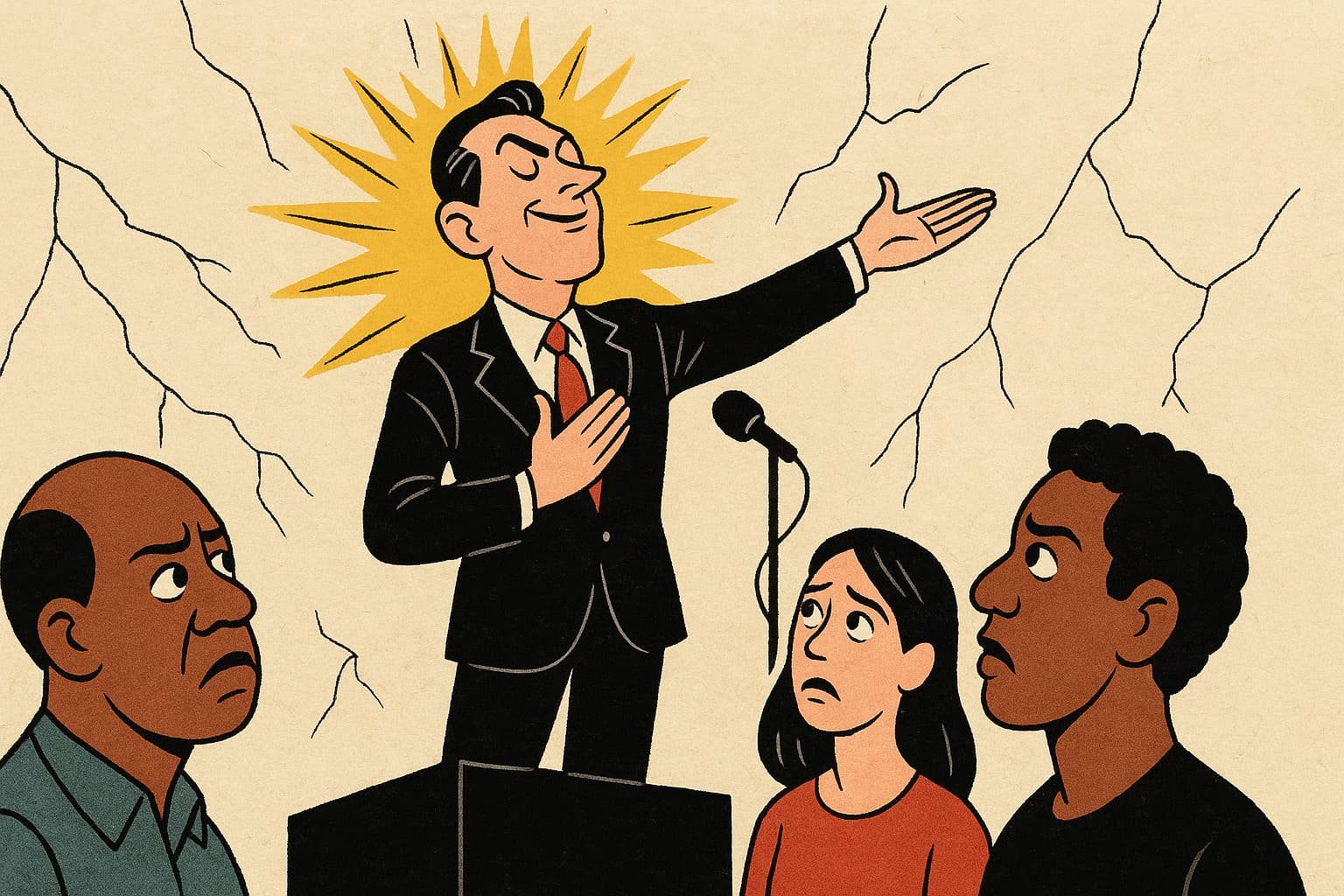
A conference hall bathed in cold light sits empty, save for a solitary figure whose presence fills the air like the echo of a past parade. There, a leader stands before the ghostly shimmer of glass walls, his own face multiplied infinitely across the mirrored panels. Applause lingers as a memory; louder than any living crowd each echo feeding an ego that has outgrown the room. His reflection grins back, unblinking, as if daring the universe to reveal a flaw. Power swirls in this vacuum: intoxicating, fragile, and blind to the storm gathering outside.
No strategist draws up battle plans for invisible wars, but narcissists wage them daily. The team’s laughter becomes applause, honest questions wither into obedience, and the line between confidence and delusion dissolves into the boardroom carpet. Every celebration turns into a coronation, and every meeting morphs into a stage play with one starring role. The world outside shrinks to a single audience of mirrors, each one polished, ready to reflect the legend the leader demands to see. No amount of revenue can fix what rots at the core when vision turns into a spotlight that burns instead of warms.
Yet, behind this glamorous armor, companies shudder. The culture mutates; first into spectacle, then into silence; until even the most loyal lose the rhythm of their work. Old allies remember promises broken under the weight of ego, investors watch numbers soar then nosedive, and an entire team starts to wonder if their collective genius has been reduced to set dressing. There’s always a price for false gods, and it’s paid with trust, loyalty, and the kind of innovation that only honest conflict can ignite. Empires rise on cults of personality, but they crumble under the same lonely banners.
A former executive from a rising tech darling once whispered in a bar, “Every quarter, the applause got louder, but so did the emptiness.” Her story, like so many, is a parable: behind every shocking business triumph, there might lurk a king obsessed with his own reflection. The fall isn’t sudden. It’s a slow unraveling; like a sweater pulled thread by thread until there’s nothing left but the memory of applause and a cold, quiet throne.
Here lies the riddle: why do teams follow leaders who mistake worship for wisdom? And what happens to those companies when the mirrors finally shatter? Business isn’t just about numbers. It’s about the hidden costs of unchecked ego, the secrets in plain sight, and the downfall that sneaks in, quiet and devastating, like a thief at dawn.
Quick Notes
- Mirrors Replace Whiteboards: When leadership becomes performance, reflection replaces connection. Employees mimic approval, innovation dries up, and authenticity vanishes leaving only the leader’s narrative, uninterrupted and unchallenged.
- Charisma or Chaos? Narcissist leaders weaponize charm and vision to dominate meetings, silence dissent, and center themselves in every win and loss. Teams learn to prioritize praise over progress, rewarding egos rather than solutions.
- Collapse of Culture: What starts as magnetic confidence devolves into fear-driven obedience. True talent drifts away quietly, leaving behind a hollow brand and disengaged staff. The cracks reveal themselves too late for easy repairs.
- The Messy Human Cost: Real-life stories expose the toll; employees crushed under the weight of invisible expectations, managers punished for candor, brands that lose their soul in the name of one person’s legend.
- Breaking the Spell: Escaping the cycle takes courage, truth-telling, and a willingness to confront the myth. The only path back to greatness runs through humility, transparency, and a hard look at the stories leaders tell themselves and their teams.
The Charisma Trap—When Genius Becomes a Gospel
Charisma in business is the currency of ambition, trading vision for loyalty in an endless market of hope. A CEO at a health-tech unicorn once inspired teams with late-night monologues, rallying exhausted engineers over pizza and projections, selling impossible futures as if they were already true. What began as inspiration turned into expectation, with every doubt framed as betrayal, every question as an attack on destiny. People learned to nod, smile, and swallow their instincts, convinced their doubts were the real enemy. The cost of dissent wasn’t just missed promotions but an exile from the community that charisma built.
In the charismatic leader’s world, problems dissolve into opportunities as long as they remain unspoken. The buzz of the company’s open office became a soundtrack for bravado, with team chats filling up with emojis rather than honest feedback. Leaders who command by sheer force of personality build loyalty that looks bulletproof from the outside but cracks under real pressure. Employees tell stories of working through weekends, fuelled not by passion but the fear of disappointing a visionary who never seemed to need sleep or second opinions. Energy is contagious, but so is exhaustion.
A close look at Enron, WeWork, or Theranos reveals a common thread: confidence, unchecked, transforms into gospel. Teams that once felt invincible learned the hard way that belief without skepticism is a dangerous cocktail. In one pivotal meeting at Theranos, an engineer quietly pointed out a flaw. The response? A public dressing down, cloaked as a lesson in “thinking bigger,” but in reality, a warning shot to anyone else considering honesty over harmony. That moment spread like wildfire, silencing the dissent that could have saved billions.
Pop culture worships the charismatic anti-hero, from Tony Stark to Jordan Belfort, but misses the aftermath left behind. In real boardrooms, the cost of this myth is measured in broken careers, abandoned ideas, and companies that run out of stories before they run out of money. The lesson is brutal but essential: charisma can inspire, but unchecked, it can also infect.
If you have ever watched a talented peer vanish from Slack, their name scrubbed from company lore, you have seen the ghost of charisma’s darker side. Teams don’t just lose contributors; they lose the future they might have built together, replaced by a narrative that belongs to one person and one person only.
The Hidden Tax of Obedience—How Fear Silences Innovation
Obedience masquerades as alignment in organizations ruled by narcissists, but it’s more like a slow poison than a shared vision. Employees in a once-promising fintech startup remember the shift: open brainstorming replaced by one-way “feedback” sessions, laughter fading into measured silence, every idea running through a filter of “what would the boss think?” Creativity suffocated, ambition shrank, and the most inventive minds started searching for exits instead of breakthroughs.
This isn’t a rare story. Amazon, famously tough, has seen periods where creative engineers quietly fled after leaders rewarded loyalty over challenge. When people worry about their jobs more than their impact, groupthink becomes survival. Companies fall in love with their own mythology, spending more time perfecting the script than solving real problems. A new marketing director at a growing consumer brand described his onboarding as “an exercise in learning the founder’s favorite phrases.” The irony: the brand’s entire value proposition was “disruption,” but its soul had calcified into routine.
A clever junior at an advertising agency once kept a notebook called the “Book of Things Not to Say.” In it, she logged every comment that derailed her career prospects; suggestions, questions, and insights that earned nothing but cold glances or nervous laughter. When talent self-censors, organizations start producing not art, but artifacts: safe, sterile, and forgettable. Real innovation; the kind that terrifies competitors can’t survive in an ecosystem where truth is the enemy of tranquility.
Narcissist leaders rarely notice the exodus until it’s too late. People vanish in waves, and the only ones left are those most adept at camouflage. The company’s heartbeat slows, its culture turns gray, and what was once an engine of possibility becomes a graveyard of unused ideas. Investors feel it first, then customers, and finally, the press starts asking uncomfortable questions.
A famous management consultant said, “Teams outlive their leaders, but the scars left by fear can haunt an organization for a generation.” In this silence, brands lose their ability to adapt, learn, and evolve. The real tax of obedience is paid not in dollars but in futures never realized.
Empires Built on Sand—The Rise and Fall of Myth-Makers
Every empire built on ego looks invincible until the tide turns. The founder of a hot SaaS startup once refused to address negative reviews, insisting that “real customers don’t care about details.” It worked; until it didn’t. The next product launch flopped spectacularly, leaving the team scrambling to explain what went wrong while the leader doubled down on blaming “disloyalty” instead of looking in the mirror. Reputations, once solid, unravel fast when self-delusion infects decision-making.
At the height of the dot-com boom, one high-profile fashion company became a media darling because of its eccentric founder’s public persona. Employees were asked to clap at every team meeting, regardless of results. The day applause stopped, the layoffs began. Investors watched as charisma gave way to chaos, and stories of “culture” quickly turned into cautionary tales. Myth can carry a brand only so far before reality steps in.
Case studies teach that every rise contains the seed of a potential downfall, but narcissist-led organizations learn this lesson the hard way. The higher the pedestal, the harder the fall. One former manager at a global logistics firm recounted how a CEO’s refusal to listen to frontline staff led to a million-dollar mistake that took years to fix. “He thought we were too negative. In the end, we just stopped talking,” she said.
Netflix’s famous culture deck speaks of “radical candor,” but for companies worshipping founders rather than values, candor is a threat. When narrative replaces numbers and stories crowd out strategy, even the best brands can lose their edge. What feels revolutionary in the beginning; endless vision, relentless positivity, charisma as a business model; becomes unsustainable when real-world complexity kicks in.
In every myth, there is a moment of reckoning. For the narcissist leader, that moment is almost always a surprise. They built their empire on stories, but forgot that even the best storytellers need someone to tell the truth.
The Human Toll—Burnout, Betrayal, and the Price of Illusion
Beneath the surface of every high-performing, high-drama team, there’s a hidden ledger that records the emotional costs of following a narcissist. Talented employees who started their careers with fire in their eyes now carry a kind of professional exhaustion that sleep cannot cure. A project manager at a retail tech firm described the feeling as “winning the lottery, then realizing you owe more than you ever won.” That’s the magic trick: narcissist leaders convince teams to gamble their well-being for an illusion of shared glory.
Office politics become gladiatorial combat when truth is dangerous and vulnerability is weakness. The HR director at a midsize media company shared a micro-story: she once hosted an offsite to rebuild trust after a mass resignation, only to be pulled aside by the founder and told, “No more honesty sessions. You’re making us look weak.” Culture, built on confession and connection, withers when leaders equate criticism with betrayal.
Real life, not theory, teaches that burnout spreads like wildfire in these cultures. Employees compete to hide fatigue, managers punish transparency, and the cycle feeds itself until someone finally collapses. A young engineer at a global gaming company once checked himself into a hospital for stress, only to be reprimanded by his manager for “poor time management.” The lesson was clear: the legend matters more than the person.
These stories multiply in private messages, exit interviews, and late-night conversations over drinks. They’re the dark matter of modern business; the pain nobody writes into the mission statement but everyone feels. Startups that once promised purpose lose their brightest to burnout, leaving only those willing to trade health for proximity to power.
The most profound cost is also the hardest to measure: lost humanity. Companies don’t die when numbers dip; they die when trust vanishes. The price of illusion isn’t just turnover, but the slow, silent bleeding of hope from the people who once believed they were building something real.
Shattering the Mirror—How Teams Reclaim Truth and Build Again
Escaping the reign of narcissism requires a collective act of bravery. After a near-meltdown, a team at a financial services firm banded together to confront their charismatic but divisive leader. It started with one manager quietly telling the truth in a meeting, refusing to clap for an idea that didn’t make sense. That act; small, almost invisible became the pebble that started an avalanche of honesty. Trust, once lost, returned through shared risk and mutual vulnerability.
Culture shifts when leaders listen, but the real power lies with teams. Organizations that outlast narcissist reigns are those where people rediscover the value of disagreement, the power of dissent, and the beauty of building together. A marketing team at a consumer electronics company rebuilt their entire playbook after their founder was ousted, returning to basics: real feedback, peer coaching, and shared wins. Revenue rebounded, but more importantly, so did morale.
Contrary to myth, calling out a toxic culture isn’t career suicide; it’s survival. The head of strategy at a healthcare startup famously resigned in protest after her CEO refused to admit mistakes. Within months, she launched her own consultancy, hiring away the best and brightest from her former employer. Her story became a case study in industry journals about the long-term value of truth over loyalty.
Organizations that foster truth-telling don’t just survive; they lead. Case studies show that companies ranked high in psychological safety outperform those obsessed with hierarchy. Leaders who admit mistakes, share credit, and welcome challenge create environments where innovation thrives. It isn’t charisma that builds legacies, but humility.
The most powerful act is the most human: naming reality, even when it hurts. Teams that reclaim the narrative break free from old myths and start telling new stories; ones rooted in trust, truth, and the messy, glorious business of being real.
Lessons Echo After the Silence
A vast office lies quiet under the late glow of evening, shadows stretching where once laughter and ambition filled the air. The leader sits surrounded by empty chairs, the applause of imagined crowds gone, leaving only the soft hum of forgotten conversations. In the silence, a single photograph on the wall blurs beneath the light, the faces in it smiling with the hope of a future they built together. Memories of every triumph now flicker between pride and regret, each one a silent witness to the choices made and the trust spent.
Not far away, teams gather around kitchen tables and city rooftops, sharing stories that no quarterly report can measure. They speak in quiet voices, but their words build something new; a culture of candor, a foundation of resilience, a blueprint for the kind of leadership that does not vanish when the mirrors shatter. The downfall of the narcissist reign is not the end of the story but the beginning of a deeper kind of success, woven from the threads of truth, forgiveness, and relentless curiosity.
Every company carries its ghosts, but those willing to name them reclaim the power to change. The most valuable lesson lingers in the echo after the last applause: greatness built on illusion cannot last, but greatness built on honesty endures. In every team, the real heroes are those who dare to break the silence. So ask yourself: will you chase the legend, or will you build the legacy?