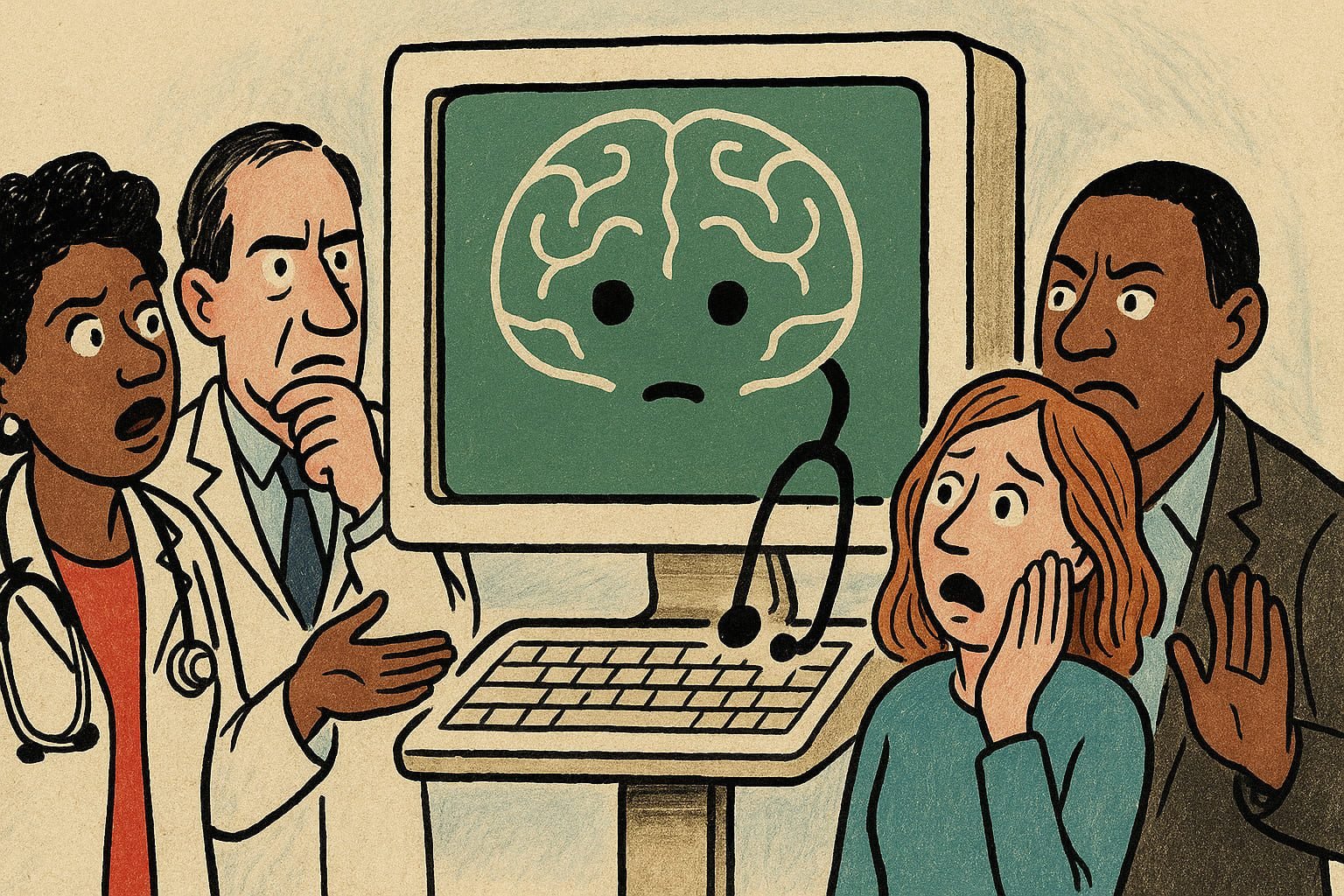
Imagine you’re in a hospital bed at 3 a.m., the beeping of machines echoing down a sterile hallway. You reach for reassurance, expecting the steady hand of a seasoned nurse or doctor. Instead, a tablet flickers to life, an algorithm runs, and a machine suggests your next treatment. Is this a miracle or a gamble with your life? As artificial intelligence invades healthcare, society stands at a crossroads; one road paved with hope, the other with uncertainty. Are we racing toward a future where machines cure diseases faster than ever before, or are we surrendering our most sacred trust to code that barely understands us?
Every headline touts AI as a medical miracle; spotting cancer, decoding genomes, predicting pandemics before the first cough. But beneath the hype, real fears simmer. What happens when an algorithm gets it wrong? Who’s responsible when the bot misreads your symptoms? Are we ready to trust silicon with the messiness of human life and death? The stakes could not be higher. This isn’t just a battle between tradition and technology; it’s the most audacious wager healthcare has ever made.
This is a story of innovation, risk, and the age-old tension between progress and peril. AI is rewriting the rules of medicine faster than most people can grasp. The revolution is thrilling, terrifying, and, whether we like it or not, utterly unstoppable. The real question isn’t “Will AI transform healthcare?” It’s “Will we control the transformation; or will it control us?” Buckle up. This gamble has only just begun.
Quick Notes
- AI Promises Medical Miracles, But Risks Remain: Artificial intelligence brings unprecedented diagnostic speed and accuracy, but can also amplify bias or errors if not carefully managed.
- Human Care Faces Automation’s Double-Edged Sword: AI can free doctors from paperwork and boost patient access, but overreliance risks losing empathy and trust-the heart of healing.
- Data Drives Everything, Raising Privacy Stakes: Machine learning thrives on big data, turning health records into treasure, but exposes patients to new threats of surveillance and cyberattacks.
- Real-Life Stories Show Triumphs and Tragedies: Case studies of success and failure prove that AI’s potential is matched only by its pitfalls, making oversight and accountability essential.
- Tomorrow’s Healthcare Needs Human Wisdom, Not Just Code: The future depends on blending cutting-edge technology with ethical, transparent, and patient-centered care; no shortcuts allowed.
The Medical Miracle Machine: Promise or Peril?
Healthcare has always craved breakthroughs; penicillin, X-rays, open-heart surgery. Now, artificial intelligence bursts onto the scene with promises to revolutionize everything from diagnostics to drug discovery. Hospitals deploy AI tools that scan X-rays for tumors with uncanny speed and accuracy, often spotting problems doctors miss. Algorithms decode genetic data, helping researchers hunt for the root causes of rare diseases. Patients dream of a world where treatment is personalized, precise, and proactive.
Yet the promise isn’t without pitfalls. AI systems, for all their brilliance, learn from human data and humans are messy, biased, and imperfect. A recent case saw a widely-used skin cancer detection tool misdiagnose dark-skinned patients, simply because its training data skewed pale. Technology, when rushed, can reinforce injustice rather than cure it. Every advance brings a new risk, making vigilance essential.
Medical professionals are both excited and anxious. Oncologist Dr. Mia Sandoval recounts using AI to screen mammograms faster than her team ever could. Early detection soared, but so did false positives. Patients celebrated earlier diagnoses, but many endured unnecessary biopsies. Technology amplified the stakes, for better and for worse.
Patients themselves are wary. Sarah, a diabetic mother in Seattle, saw her AI-powered insulin pump deliver perfect doses for months until a software update glitched, triggering a terrifying sugar crash. The fix was fast, but trust took longer to repair. Stories like Sarah’s ripple across online forums, turning hype into hard questions about reliability.
At its best, AI can unlock cures. At its worst, it can blindside even the most prepared teams. Like every great medical advance, the miracle machine is only as good as the wisdom guiding its use. Every leap forward demands humility, skepticism, and a healthy dose of doubt.
Empathy vs. Efficiency: Can AI Really Care?
Medicine isn’t just about data points and diagnoses. Healing hinges on human connection; listening, comforting, knowing when to hold a hand instead of a chart. Artificial intelligence, for all its computational genius, can’t share a patient’s tears or understand the subtle cues behind a trembling voice. As hospitals rush to automate tasks and optimize efficiency, some worry compassion may become collateral damage.
AI chatbots now answer millions of health questions, from late-night symptoms to mental health crises. They offer instant advice, direct patients to resources, and even monitor mood swings. For those in remote areas, this is nothing short of a lifeline. But what about the nuances; the look of fear, the hesitation before answering a sensitive question, the unspoken plea for help?
Consider the story of John, a retiree in London who used a mental health chatbot during a dark spell. The bot replied instantly, but John missed the warmth of a therapist’s voice. He credits the AI with saving his life but still wishes for human empathy. His story is echoed by thousands who find tech support efficient but emotionally hollow.
Doctors, too, feel the squeeze. Dr. Olivia Chen, an emergency physician, used to spend half her shift on paperwork. Now, AI tools streamline recordkeeping, letting her focus on patients. She sees more people, solves more problems but worries that relentless optimization may push medicine toward a cold calculus of time and numbers.
The central paradox emerges: AI makes healthcare faster, cheaper, and more accessible, but risks losing the very soul of medicine. The challenge isn’t to stop the machines. It’s to keep the heart in healthcare, no matter how smart the tech becomes.
Data, Dollars, and Danger: Who Owns Your Health?
Behind every AI marvel lies a mountain of data. Medical records, wearable devices, insurance claims, genetic tests; all are fuel for the machine learning fire. The more data, the smarter the algorithm. But as hospitals and startups hoard personal health information, privacy fears rise. Who owns your heartbeat, your genome, your digital twin?
Cybersecurity nightmares haunt the healthcare sector. Data breaches leak sensitive details, from cancer diagnoses to home addresses. Hackers target hospitals, holding records ransom and jeopardizing patient safety. The rush to digitize medicine brings a new kind of risk one that isn’t fixed with a bandage or a pill.
Big Tech eyes healthcare like a hungry wolf. Companies like Google and Apple build health platforms, eager to monetize the most intimate aspects of your life. Patients become customers, and every search or sensor reading turns into a data point for profit. The potential for innovation is huge, but so is the threat of exploitation.
Patients are caught in the middle. Lucy, a breast cancer survivor in Mumbai, agreed to share her treatment data for research. Months later, she discovered her records were sold to marketers, not scientists. The sense of betrayal runs deep. Stories like Lucy’s spark calls for better laws, clearer consent, and real accountability.
The data gold rush is unstoppable. AI healthcare needs information to thrive. But without transparency, security, and respect for patient rights, the miracle risks turning into a minefield; one where profit trumps ethics and care.
Cautionary Tales and Comebacks: AI’s Winners and Losers
The path to AI-powered medicine is littered with cautionary tales. Some algorithms shine in the lab but stumble in real-world clinics. An ambitious hospital in New York deployed a machine learning tool to predict patient readmissions. Early tests dazzled. Yet, when rolled out system-wide, the algorithm flagged low-risk patients and missed the sickest. The result: wasted resources, frustrated staff, and a lesson in humility.
On the flip side, AI has delivered stunning victories. In a remote African clinic, a simple smartphone app powered by machine vision now screens eyes for early signs of blindness. Local nurses, once limited by a shortage of specialists, can now spot problems and save sight with a snap of the camera. Technology breaks barriers, leveling the playing field for the world’s most vulnerable.
Every win is hard-fought. Dr. Anwar, a neurologist in Cairo, tells of using AI to analyze brain scans for stroke patients. One misclassification nearly led to the wrong surgery. The mistake was caught, but not before anxiety rippled through the team. They responded by retraining the system and creating new safeguards, turning a near-miss into a teaching moment.
Failure breeds innovation. A pediatric hospital in Toronto piloted an AI triage system. The first week, the algorithm over-prioritized minor fevers and missed a child with sepsis. Instead of ditching the tool, staff paired it with seasoned nurses, blending tech and intuition. Patient care improved, and the system now serves as a global model for safe integration.
Every AI experiment in healthcare is a gamble; a risk that can end in disaster or redefine what’s possible. What separates the winners from the losers isn’t luck. It’s a relentless commitment to learning, adapting, and never letting machines replace human judgment entirely.
The Future Is Human: Building Ethical, Patient-Centered AI
Technology alone can’t fix healthcare’s deepest problems. The future belongs to those who blend digital genius with moral clarity. Building ethical AI demands more than clever code; it requires listening to patients, including diverse voices, and holding power to account. Transparency, explainability, and consent must become the new normal.
Training data must reflect real-world diversity, not just the privileged or the easy-to-reach. Developers must admit what algorithms cannot do, not just what they can. The best systems empower clinicians, not sideline them. Think of AI as the world’s best assistant; brilliant, fast, and tireless, but always needing a human guide to steer the ship.
Regulators are racing to keep up. Europe’s GDPR and America’s patchwork of privacy laws attempt to rein in Big Tech and healthcare titans alike. Yet laws can only go so far. The real work happens in hospitals, clinics, and coding labs, where decisions are made every day that shape life and death.
Patients must demand more. Ask tough questions: Who benefits from AI? Who is at risk? Can you opt out? The future will be written by those who refuse to be passive subjects in the healthcare experiment. Accountability isn’t a trend. It’s the lifeblood of trust.
A tech founder in Boston, Melissa, built an AI startup focused on rare diseases. Instead of chasing venture capital, she crowdsourced patient feedback at every step. Her platform succeeded because it treated patients not as data points, but as partners. Her story is the blueprint for healthcare’s future: human at the center, code at the service.
All Bets Are Off: And the Stakes Have Never Been Higher
AI is no longer a futuristic fantasy in medicine; it’s the reality pulsing through emergency rooms, research labs, and living rooms around the world. The great healthcare gamble is underway, and the stakes couldn’t be higher. Algorithms may unlock cures and stretch the boundaries of what’s possible, but unchecked, they can just as easily breed chaos, inequity, and loss.
The real question isn’t whether technology will change healthcare. It’s who will guide that change. Will we build a world where patients, not profit, come first? Where machines empower rather than replace the healers who hold society together? The future isn’t set in code. It’s written every day in the decisions we make, the stories we share, and the values we choose.
Don’t wait for a headline to make you care. If you find yourself under the sterile lights of a hospital, would you trust the code, the caregiver, or the collaboration between both? The answers you demand today will shape the medicine you rely on tomorrow. One thing’s for sure; the gamble is on, and you’re already at the table.
Next time you see an AI healthcare headline miracle or scandal ask yourself: Would you stake your life on an algorithm, or do you believe healing demands more than code? The future of medicine is in your hands. What kind of care will you fight for?
Why scroll… When you can rocket into Adventure?
Ready to ditch the boring side of Life? Blast off with ESYRITE, a Premier Management Journal & Professional Services Haus—where every click is an adventure and every experience is enchanting. The ESYRITE Journal fuels your curiosity to another dimension. Need life upgrades? ESYRITE Services are basically superpowers in disguise. Crave epic sagas? ESYRITE Stories are so wild, your grandkids will meme them. Want star power? ESYRITE Promoted turns your brand cosmic among the stars. Tired of surface-level noise? ESYRITE Insights delivers mind-bending ideas, and galactic-level clarity straight to your inbox. Cruise the galaxy with the ESYRITE Store —a treasure chest for interstellar dreamers. Join now and let curiosity guide your course.