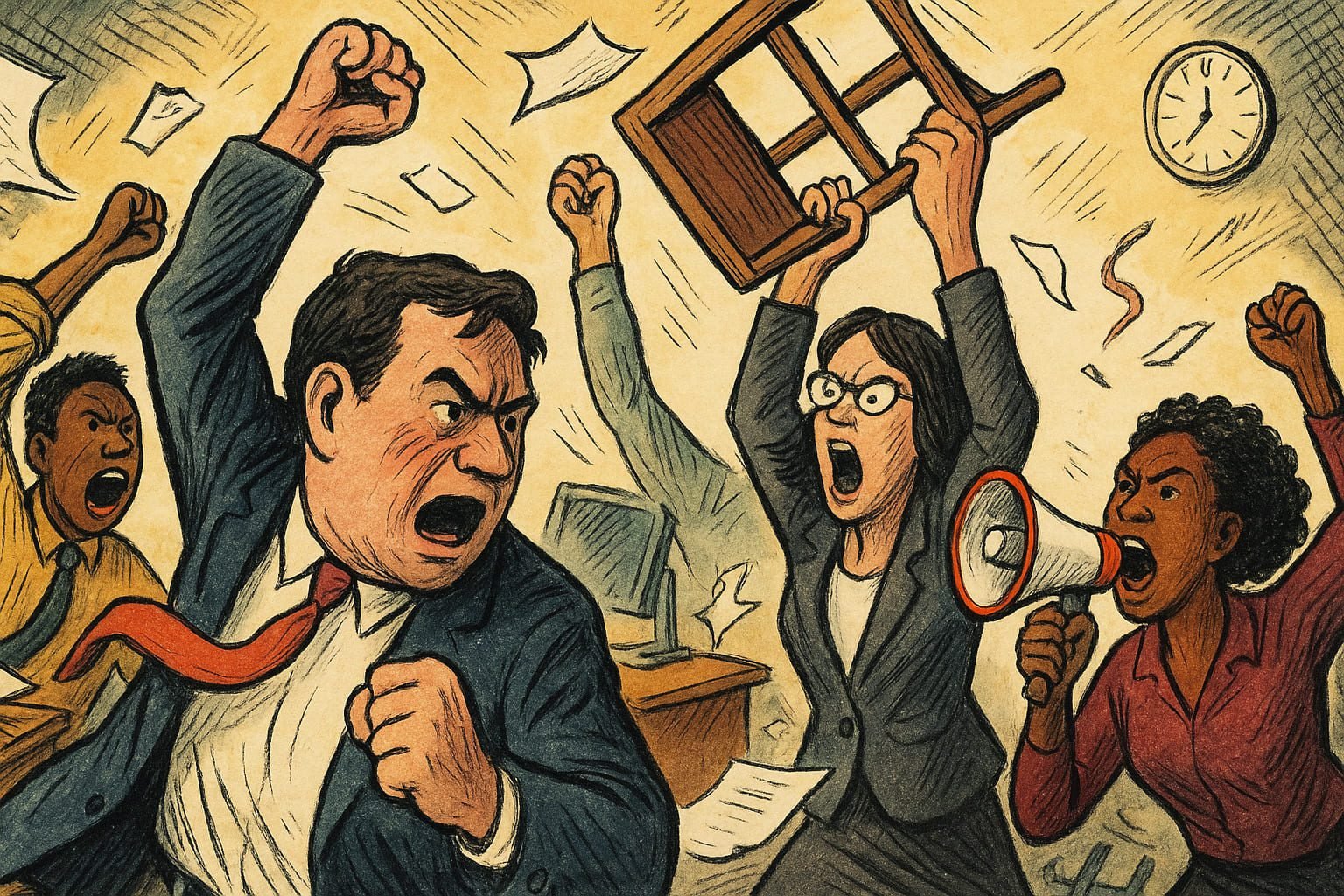
A conference room waits, holding its breath. Somewhere between the faint buzz of a ceiling light and the shuffling of anxious shoes, a thousand words remain unsaid. The air is thick with the tension of people who see too much, say too little, and mask their true thoughts behind practiced nods. Every wall bears witness to secrets that coil beneath the glossy surface of professionalism. Here, silence isn’t peace; it’s a fuse, lit and forgotten, waiting to reach the dynamite below.
Inside this hush, people look at screens but think about resignation letters, deadlines, and all the meetings that should have ended with real answers. A manager smiles, yet the corner of her mouth trembles, sensing that her team has drifted far from the candor they once shared. On Slack, emojis do the talking, but actual problems gather in shadow, ignored and breeding resentment like bacteria in the dark. In this office, people learn to avoid eye contact rather than risk the sharp sting of honesty.
Power isn’t always loud. Sometimes, it hums beneath the surface, invisible and unstoppable, breaking spirits and warping decisions without a single raised voice. In tech startups and hospital wards, government agencies and creative agencies alike, silence tightens its grip as employees hide their fears and leaders dodge discomfort. The real chaos never arrives with shouting or slammed doors; it comes when voices disappear, leaving the field wide open for the most dangerous form of dissent.
Across industries, silence is the most loyal saboteur. It lets toxic behaviors fester, blocks the flow of ideas, and hands control to those who play politics best. People wonder why innovation dries up, why motivation erodes, and why “team spirit” feels like an ancient myth. The answer is buried in the spaces between words, in the meetings where nobody dares to ask, “What’s really going on here?”
Everyone senses it: a quiet pressure pressing down on ambition, trust, and hope. The world tells us that keeping quiet is wise, that discretion keeps the peace, that those who speak up risk everything. Yet in boardrooms and on factory floors, history whispers another truth—silence is the architect of the greatest workplace catastrophes. This story isn’t about angry mobs or dramatic walkouts. It’s about what happens when silence wins, and chaos is the only thing left to fill the void.
Quick Notes
- Silence is not golden; it’s explosive: When nobody speaks up, trouble doesn’t disappear—it multiplies. Picture a team meeting where everyone pretends everything’s fine, only for a major project to crash because issues were swept under the rug.
- Quiet cultures breed hidden rebellions: When people feel unheard, resentment simmers. Companies like Theranos, once a Silicon Valley darling, spiraled into scandal because employees feared telling the truth.
- Fear kills feedback and trust: A manager at a high-growth fintech once learned too late that her top developer quit not for money, but because she was “done being invisible.” Even small acts of silence can spark massive turnover.
- Innovation suffocates without open voices: Google’s early 20 percent time rule, where anyone could pitch ideas, created breakthroughs. When that culture stiffened, innovation slowed. Teams thrive when wild ideas and warnings can be shared without fear.
- The real chaos comes disguised as calm: From Wall Street to Main Street, businesses crumble not from loud dissent but from silent compliance. The most powerful lesson: The more people hold back, the more chaos lurks just out of sight, ready to explode when you least expect it.
The High Cost of Hushed Voices
Silent offices look orderly on the surface, but beneath that quiet, costs pile up like unpaid invoices. Productivity tanks when problems are hidden instead of fixed, and errors become repeat offenders, allowed to run wild because nobody feels safe enough to name them. Leaders often mistake the absence of complaints for contentment, not realizing that most people have simply learned to keep their worries to themselves. The price? Missed deadlines, lost clients, and wasted potential—all paid in the currency of unspoken truth.
True stories echo this theme across industries. At a fast-growing logistics company, employees started leaving in waves after a poorly managed merger. An anonymous survey revealed the cause: people felt their feedback vanished into a black hole, never to be acknowledged, let alone acted upon. Management scrambled to recover, but the best talent was already gone, and the culture had curdled. This is no rare occurrence; it happens anywhere silence takes root and honesty gets traded for “playing it safe.”
The myth that quiet equals calm is both persistent and dangerous. In reality, forced silence creates a breeding ground for passive aggression and covert resistance. Consider the story of Karen, an HR specialist who watched her department’s best ideas wither because her boss “didn’t want to rock the boat.” Eventually, the team stopped offering solutions, choosing instead to let inefficiencies fester. By the time leadership noticed, it was too late to restore the lost sense of ownership and energy.
Unchecked silence robs organizations of their edge. Research from Gallup and Harvard Business Review highlights the direct connection between open communication and bottom-line performance. Yet, many organizations still rely on the outdated belief that discretion equals professionalism. Ironically, the most “professional” teams are often the ones quietly falling apart at the seams. Real productivity demands the oxygen of debate and the courage to say what everyone else is thinking.
Silence, then, isn’t neutral—it’s corrosive. The longer it lingers, the more it distorts reality, enabling toxic leaders and bad policies to survive unchecked. The silent treatment, when institutionalized, becomes the most effective form of sabotage a company can endure. When voices vanish, so does the possibility of real progress. The result is an expensive, avoidable mess—one that organizations pay for with lost innovation, shattered trust, and dwindling morale.
Hidden Rebellion: When People Stop Caring
Some uprisings arrive with banners and angry chants, but the most dangerous ones look like nothing at all. When employees stop caring, the silence is deafening. At first, it’s small: missed meetings, late emails, the slow withdrawal from projects that once sparked pride. Gradually, entire departments enter a kind of emotional hibernation, where nobody risks criticism and everyone acts like an extra in someone else’s movie.
One unforgettable case unfolded at a major insurance firm, where frontline staff faced a wave of layoffs. Instead of voicing outrage, employees responded with a chilling calm. Customer complaints were ignored, claims processed slowly, and mistakes went unreported. Productivity cratered, but there were no confrontations, no fights—only the steady drip of people opting out. The rebellion wasn’t loud, but it was total, and the company’s reputation suffered for years.
Psychologists call this phenomenon “organizational disengagement.” It’s the moment when people decide it’s safer to say nothing than to risk punishment or ridicule. In cultures where dissent is punished or ignored, silence becomes a shield—and, ironically, a weapon. The organization loses access to the very insights and warnings that could save it from disaster. The cost is hard to measure until the damage is already done.
Pop culture tells this story with razor-sharp accuracy. Think of the crew in “Office Space,” quietly plotting revenge with slow-motion sabotage, or the workers in “The Office” who survive corporate chaos by doing as little as possible. These fictional scenarios feel true because they are: every workplace has its silent rebels, quietly unplugging their energy and creativity as a last resort.
The deepest rebellion is invisible. When employees no longer trust their leaders to listen or act, they simply stop trying. The result isn’t a dramatic showdown but a slow-motion collapse. For every headline about a walkout, there are thousands of quiet exits, resignations in spirit if not in fact. The organization still stands, but the soul has already left the building.
Fear’s Grip: How Silence Blocks Progress
Fear thrives in the empty spaces where words should be. When employees worry that speaking up will cost them their job, their reputation, or their relationships, silence takes control. At a promising biotech startup, a junior scientist named Javier discovered a critical flaw in a new product. The room froze. No one wanted to challenge the company’s rising star CEO. Months later, the flaw became a scandal, costing millions. Fear had done what incompetence never could.
The cycle repeats across industries, from finance to manufacturing. In these places, fear becomes an unofficial policy. Employees measure every word, rehearse every sentence, and learn to avoid topics that might upset the wrong person. Even well-meaning leaders sometimes create this environment without realizing it. “You’re here to solve problems, not make them,” one director told his staff. The message was clear: silence was safer than honesty.
Progress depends on the messy, awkward process of surfacing bad news and unpopular truths. History is packed with examples of organizations that broke new ground by welcoming dissent. Pixar, for example, built its creative empire on the “braintrust” meetings where anyone, regardless of rank, could critique the work. Mistakes became lessons, not ammunition. In contrast, companies that punish candor end up blind to risk and unable to adapt when the world changes.
Courage, in this context, is a group effort. Leaders must invite criticism and reward those who highlight problems. Employees, in turn, need psychological safety to take those risks. Without both, innovation withers and groupthink thrives. The story of Nokia’s fall from mobile phone glory illustrates this perfectly. Engineers and designers knew their product was behind, but nobody dared challenge the narrative until the market forced the truth out into the open.
The cost of fear is measured in missed opportunities and avoidable disasters. Every time an employee swallows their warning, the organization steps closer to chaos. The tragedy is that it’s so easily preventable—if only people could trust that speaking up was worth the risk. Until that changes, the cycle of silence, stagnation, and eventual crisis will continue, one quiet office at a time.
Innovation’s Death by Silence
Innovation is noisy. Breakthroughs happen when people argue, question, and challenge the status quo. When silence takes over, creativity dies in its sleep. At a cutting-edge design firm, the founder, Melina Park, used to hold “failure parties” to celebrate bold ideas that didn’t pan out. Everyone shared what went wrong, and the atmosphere crackled with possibility. When a new CFO decided “mistakes are expensive,” the parties stopped. So did the stream of wild, winning concepts.
The story repeats itself in companies both big and small. Google’s early decision to let engineers spend a fifth of their time on passion projects produced Gmail and AdSense. When the culture shifted to prioritizing predictable success, the pipeline of blockbuster ideas slowed to a trickle. Even in creative industries, silence isn’t golden—it’s deadly. Teams that fear ridicule or rejection quickly become echo chambers, recycling safe ideas and burying the next breakthrough.
Innovation depends on candor. The best ideas are often half-baked, awkward, or even outlandish at first. If people feel their suggestions will be shot down, they keep their brilliance to themselves. At Netflix, leaders are trained to encourage dissent and to model vulnerability. One manager famously began a meeting by admitting her own blind spots, inviting the team to challenge her thinking. That single act flipped the script, leading to a surge in creative solutions and a culture of shared ownership.
Historical failures offer grim warnings. Blockbuster Video dismissed the rise of streaming because lower-level staff, who saw the threat coming, were too intimidated to speak up. Their silence didn’t just cost jobs; it erased an entire industry. In every field, the quietest teams are the ones left behind, while the loudest, most open groups drive change.
The lesson is simple but hard to practice: organizations must make noise if they want to move forward. This means rewarding the brave, listening to the weird, and celebrating the wildest failures alongside the wins. When silence rules, progress stalls. When voices rise, possibility is limitless.
The Anatomy of a Silent Collapse
Collapses rarely come as thunderclaps. Most unfold in eerie quiet, with warning signs ignored or explained away. At a renowned advertising agency, whispers of dissatisfaction grew as workloads ballooned and recognition shrank. Top talent stopped proposing campaigns, then stopped responding to emails, then stopped showing up altogether. The silence wasn’t peaceful—it was the sound of an empire crumbling from within.
Real stories bring this home. A project manager at a global consulting firm watched her team’s energy evaporate after a beloved leader was forced out without explanation. No one dared ask questions. Small mistakes snowballed into client disasters. In the end, the firm’s reputation unraveled not through scandal or controversy, but through the quiet attrition of people who once cared.
Silent collapses look neat on the outside. Stock prices hold steady, press releases sound optimistic, and executives talk about “transition” or “realignment.” Yet underneath, the culture is hollowed out. People stop believing their work matters. Initiatives fail for mysterious reasons. Eventually, even the best-laid plans fall apart, leaving leaders to wonder why everything fell apart without warning.
Philosophers have long warned about the danger of collective denial. When no one dares to challenge the group’s assumptions, disaster sneaks in through the back door. Ancient myths and modern history agree: it’s not the loudest threats that ruin us, but the ones we refuse to acknowledge. Silence is both symptom and cause, a signal that the bonds of trust and purpose have broken.
The anatomy of a silent collapse is always the same: issues hidden, feedback dismissed, innovation strangled, passion snuffed out. By the time chaos erupts, the real damage was done in the days and weeks of quiet, everyday neglect. Organizations ignore this lesson at their peril. When silence wins, chaos claims the crown.
The Sound of Shattered Certainty
An empty hallway glows under cold fluorescent lights. Coffee cups sit untouched on a windowsill, cooling in the stillness. Outside, rain smears the city skyline, a blur of ambition and regret. The meeting room, once alive with laughter and tension, now holds only the echo of unspoken dreams. The silence is total, as if the building itself is holding back tears.
A senior executive stands by the window, suit jacket draped over one shoulder, replaying a hundred conversations never had. The faces of colleagues flicker in memory—smiles strained, eyes averted, voices that trembled before vanishing. Across the street, another company begins its day, unaware that the next quiet collapse may have already begun.
The lesson lands with the force of revelation: chaos isn’t born of noise or conflict, but from the slow, suffocating weight of words left unsaid. The greatest revolutions begin not with shouting, but with the refusal to be silent any longer. Every moment of honesty is a rebellion against decay. Every hard truth spoken is a safeguard against the quiet end.
Somewhere, a door creaks open, breaking the hush. Maybe this time, someone will speak up. Maybe the real work begins with the courage to break the silence and face the storm together.
You’re holding the match. Will you light the fuse—or let silence decide your fate?
