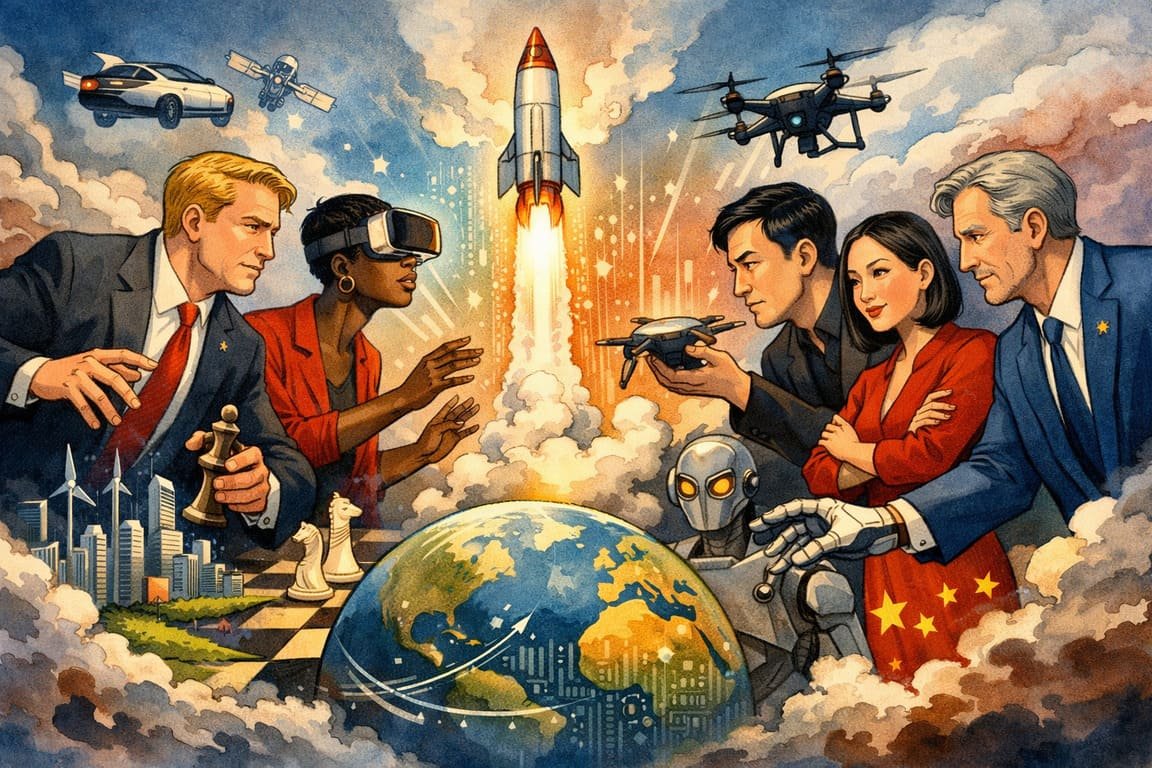
The room is silent except for the soft pulse of machines doing work no one watches anymore. Lights blink. Fans hum. Somewhere inside that infrastructure, influence shifts without ceremony. No speeches announce it. No borders move. The global tech showdown unfolds quietly, buried in code, supply chains, standards, and defaults. Power no longer needs spectacle. It prefers invisibility.
Technology has replaced territory as the most valuable strategic ground. Control over data, chips, networks, and platforms now shapes economic strength, military capability, and cultural reach. Governments understand this even when public debate lags behind. A single advance in artificial intelligence or semiconductor design can tilt advantage for years. The race feels urgent because the reward compounds. Once dominance sets in, catching up becomes brutally difficult.
What makes this contest dangerous is how ordinary it looks. The battlefield hides inside convenience. Smartphones. Cloud storage. Navigation apps. Digital payments. These tools feel neutral, almost friendly. Yet each carries dependency. Standards decide compatibility. Supply chains decide vulnerability. When access tightens, entire industries wobble. The tech showdown stays quiet until something breaks, then everyone notices at once.
States approach this struggle with sharply different philosophies. Some marshal resources toward national champions, coordinating research, manufacturing, and policy tightly. Others trust private enterprise, assuming innovation thrives best without direction. Each path carries cost. Centralization accelerates focus but risks stagnation. Market freedom sparks creativity but invites fragmentation. No model guarantees leadership. Each merely shapes how failure arrives.
Semiconductors reveal the stakes most clearly. These tiny components power everything from household appliances to advanced weapons. Producing them demands precision, trust, and stability across borders. Disruption ripples outward instantly. When access narrows, alliances strain. Governments scramble to secure supply, realizing how concentrated production became while efficiency ruled unchecked. Dependency exposes fragility.
Data deepens the imbalance. Whoever governs data flows governs intelligence. Privacy laws, surveillance norms, and platform rules differ widely, reflecting values but also strategy. Data feeds algorithms. Algorithms shape behavior. Influence now travels through recommendation engines as effectively as diplomacy once did. Power persuades without appearing to persuade.
Culture becomes collateral damage. Platforms amplify some voices while muting others. Content moderation reflects political pressure as much as principle. A social network’s design can ignite protests or dissolve them. Tech firms claim neutrality, yet neutrality collapses at scale. Every design choice nudges attention, emotion, and belief.
Private companies sit uncomfortably at the center of this transformation. They wield influence once reserved for states while lacking democratic mandate. Executives make decisions affecting millions across borders. Governments alternate between courting them and restraining them. Regulation trails innovation because innovation is designed to outrun it. Power accumulates faster than accountability.
There is also a psychological dimension that rarely gets discussed. Technological leadership breeds confidence. Nations that lead feel future ready. Those that lag feel exposed. This perception influences education, migration, and investment. Talent follows momentum. Momentum reinforces itself. The tech race feeds on belief as much as capability.
Ethics complicate victory. Artificial intelligence raises questions about bias, autonomy, and labor. Surveillance promises safety while threatening freedom. Winning the tech showdown without losing legitimacy becomes the harder challenge. Power secured without trust corrodes from within. History has punished every empire that ignored this lesson, regardless of its tools.
Smaller nations maneuver creatively. Some specialize deeply. Others align strategically. A few carve niches by setting standards or mediating flows. Influence no longer requires size alone. It requires relevance. Technology allows leapfrogging, but it also deepens divides for those locked out early.
The obsession with who wins misses the deeper truth. This contest does not end cleanly. Power diffuses, fragments, recombines. Today’s leader can stumble tomorrow. Systems grow complex. Interdependence tightens. Total dominance becomes harder to sustain, even for the strongest players.
Somewhere, code deploys quietly, a decision encoded without debate, a default set that millions will accept without noticing. The tech showdown will not end with a flag raised or a treaty signed. It will end with societies realizing that participation mattered as much as leadership, and that the most consequential battles were fought silently, while attention drifted elsewhere.
