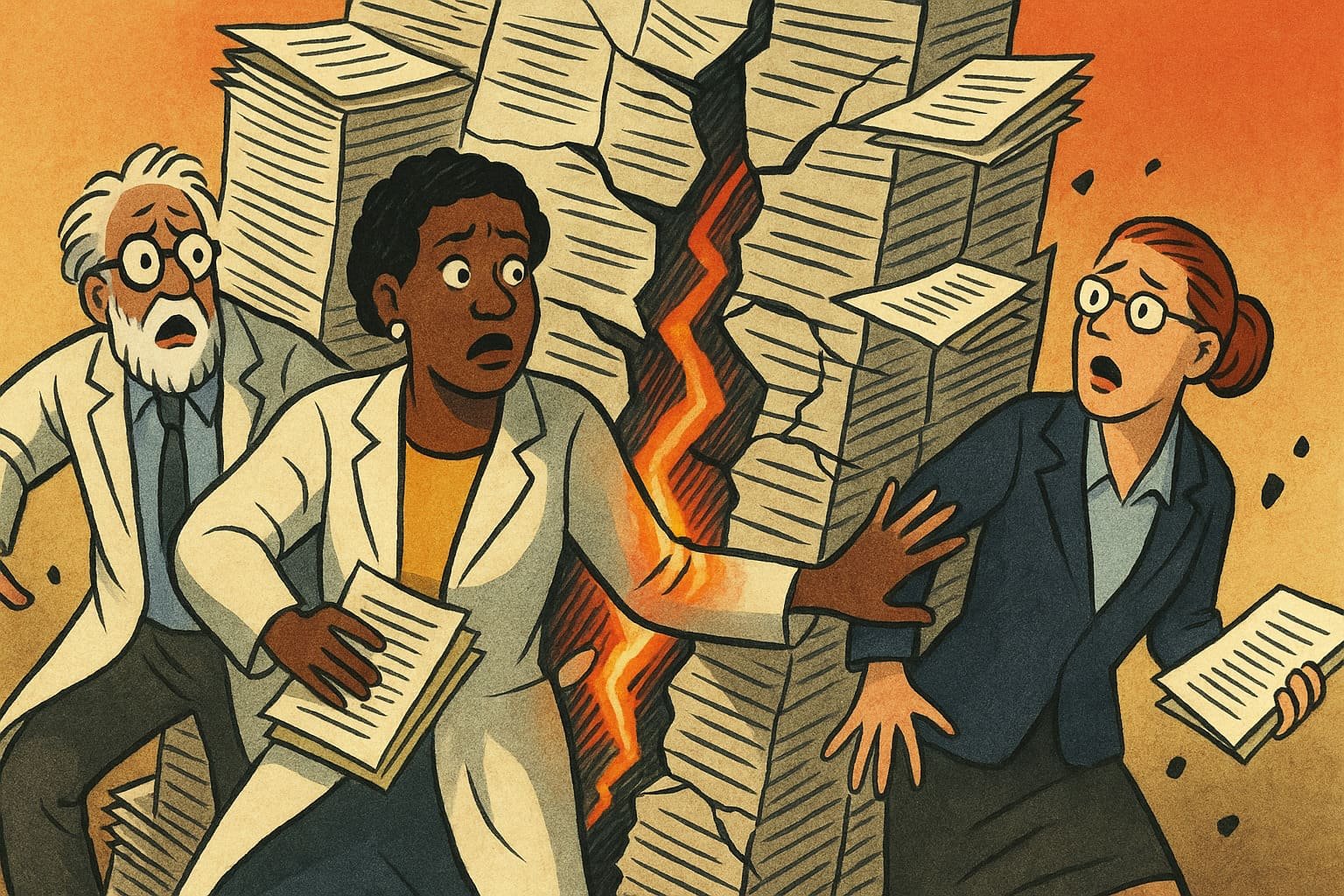
Under sterile fluorescent lights, a crowd gathers in the vast marble atrium of the world’s most respected research institute. Tension slices the air as a celebrated scientist quietly tears open an envelope revealing the verdict on her decade-long study. Cameras flash, faces freeze, the room’s anticipation crackling like static before a thunderstorm. Peer review once stood here as the unshakeable altar of truth, its rituals guarding the world against error, hype, and fraud. But lately, whispers wind through these corridors: flawed papers racing past tired reviewers, journal editors cornered by profit, researchers chased by a wolfpack of deadlines and digital outrage. It’s not just a handful of bad actors or the occasional retraction fueling the anxiety—this feels like a slow-motion avalanche, the sacred pillars trembling as each stone of scrutiny loosens. In this uneasy pause before applause or disappointment, a single question hangs: can the guardians of evidence still defend the walls, or are we all quietly witnessing the collapse of trust in knowledge itself?
Below the surface, stories swirl. A young data analyst in Boston scrolls her phone, noticing a famous cancer trial’s retraction buried beneath news of viral celebrity gossip. At a crowded café in Nairobi, a startup founder vents about academic gatekeepers rubber-stamping articles while real innovation withers in waiting. High above, inside the glossy boardrooms of global journals, old-school editors debate policy while anonymous reviewers sneak glances at their own unread piles. This is not science fiction—it is the unsettling new normal, a paradoxical era where we are drowning in research yet thirstier than ever for genuine insight.
This is a world that reveres science but worships speed, where the badge of “peer-reviewed” feels at once holy and, at times, hollow. In this surreal stage, every discovery teeters between fame and farce. The collapse is not a dramatic explosion, but a million silent cracks—each one a shortcut, a conflict of interest, a missed error, or a reviewer asleep at the wheel. What happens when the guardians nod off and the ghosts of unchecked claims begin to dance across the pages that shape the future?
This is the setting for a modern reckoning, where truth itself is put on trial—not by a jury of peers, but by a world that wonders if peer review can still deliver what it promises. Step into the fray, and watch the spectacle unfold, where data, ambition, and human fallibility clash beneath a dome of flickering hope. This is not just a crisis for scientists or scholars. This is the frontline in the battle for trust, meaning, and the soul of knowledge itself.
Quick Notes
- Cracks in the Armor: Peer review, once hailed as science’s firewall, now sags under profit pressure, reviewer fatigue, and a deluge of questionable research, exposing the world to more errors, retractions, and scandals.
- Trust on Life Support: When journals fast-track studies for fame, researchers cut corners to survive, and overworked reviewers skim or skip details, ordinary people pay the price—think medical myths, data disasters, and lost faith in expertise.
- Gatekeepers or Rubber Stamps?: Once feared, peer reviewers now work for free, racing through endless submissions, sometimes missing fraud, plagiarism, or honest mistakes, letting dangerous ideas slip through the cracks and into the mainstream.
- Behind the Scenes: Power struggles, publisher profit motives, and the lure of citation counts tilt the system. Startups like Retraction Watch and whistleblowers expose a “Wild West” of predatory journals and fake peer reviews, raising the question: Who’s really checking the checkers?
- Your Role in the Drama: You are not just a spectator. Whether you’re a business leader, student, or casual reader, your skepticism, choices, and hunger for the truth shape the future of knowledge. The collapse is not inevitable—unless you look away.
The Hollow Crown—How Peer Review Lost Its Magic
Peer review was once the shining crown on the head of science, the ultimate mark of credibility. Today, its luster fades under a storm of controversy, with once-revered journals forced to apologize for papers that should never have passed scrutiny. Tales abound of major breakthroughs that crumble under replication, embarrassing the gatekeepers who approved them. The relentless drive for publication turns scholars into paper-churning machines, more concerned with hitting quotas than chasing the truth. Every week brings new headlines about retractions, prompting many to ask: has peer review become an empty ritual, or can it still separate real insight from the sea of noise?
Imagine Dr. Arjun Patel, a sleep-deprived neurologist in London, sifting through reviews riddled with vague suggestions and copy-pasted comments. He once believed that peer review would elevate his work, but too often it feels like a box-ticking exercise, a thin veil barely hiding the biases of reviewers too busy, too petty, or too uninterested. Sometimes the feedback contradicts itself, leaving him wondering whether science is truly advancing or just running in circles. When the retraction of a high-profile Alzheimer’s study rocks the headlines, Dr. Patel’s faith in the system cracks a little more, leaving him to ponder whether his years of dedication matter in a world obsessed with citation counts and metrics.
Case studies from companies like Theranos haunt the business world, showing how unchecked hype and rubber-stamped research can cost billions and endanger lives. Investors and executives now second-guess the legitimacy of “peer-reviewed” claims, knowing that prestigious journals sometimes let flashy findings override careful skepticism. In the tech sector, leaders like Elon Musk have voiced doubts about slow, archaic systems, urging a new era of transparency and real-time critique. Yet, as the traditional model stumbles, few viable replacements emerge, trapping innovation in a maze of conflicting priorities.
A sharp look at predatory journals reveals a parallel universe where anyone can publish anything, often for a fee, no questions asked. In this wild ecosystem, imitation mimics authority, muddying the waters for everyone from curious undergraduates to boardroom decision-makers. The explosion of open-access publishing brings more voices to the table but also more noise, forcing readers to navigate an information jungle where even the most outlandish claims can masquerade as vetted science.
Despite these challenges, a handful of courageous editors and reviewers still fight for rigor, transparency, and honest debate. Their names rarely make headlines, but their quiet resistance holds the line against total collapse. As institutions grapple with reforms—double-blind review, data sharing, open commentary—the question remains: can incremental fixes rebuild a system sagging under the weight of its own contradictions? Or are we witnessing the last gasp of a once-glorious tradition?
Trust Deficit—When Science’s Bedrock Begins to Crumble
Every society needs a foundation to stand on, and for centuries, peer review has served as the bedrock beneath modern knowledge. When cracks appear in this foundation, the tremors ripple far beyond university walls, shaking confidence in everything from medicine to policy, finance to tech. The dangers aren’t just theoretical; they hit home when flawed studies change treatment guidelines, disrupt markets, or drive public debate off a cliff. In a world saturated with “alternative facts,” trust in expertise is no longer a luxury—it’s the currency of survival.
Dr. Priya Nair, a pediatrician in Mumbai, remembers the confusion that swept her clinic when a widely cited vaccine study was revealed as fraudulent. Parents hesitated, rumors swirled, and childhood diseases surged. The fallout was not just scientific—it was human, a cascading loss of confidence that threatened lives and futures. The collapse of trust is not a distant abstraction but a daily reality, played out in headlines, hospital wards, and family dining rooms.
At the heart of the trust crisis lies a paradox: the world has never needed good science more, yet never doubted it so deeply. Public debates rage over climate, nutrition, and emerging technologies, each side wielding research like weapons. When peer review fails, the casualties are real—misdiagnosed patients, misguided policy, wasted investments, and a growing sense of cynicism. Every shortcut, every overlooked error, every whisper of bias erodes the fragile bridge between experts and the people who depend on them.
Powerful voices, from Bill Gates to Angela Merkel, have called for a revival of rigorous, transparent science as a public good. But reform remains elusive, often stymied by commercial interests, inertia, and the sheer volume of new research. Meanwhile, bad actors exploit the confusion, pushing pseudoscience into mainstream media, social feeds, and even policy. The consequences are not just individual but collective, shaking the scaffolding that holds modern life together.
If peer review once stood as a shield, today it feels like a patched-up umbrella in a hailstorm of misinformation. And yet, in the eye of the storm, moments of heroism still shine. Whistleblowers risk careers to call out fraud, teams of citizen scientists cross-check data, and communities rally for evidence-based solutions. These sparks hint at a path forward—but only if society chooses vigilance over comfort, skepticism over blind faith.
Behind the Curtain—The Hidden Forces Warping Review
Few outsiders glimpse the true drama behind closed doors, where papers are judged and verdicts delivered. Peer review is not a perfect machine but a chaotic theater of egos, incentives, and unseen pressures. Reviewers are unpaid, often anonymous, juggling workloads that would break most professionals. Fatigue and burnout are common, opening doors for mistakes, bias, or—worse—willful neglect.
Stories circulate of a Nobel Prize contender, Dr. Liang Chen, whose work languished for years under jealous rivals. Meanwhile, a celebrity influencer published a viral, error-riddled study after a friend “fast-tracked” it through an editorial backchannel. Real-life dramas like these make headlines but barely hint at the day-to-day dysfunction. Behind the scenes, reviewers fret over retaliation, conflicts of interest, and professional alliances, sometimes letting personal motives cloud judgment.
Technology, once seen as the solution, brings its own complications. Automated review platforms promise speed, but sometimes flag genuine breakthroughs as “outliers,” stifling bold thinking in favor of safe consensus. Open review, touted for its transparency, can devolve into public shaming or popularity contests. The dream of a perfect system—a level playing field for ideas—collides with the messy, human realities of fatigue, politics, and ambition.
The proliferation of journals, fueled by profit motives and academic “publish or perish” culture, adds further strain. Reviewers drown in requests, tempted to skim, rubber-stamp, or simply decline to participate. Editors struggle to find experts willing to read yet another dense manuscript, sometimes resorting to underqualified stand-ins. As the volume of research explodes, the line between careful curation and chaotic churn blurs.
Yet for every horror story, there are tales of redemption—an underdog paper rescued by a thoughtful reviewer, a team that caught a critical error before publication, a global collaboration that rebuilt trust after a scandal. These moments, though rare, show the power of community and shared mission. They remind us that behind every process are people, flawed but striving, sometimes failing but often fighting for truth.
Gatekeepers on Trial—The Human Cost of Failure
When peer review stumbles, the effects cascade outward, hitting not just scientists but everyone who relies on research to guide decisions. Students, business leaders, investors, and policy makers all depend on the stamp of approval that peer review confers. As that stamp loses its authority, confusion and cynicism take root, replacing confidence with anxiety.
A finance executive in New York, Emily Jackson, recalls the day her team invested in a biotech startup backed by a “landmark” study. Months later, the research unraveled under fresh scrutiny, and millions vanished almost overnight. The loss wasn’t just financial—it was a blow to her team’s belief in expertise, a lesson in humility that still stings years later. Across industries, similar stories echo: bad data leading to failed products, wasted resources, or misguided strategy.
The human cost is not just about dollars or prestige. When educators teach from flawed studies, students inherit confusion. When public health officials base policies on weak evidence, entire populations suffer. The ripple effect is enormous, reaching from boardrooms to classrooms, hospital wards to kitchen tables.
Predatory journals and fake peer reviews make matters worse, eroding trust and muddying the marketplace of ideas. Scammers have found gold in confusion, luring unsuspecting authors and readers into a hall of mirrors where nothing is quite as it seems. Tech companies, once eager to harness new research, now invest heavily in internal review, second-guessing what used to be a gold standard. The cost is measured in delays, doubt, and, sometimes, despair.
Yet the crisis also creates an opportunity. A new wave of reformers pushes for radical transparency, open data, and collaborative review, seeking to rebuild faith in the process. They embrace failure as a teacher, not a disgrace, and invite diverse voices into the conversation. The hope is that, by facing the flaws head-on, the system can emerge stronger, wiser, and more human.
The Road Ahead—Rebuilding a Shattered Mirror
With each headline about scandal or retraction, the case for change grows more urgent. The future of peer review hangs in the balance, caught between nostalgia for lost rigor and hope for innovation. The question is not whether the system will change, but how, and who will lead the charge.
Some journals experiment with open review, inviting readers to comment and critique in real time. Others launch mentorship programs for young reviewers, teaching not just technical skills but the ethics of honest criticism. Tech startups offer blockchain-based review trails, making every step transparent and tamper-proof. Grassroots networks, like the Open Science Movement, rally scientists and citizens alike to demand better standards and greater accountability.
Change is never easy, and resistance abounds. Traditionalists cling to secrecy, fearing a loss of control. Innovators battle for funding and legitimacy. The struggle is fierce, with egos, reputations, and even livelihoods at stake. But slowly, the pendulum shifts, as more voices call for openness, fairness, and humility in the face of complexity.
What emerges is a new kind of peer review—messy, imperfect, but alive with possibility. The next generation of researchers, scarred by past failures, vows not to repeat them. Reviewers see themselves as stewards, not just gatekeepers. Editors listen more closely, mindful that every decision shapes the fate of ideas and the faith of a world hungry for truth.
The real test will come not from rules or technology, but from culture. Can the guardians of knowledge cultivate honesty, courage, and empathy, or will old habits drag the system down again? The answer depends on everyone with a stake in truth—from the seasoned scholar to the curious reader, the cautious investor to the hopeful patient.
When Guardians Sleep, Shadows Feast
A cold rain beats against the windows of a lecture hall where the next generation gathers, hungry for answers, wary of illusion. The stage is empty now, but traces of heated debate linger in the air. An old professor runs a trembling finger across the spine of a battered journal, its gold letters faded from countless hands. Students’ eyes dart between hope and doubt, measuring the silence between questions.
Somewhere, a reviewer’s coffee grows cold at midnight, the pale glow of a laptop screen reflecting lines of uncertain prose. A lone editor rubs tired eyes, wrestling with another wave of claims demanding to be heard. Across the world, ideas flicker and fade, their fate decided in unseen battles fought not just with intellect, but with conviction and conscience.
The system endures not through perfection, but because imperfect people refuse to give up on it. As long as someone, somewhere, insists on asking the hard questions, the search for truth will stumble forward, battered but unbroken. It is not the rituals or titles that matter, but the stubborn, messy courage to challenge, to doubt, and to demand more.
The end of certainty is not the end of wonder. Only you can decide which stories shape the future—and which lies slip by, unchallenged.
