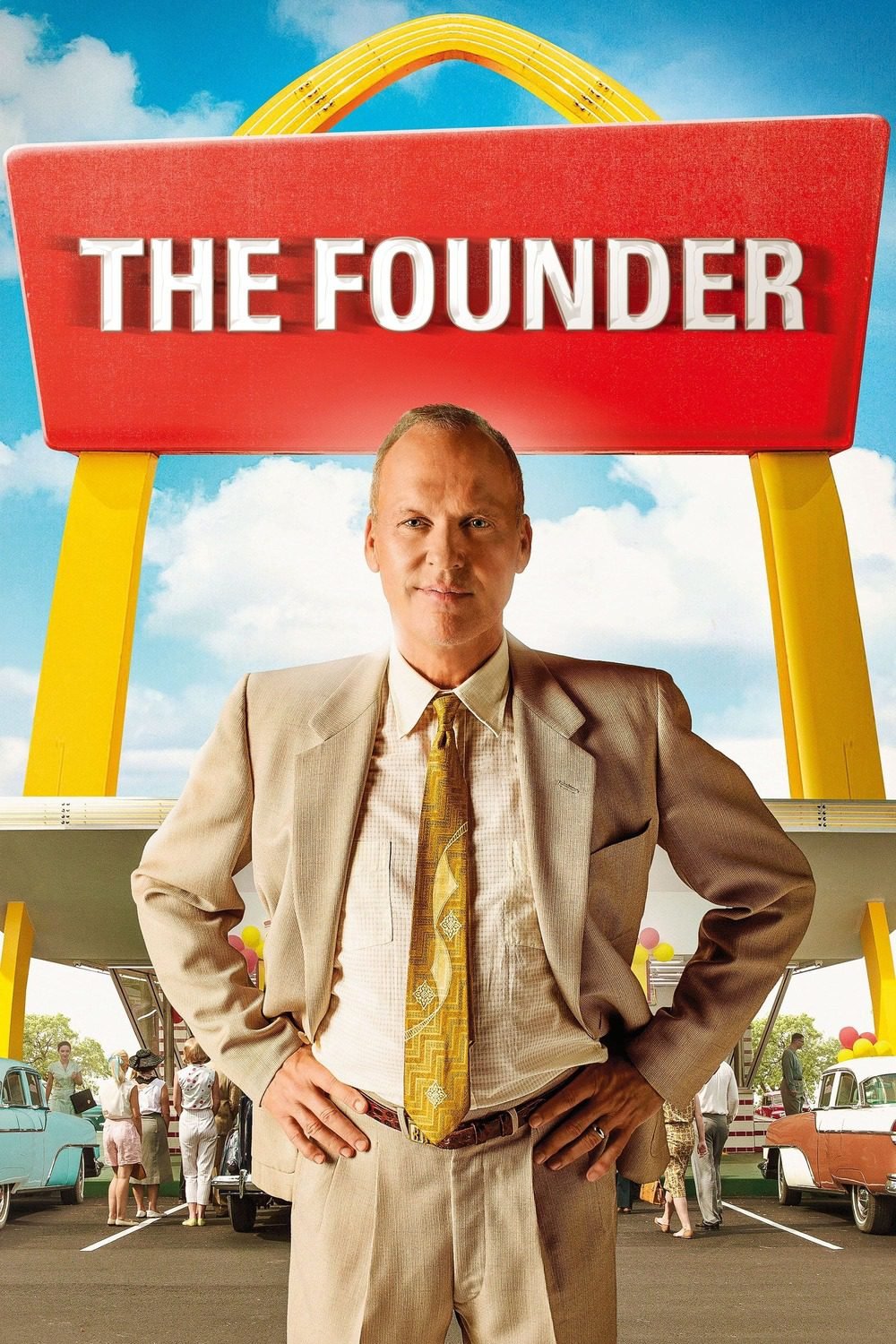
There’s a strange irony in watching The Founder while munching on McDonald’s. The salt on your fingertips tastes a little sharper, the fries suddenly crunch with a sense of betrayal. What begins as a tale of humble beginnings in a 1950s roadside kitchen quickly transforms into one of the most fascinating and unsettling business takeovers in American history. This film doesn’t just tell you how McDonald’s came to dominate the world; it questions what it cost. It’s the kind of movie that sticks to your conscience longer than ketchup on a white shirt.
Ray Kroc, played with calculated charm by Michael Keaton, is not your typical rags-to-riches hero. He’s a traveling milkshake machine salesman in his fifties with a worn-out car and bigger dreams than his bank account can handle. But when he stumbles upon a small yet hyper-efficient burger joint in San Bernardino, California, he sees more than just a meal; he sees a franchise empire just waiting to explode. His hunger isn’t for fast food; it’s for immortality. And it’s a hunger that won’t take “no” for an answer.
This isn’t just a story about burgers and branding. The Founder is a sharp-edged dissection of ambition, ethics, and the blood sport of American capitalism. It’s a masterclass in negotiation, manipulation, and the darker side of entrepreneurial grit. Watching it feels like a behind-the-scenes tour of a brand’s soul; if that soul were sold at a discount and shrink-wrapped in plastic. The film doesn’t lionize Kroc, but it doesn’t quite villainize him either. It just lays out the facts and lets us stew in our moral discomfort.
That’s where the brilliance of The Founder lies. It never tells you what to think. It seduces you with the success story, then yanks the rug out with a quiet “but at what cost?” It asks whether greatness requires betrayal, whether legacy is worth the lives it flattens along the way. And it does this with a crisp script, razor-sharp pacing, and a chillingly magnetic lead performance.
So why should you watch The Founder? Because it’s not just about how McDonald’s became a fast-food juggernaut. It’s about how America built its dreams one handshake, one contract, and one backstab at a time. You’ll walk away entertained, enraged, and maybe, just maybe, rethinking your next drive-thru order.
Quick Notes
- Michael Keaton’s performance is magnetic, painting Ray Kroc as a complex figure; part underdog, part corporate shark; that keeps you guessing until the credits roll.
- The McDonald brothers built a revolution, crafting a “Speedee System” that redefined food service, only to watch it slip from their grasp into the hands of a more aggressive visionary.
- The film quietly critiques the American Dream, showing how ambition can morph into exploitation when morality becomes negotiable in the pursuit of success.
- Sharp direction and tight pacing make business drama feel cinematic, transforming boardroom betrayals and franchise fights into high-stakes psychological warfare.
- It’s a cautionary tale disguised as a business lesson, reminding viewers that not all growth is good, and not all founders finish first.
From Milkshake Salesman to Empire Builder
Ray Kroc, a struggling salesman armed with little more than grit and a suitcase full of milkshake mixers, stumbles into a life-altering opportunity when he encounters a bustling burger joint in Southern California. Run by Mac and Dick McDonald, the restaurant is a marvel of efficiency and simplicity. The brothers have created a streamlined kitchen they call the “Speedee System,” a symphony of synchronized movement that churns out quality food at record speed. To Ray, it’s not just a restaurant; it’s a revolution waiting to be franchised across America. His eyes light up, not from the taste of the burgers, but from the potential to sell that experience to the masses.
Despite initial hesitation, the McDonald brothers agree to partner with Ray and allow him to franchise their concept. Their core concern? Maintaining the quality and values that define their brand. They make him sign a strict contract to preserve the McDonald’s name and operations. But Ray, ever the cunning visionary, finds their rigid idealism suffocating. While they’re focused on preserving integrity, he’s dreaming about scale, leverage, and capital. He wants McDonald’s not to be a burger joint, but a symbol; bigger than Coca-Cola, louder than Ford.
As the franchise locations multiply, Ray’s vision starts to eclipse the brothers’ control. He brings in a new cast of players who share his hunger for expansion. A key turning point comes when he realizes the real goldmine isn’t in the burgers; it’s in the real estate. By creating the Franchise Realty Corporation, Ray gains control of the land on which each McDonald’s sits, allowing him to wield unchecked power over franchisees and sidestep the brothers’ authority.
This financial pivot gives Ray leverage, and from there, the takeover is swift and brutal. He rebrands himself as the “founder” of McDonald’s, pushing the original visionaries into the background. In a series of increasingly aggressive moves, he rewrites contracts, manipulates language, and ultimately buys out the McDonald brothers for a paltry sum; with a handshake deal that he never honors. It’s a cold, calculated move, and one that permanently rewrites the story of who gets to be called a “founder.”
By the end, Ray stands alone, a titan in a tailored suit rehearsing speeches about persistence and patriotism while sipping a milkshake with chilling calm. The film closes not with fanfare but with quiet devastation. The McDonald brothers’ name is stripped from their own restaurant. Their story becomes a footnote in the empire they created. And Ray Kroc becomes a household name not because he invented McDonald’s, but because he was ruthless enough to take it.
Key Lessons and Insights to Learn from the Movie
Success is rarely about who starts the race; it’s about who finishes it with control. Ray Kroc didn’t invent the McDonald’s system, but he understood something far more powerful than burgers: ownership. The film drives home the importance of leverage; how controlling land and assets, rather than just ideas, can flip the balance of power. It’s a stark reminder that innovation can be bought, but infrastructure is where the real empires are built. Many entrepreneurs today still overlook this crucial distinction, chasing creative sparks while ignoring the foundation that sustains them.
The movie also raises a deeply uncomfortable truth about visionaries and values. The McDonald brothers prioritized consistency, quality, and customer experience. They wanted their name to mean something more than just profit. Ray, on the other hand, was laser-focused on scale and dominance. This clash of ideology reveals a brutal reality: in business, idealism often loses to ambition. Watching The Founder forces viewers to confront the question; can you win in business without compromising your values? And if you can’t, is winning even worth it?
Another powerful insight emerges from Ray’s transformation. He begins as a likable underdog, hustling from diner to diner with optimism and charm. But as his power grows, so does his detachment. The Ray Kroc at the end of the film is not the same man who begged for a chance at the beginning. The lesson? Success changes people and often not for the better. It’s a cautionary tale about how unchecked ambition and ego can warp intentions and relationships beyond recognition.
The film also underscores the dangers of handshake deals and misplaced trust. The McDonald brothers operated on honor, believing a man’s word meant something. Ray exploited that belief to devastating effect. In today’s hyper-legalized world, the idea of trusting someone without a signed document may sound naive. But The Founder shows how easy it is for trust to be weaponized. It’s not just a story about betrayal; it’s a masterclass in the consequences of failing to protect your interests legally and strategically.
The Founder offers a sobering meditation on legacy. Ray Kroc may have built a global brand, but at what personal cost? His relationships crumbled. His ethics frayed. He claimed the title of “founder,” yet he spent the rest of his life defending it. The movie doesn’t offer a clean moral because real-life business rarely does. Instead, it challenges viewers to redefine what success looks like and whether legacy should be measured by how loudly your name is remembered, or how honestly you lived your truth.
Capitalism Served Cold and Calculated
Watching The Founder is like biting into a perfectly wrapped burger only to discover it’s filled with something far more bitter than beef. It seduces you with the shiny promise of entrepreneurial triumph but leaves a lingering taste of disillusionment. This isn’t your feel-good rise-to-the-top Hollywood fantasy; it’s a surgical, unflinching look at how ambition, when weaponized, can upend morality and rewrite history. By the end of the film, the question isn’t whether Ray Kroc succeeded. It’s whether he deserved to.
Michael Keaton’s performance turns this story from documentary fodder into a psychological deep dive. He captures the duality of a man who could inspire loyalty with a smile while orchestrating betrayal with a pen. It’s a portrayal that feels eerily relevant in today’s world of corporate power grabs and founder feuds. You see shades of Kroc in tech CEOs, political strategists, and billionaire disruptors; charming on the surface, cunning underneath. The performance lingers, not just in memory, but in the way you’ll view every next “rags to riches” story you hear.
What makes The Founder so compelling is its refusal to pick sides. It doesn’t vilify Kroc outright, nor does it paint the McDonald brothers as infallible saints. It recognizes that business is messy, people are flawed, and success often involves stepping over others. The moral ambiguity is what elevates the film from biography to parable. It forces reflection, discomfort, and perhaps most painfully recognition. Who hasn’t compromised something to chase a bigger dream?
In a real-world twist of irony, many viewers will walk into a McDonald’s long after watching this film. They’ll order their food under golden arches built on fractured partnerships and bulldozed values. Yet the experience is seamless, comforting, familiar. That’s the genius of Ray Kroc’s legacy; it hides the chaos behind pristine countertops and cheerful jingles. The film doesn’t demand boycotts; it demands awareness. It challenges the audience to see beyond the brand and into the boardroom where it all began.
The Founder isn’t about who was right or wrong. It’s about what happens when vision meets opportunity and ethics get squeezed out in the middle. It’s a fast-paced history lesson, a slow-burn tragedy, and a mirror held up to modern ambition. Whether you’re a startup dreamer or a seasoned executive, the film offers something urgent and haunting: a cautionary blueprint of how easy it is to confuse domination for greatness. And once you’ve seen it, you can’t unsee the price of every “Value Meal” you’ll ever order again.
Disclaimer
It’s also critical to remember that whether the Movie is either a work of fiction or a real-life depiction, it must be emphasized that the actions depicted within are not encouraged in reality and shouldn’t be imitated. The review aims to analyze the storytelling, characters, and business decisions portrayed in the Movie solely for educational and entertainment purposes. Any ethical & unethical practices highlighted in the Movie are not endorsed by the Esyrite publication.
Why scroll… When you can rocket into Adventure?
Ready to ditch the boring side of Life? Blast off with ESYRITE, a Premier Management Journal & Professional Services Haus—where every click is an adventure and every experience is enchanting. The ESYRITE Journal fuels your curiosity to another dimension. Need life upgrades? ESYRITE Services are basically superpowers in disguise. Crave epic sagas? ESYRITE Stories are so wild, your grandkids will meme them. Want star power? ESYRITE Promoted turns your brand cosmic among the stars. Tired of surface-level noise? ESYRITE Insights delivers mind-bending ideas, and galactic-level clarity straight to your inbox. Cruise the galaxy with the ESYRITE Store —a treasure chest for interstellar dreamers. Join now and let curiosity guide your course.
