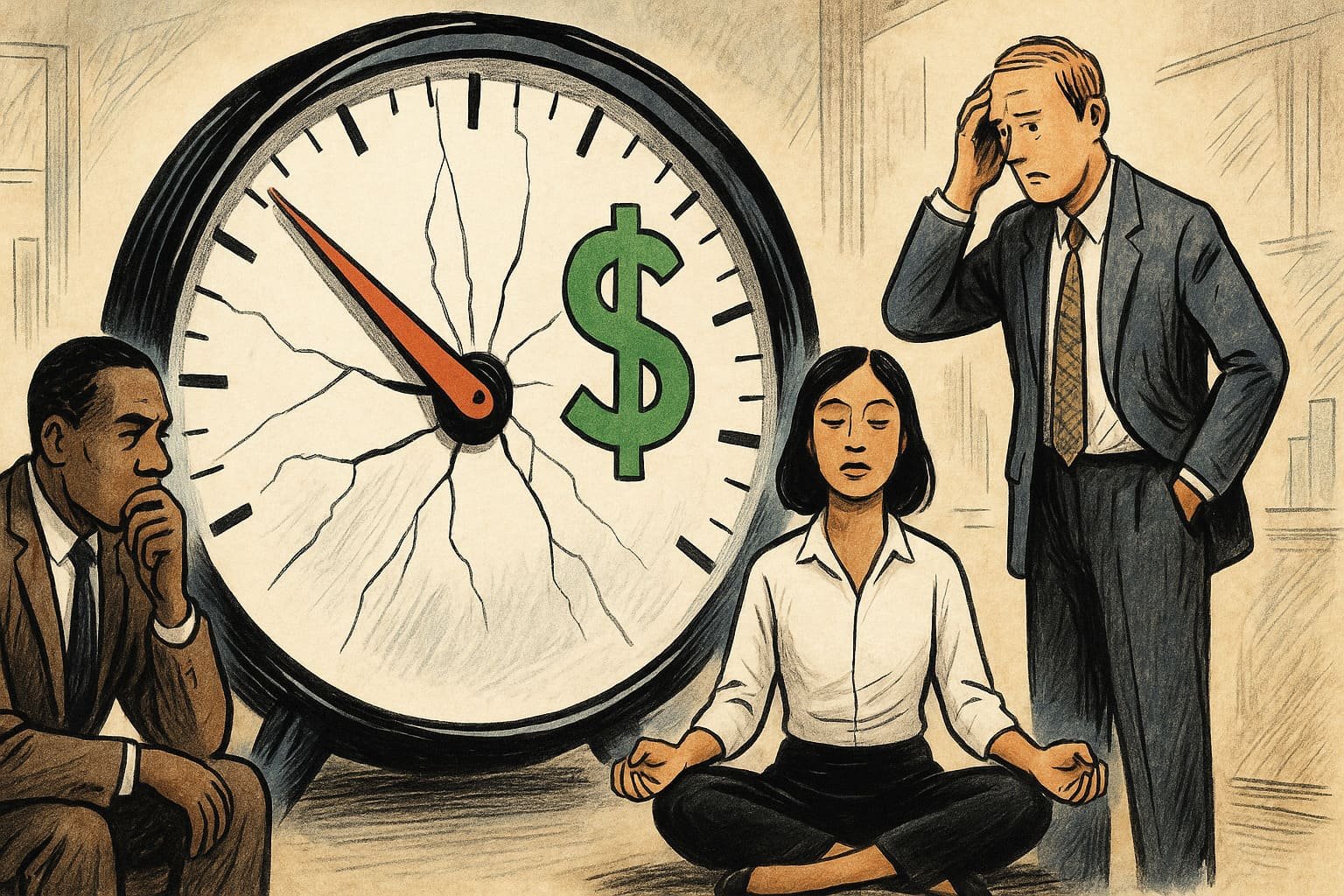
Lights up. Picture a meeting room glowing with screens, every forehead creased, every heartbeat synced to the relentless tick of a digital clock. The aroma of burnt coffee competes with the blue glare from a hundred devices. Everyone’s talking about how to “move faster” yet something feels off, like a jazz band missing its rhythm. There’s a kind of invisible chaos humming under the surface, the same way a city feels tense before a storm breaks.
Now picture a leader in that room who, with the nerve of a Netflix antihero, calls for a full stop. Phones down. Laptops closed. Breaths taken. It’s not a meditation retreat, but a deliberate act of rebellion: a standstill in a world that worships velocity. The air thickens, a nervous energy crackles, and eyes dart around as if someone just pulled the plug on the Matrix. Here, stillness is not a lack of action; it’s the loudest disruption the team has ever heard.
There’s irony in how the gospel of business preaches hustle, speed, and acceleration, but rarely whispers about the power of intentional pause. The myth says only those who run win, but history has a nasty habit of rooting for the tortoise over the hare. Netflix didn’t binge its way to dominance by copying Blockbuster’s frantic release schedule. Patagonia’s most profitable campaign started with a blunt “Don’t Buy This Jacket” headline an act of corporate stillness that shattered records.
Momentum, as any Formula One driver will admit, is a double-edged sword. Drive too fast and every bump becomes a threat. Too slow and you stall. The sweet spot? It’s the quiet in-betweens, the moments of intentional friction, when teams pull back, re-examine, and decide to drive with purpose rather than panic. Stillness isn’t the enemy of profit; it’s the double agent hiding in plain sight.
Look beneath the hood of any company that’s doubled its impact and you’ll find a pattern: a leader who knows when to hit pause, a team that’s brave enough to rethink, a culture where “busy” isn’t confused with “effective.” It’s not about Zen gardens and scented candles, but the sharp discipline of knowing when to stop sprinting and start seeing. The real profit lies in the pauses.
As the curtain rises on this strange new economy, the rules of the old speed game are wearing thin. Readers, welcome to the era where slowing down just might be the fastest way to win.
Quick Notes
- Stopping is a Strategy, Not Surrender: When everyone else is scrambling, pressing pause feels like heresy. Yet the real power play isn’t about being the first to finish; it’s about daring to stop, rethink, and own the next move. Companies like Pixar and Patagonia built legends around strategic slowdowns, not frantic launches.
- Busy Isn’t Productive: Quiet Isn’t Lazy: A jammed calendar doesn’t equal output. Stillness is often where the sharpest decisions, boldest pivots, and greatest profits are born. Ask the manager who saved a sinking deal by taking an unscheduled day off and returned with a fresh strategy.
- Every Team Needs a Red Light: Great leaders design systems for reflection. That could mean no-meeting Wednesdays or ten minutes of collective silence before brainstorming. The effect? Fewer costly mistakes, less burnout, and more moments where true genius sneaks in.
- Case Studies Prove the Contrarian Point: Netflix’s slow, deliberate user-experience rollouts trumped the breakneck chaos of its early rivals. When Ferrari took a season to re-engineer instead of just racing faster, the comeback shocked the entire industry. Slow isn’t sexy, but it doubles down on long-term success.
- Stillness Is the New Growth Hack: Ironically, in a world where hustle porn sells, the fastest way to stand out is to step back. The companies and creators who resist the pressure to rush; who pause, ponder, and act with intent are the ones rewriting the rules and doubling profit when everyone else is running in circles.
The Great Speed Trap – Why Faster Isn’t Always Smarter
Look around any office, and the race is on. Deadlines shout, inboxes multiply, and everyone is one caffeine jolt from burnout. The faster the world spins, the more teams feel trapped in a hamster wheel of productivity theater. Yet behind the curtain, something odd keeps happening: the rush often makes businesses dumber, not smarter.
Real estate agent Maria Gomez watched her competitors burn out chasing every client and every lead. She built her practice by scheduling three “still hours” a week; time with no meetings, no calls, and no deals. Her clients noticed. Instead of a frantic salesperson, they found a thoughtful advisor. Maria’s revenue doubled while her rivals complained about shrinking margins. Sometimes, speed is camouflage for chaos.
Startup land loves speed. Pitches come with the phrase “move fast and break things,” but rarely do founders admit what they’re breaking is often their own judgment. At Glimmer Labs, CEO Rashid Lema banned instant responses in company chat after a series of embarrassing mistakes. The result? Errors plummeted, morale soared, and one “unicorn” deal came from a brainstorm during a mandated hour of office stillness.
A Harvard business study once asked whether faster decision cycles led to better results. The answer surprised everyone: the most profitable teams weren’t the ones with the quickest turnarounds, but those who regularly paused to check their assumptions. The best outcomes grew from reflection, not reflex.
Stillness doesn’t mean standing still. It’s more like the art of pacing in a marathon. Elite runners win not by sprinting every mile, but by knowing when to conserve energy, regroup, and surge ahead. Business needs the same rhythm. Fast is seductive, but slow is sustainable.
Speed is fun, until it isn’t. Every tech crash, PR fiasco, and marketing blunder shares a root cause: someone mistook haste for brilliance. The real pros aren’t always the flashiest. They’re the ones who know when to stop, breathe, and let stillness guide the next move.
The Science of Pause – Where Profit Hides in Plain Sight
Psychologists call it the “reset effect.” When a group hits pause, cognitive overload melts away, creative circuits reboot, and teams make smarter calls. In business, these moments of enforced stillness can look risky from the outside yet they deliver hidden rewards for those brave enough to try.
Consider the story of Sunil Patel, a call center supervisor in Bangalore, whose floor was drowning in frantic calls and constant escalations. He tried something radical: every shift began with two minutes of group silence. Eye rolls turned to curiosity, then concentration. Within a month, complaints dropped, customer satisfaction soared, and employee turnover dipped. Sunil credits stillness, not scripts, for the turnaround.
The science supports this. When the brain gets a break, problem-solving networks light up like a city at dusk. Google’s famous “20% time” policy, which allows employees to pursue projects outside their main role, is just a formal way of creating strategic pauses. Many of the company’s greatest innovations, including Gmail, emerged from these pockets of stillness.
Profitable pauses aren’t just about health and mindfulness. They deliver cold, hard business results. After mandating a weekly “no work” evening, marketing agency Black Kite watched client retention rates jump. The founder, Jenna Troy, tells everyone it wasn’t a productivity hack; it was a sanity reset that gave her team space to think bigger.
Culture drives profit. Organizations that build pauses into their DNA win more than just awards for best workplace. They attract top talent, foster loyalty, and cultivate the kind of creative leaps that drive lasting growth. Stillness, paradoxically, is the best way to accelerate.
The best proof? The list of “fast failures” is long, but the legends of business; those rare firms with cult-like customer devotion and record-setting profit often cite a quiet moment, a radical pause, or an enforced slowdown as the spark for their greatest move.
Stillness as Strategy – How Leaders Use Quiet to Outsmart Chaos
In the annals of business lore, the best leaders are rarely the loudest or the fastest. They’re the ones who sense when to step out of the storm, take a seat, and wait for the world to catch up. Stillness isn’t retreat; it’s the ultimate strategic advantage.
When Angela Reyes took the helm at Foresight Tech, she inherited a team famous for moving at warp speed but infamous for missed deadlines and costly mistakes. Her first act was shocking: she froze all projects for 48 hours and invited everyone to “think, not do.” At first, panic. Then something shifted. Problems that had been swirling for months suddenly snapped into focus. Within weeks, Foresight shipped its cleanest, fastest product update in years.
Apple’s product team, legend says, built the iPhone’s legendary home button not in a frenzy of late-night code sprints, but in a series of “blank time” sessions. Designers, engineers, and execs were forced to step away from their desks and let ideas collide in silence. The result? A feature so simple, it felt inevitable.
Stillness isn’t just for the creative industries. During a crisis, supply chain manager Lucas Onyango held back on knee-jerk orders while competitors scrambled. By pausing to map out a more deliberate plan, Lucas secured inventory that saved his company millions and cemented his reputation as the calmest hand in the room.
Leaders like Angela and Lucas know that chaos rewards the bold, but only if the bold know when to stop charging and start observing. The art of pause is the leader’s hidden weapon, wielded with precision, not panic.
The lesson is clear: in a marketplace where everyone’s screaming to go faster, the rare leader who cultivates stillness can hear the signals the crowd misses. That’s where profit hides; in the quiet, just before the next big move.
The Productivity Illusion – Why Less Noise Means More Money
Every productivity app promises more speed, more hacks, more “getting things done.” But beneath the shiny dashboards, something sinister lurks. Teams chase metrics, stack meetings, and flood Slack with urgent pings, but real output flattens. The illusion of speed devours the substance of work.
Elena Zhou, an HR director at a global retailer, got tired of endless “urgent” emails. She rolled out a radical experiment: no emails before 10 a.m. or after 4 p.m. Productivity did not collapse; it exploded. People stopped reacting and started planning. Elena’s team landed the company’s biggest partnership that quarter, thanks to an idea scribbled on a napkin during a quiet morning walk.
Noise addiction kills insight. When the default setting is “respond now,” thoughtful work disappears. A team that never pauses never learns. The companies that break free from this trap find an edge that competitors, mired in the mess, cannot see.
Tech giants love to tout their hackathons, but their biggest wins come from the quiet work between events. At Stripe, engineers talk about the “Sunday Problem” the code that doesn’t solve itself until someone steps away and lets the brain wander. The profits follow the pauses, not the pings.
The real productivity boost isn’t in the latest tool, but in the ancient art of waiting. Every team that doubled profit did it not by doing more, but by learning when to do nothing at all. The illusion fades, and the real work begins. Profit loves silence. In the gaps between noise, teams build ideas that last.
The Stillness Playbook – Turning Pause Into Payoff
Turning stillness into profit isn’t about slow motion or napping at your desk. It’s about designing deliberate breaks, reflective rituals, and quiet spaces into every workflow. The best companies script their pauses as seriously as their launches.
Take, for example, Jetline Logistics. Facing a year of missed targets, CEO Ron Branson introduced the “Silent Friday” rule: no internal communications, no client meetings, just four hours for deep work. The rule met resistance at first, but soon sales proposals sharpened, project errors dropped, and burnout stories disappeared from exit interviews. Within a year, Jetline’s profit curve flipped.
Creative agencies have learned this the hard way. At Rainmaker Studios, every big campaign starts with a “blackout hour” where the whole team is offline. Ideas flow, not because they’re forced, but because space exists for them to show up. The result is not just better ads, but awards and repeat business that competitors envy.
It isn’t magic. Stillness requires structure, discipline, and courage. Leaders who champion the pause become magnets for top talent. Teams that embrace the gap between actions find themselves ahead when the dust settles.
The playbook for stillness includes rituals like silent brainstorming, “no meeting” days, and mandatory downtime between projects. It thrives in cultures that reward results, not just hours logged or tasks checked.
The true winners are those who treat stillness not as luxury, but as necessity. In the race to double profit, the best move is sometimes no move at all. Pause, reflect, then strike. That’s how the legends are made.
The Silent Thunder: Where Legends Are Forged
Somewhere in a dimly lit office, long after the keyboards have fallen silent and the world’s noise has faded, a single leader studies the quiet. Around them, the memory of urgency and the ghost of a thousand decisions swirl like dust in a sunbeam. Their power is not in the rush, but in the pause. This is where strategy replaces reaction, where intuition whispers louder than the loudest forecast, and where profit grows in the cracks between actions.
A sales manager named Victor once rescued a lost client not by firing off emails or pitching discounts, but by sending nothing for a week. The client, stunned by the silence, called back with a confession of their own indecision. In that stillness, trust grew. The deal doubled, not because Victor raced, but because he waited.
The greatest stories of business rarely feature the fastest sprint or the flashiest pivot. They are made in the moments when a company, a team, or an entrepreneur is willing to stand still while the world runs wild. That is the alchemy of stillness — the silent thunder that doubles profit and rewrites destiny.
The challenge now lingers, electric and unresolved. As readers step away from these words and the hum of a restless world, one truth echoes: The boldest move may not be the next big thing, but the deliberate, unseen pause before it.
So ask yourself: will you be the next legend who doubles profit by daring to stop or just another runner in the endless race for more?
