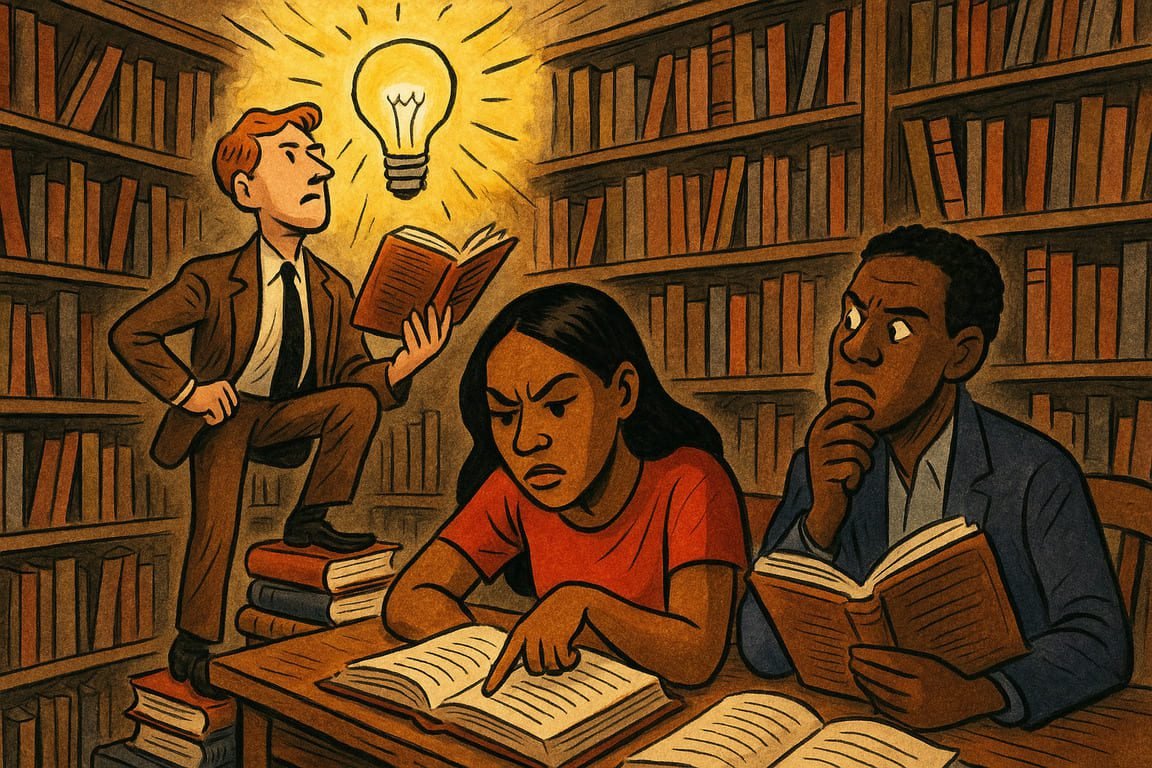
A lone desk lamp throws a golden halo across the chaos of stacked books, annotated papers, and coffee-ringed journals. In the midnight hush of a cramped study, the soft flutter of turning pages sounds like a secret. The world outside has no clue what’s happening here—one mind assembling the story behind every discovery, mapping the invisible web of knowledge, and weighing what’s been tried and what remains a mystery. Here, in this glow, the literature review becomes the most powerful weapon in the researcher’s arsenal. It isn’t just a summary. It’s an act of navigation, a reckoning, and sometimes, a revolution.
You might think literature reviews are dusty formalities, just academic rituals for the initiated. Not even close. When you step into research, you enter a battle that began long before your first experiment. The best literature reviews are the blueprints for your campaign. They show where traps lurk, where bridges were burned, and where gold lies buried beneath decades of failed attempts and flashes of brilliance.
You want to know why a literature review matters? It gives you x-ray vision. It shows you where past researchers soared and where they crashed. You spot patterns others missed, question the unspoken assumptions, and find cracks in arguments nobody bothered to fix. Imagine you’re dropped into a maze at night—literature reviews are the map you scribble on the wall, piece by piece, so you don’t wander in circles.
Every breakthrough stands on old scaffolding. Ignore what’s come before, and you’ll spend years reinventing the wheel. Savvy researchers respect the past, not out of nostalgia, but because it’s the fastest way to leap ahead. As Dr. Omar Ghosh, a trailblazer in renewable energy, likes to remind his teams, “A well-read mind is a time machine.” He credits his most disruptive work to insights hidden in obscure studies from twenty years ago.
You can’t fake a good review. Anyone can list references. Real mastery comes from synthesis—the art of weaving disparate findings into a tapestry that makes sense of confusion. It’s part detective work, part storytelling. The reviewer becomes a curator, separating what’s real from what’s noise, what’s reliable from what’s marketing hype. In a world drowning in information, that filtering skill is gold.
A killer literature review does more than explain what’s known. It exposes what nobody knows. It calls out blind spots, flawed logic, and the questions that researchers keep dodging. Every big leap in science started with someone saying, “Wait, nobody’s tested that?” or “Why do we keep making the same mistake?” Reviewers are the ones brave enough to say it out loud.
The review is where research turns personal. You begin to see your own project in the context of a much bigger drama. Every gap in the literature is a dare. Every contradiction is an opportunity to challenge the status quo. You start out as a reader but end up as a protagonist in the ongoing story of your field. That’s how the best ideas are born.
Modern literature reviews harness every tool. AI can surface hidden connections, databases link continents in seconds, and digital annotation makes cross-referencing a breeze. But none of it matters without a sharp mind asking: “Does this fit, or does it fool?” Technology multiplies your reach, but the power to decide what matters is still deeply human.
Think about Layla Obeng, who transformed HIV policy in West Africa. Her literature review was more than a survey—it was a call to arms. By exposing gaps between studies and on-the-ground reality, she rallied teams across three countries and unlocked new funding streams. Reviewers who dig deep and connect dots change lives, not just footnotes.
A great review makes you a magnet for collaborators. When people see you’ve mapped the terrain, they’ll line up to join your quest. Partners seek out those who know the landscape, who can see where to dig, and who recognize when an old trail is worth walking again. Leadership in research starts with the humility to learn from those who came before.
There’s a kind of magic in the process. Hours of reading become insights, which become hypotheses, which ignite new experiments. Every page you turn is a conversation with the dead and the living—an invisible seminar where you gather courage, ideas, and the wisdom to move the field forward. Over time, your review becomes a bridge for others to cross.
In a noisy, distracted world, deep readers become rare, almost mythical. While others skim, the literature reviewer dives. And in that depth, real breakthroughs emerge. If you want to shape the future, start by understanding the past.
The last light in the building glows above a researcher hunched over a spiral notebook. The city sleeps, but the narrative on those pages crackles with potential. Every margin scribble, every highlighted phrase, is another steppingstone across the chasm between ignorance and insight. The researcher exhales, realizing the thread that ties generations together is not the experiment, but the story told about what’s possible.
Somewhere in the tangle of forgotten studies and unlikely connections, a door swings open. The next great question waits on the other side.
Will you pick up the map and draw your own path forward?
