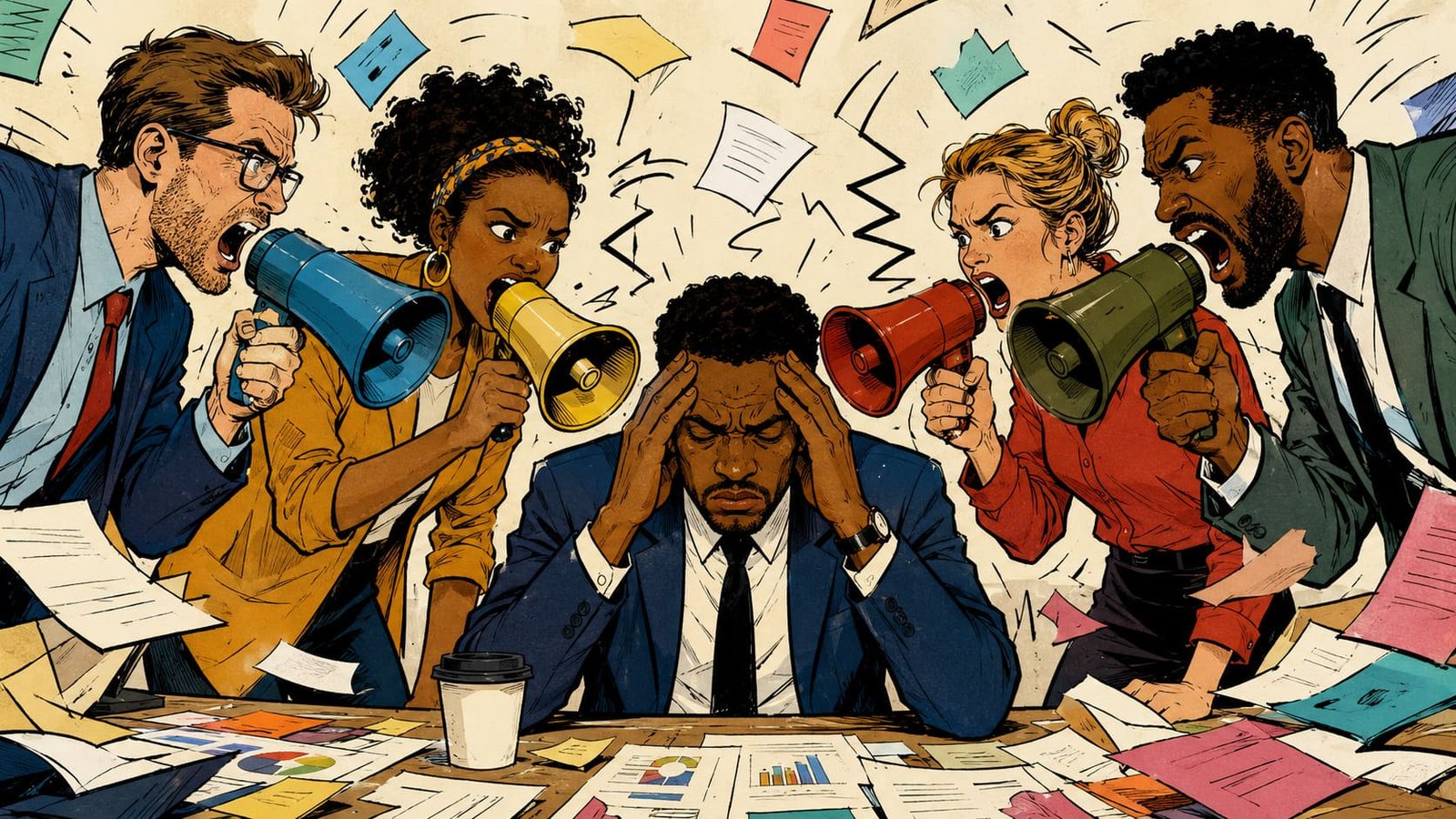
At 9:03 on a Tuesday, a leadership team receives a dashboard showing everything that matters, followed by another dashboard explaining the first dashboard, followed by an email asking everyone to attend a meeting about both. A notification flashes. Someone forwards a spreadsheet. Another person marks a message urgent. By lunchtime, the organization has communicated so successfully that nobody can answer the one question that matters: what requires a decision? Organizational noise is not a shortage of information. It is what happens when information becomes so abundant that significance loses its voice.
Management has developed an odd habit of measuring communication by volume. More updates suggest transparency, more meetings suggest alignment, and more metrics suggest control. Yet every message consumes attention, and attention is not an infinite corporate resource. When everything arrives with equal urgency, employees learn to triage rather than think, managers spend their days responding instead of deciding, and strategic priorities become buried beneath the digital equivalent of junk mail. A busy organization can therefore become less informed precisely because nobody has enough mental space to notice what matters.
Amazon’s use of written narratives for important decisions offers a useful counterpoint because writing forces an argument to survive without the protective fog of presentation slides. The discipline matters beyond Amazon. At a consulting firm, Joel noticed eleven recurring reports crossing his team’s inbox each week, yet a recurring client complaint remained unresolved. He removed most of the reports and kept one concise operating summary. Within weeks, managers began discussing the neglected problem because the signal was finally visible. Less information had produced more awareness, an outcome that made the previous reporting system look almost absurd.
Noise also changes behavior. Employees quickly learn that fast responses are often rewarded more visibly than thoughtful decisions, so calendars fill with meetings and inboxes become unofficial performance reviews. A designer named Farah once attended every meeting because she feared being perceived as disengaged. By Friday, she had spent so much time demonstrating availability that her actual project had barely moved. Her manager eventually cancelled several recurring meetings and discovered an uncomfortable truth: the organization had been confusing presence with contribution, then wondering why important work kept taking longer than expected.
Good leaders therefore behave less like broadcasters and more like editors. They decide which information deserves immediate attention, which belongs in a weekly rhythm, which requires conversation, and which should disappear altogether. Pixar’s culture of candid feedback offers another useful lesson because creative organizations depend on problems becoming visible early enough to be corrected. A manager who keeps every channel open may feel transparent, but an open channel without editorial judgment becomes a fire hose. Clarity is not achieved by saying everything. It comes from helping people hear what matters.
Every organization has a signal buried somewhere beneath its noise. It may be a customer complaint that keeps returning, an employee who has stopped speaking, a project that consumes resources without producing value, or a metric nobody wants to interpret honestly. Leaders cannot eliminate uncertainty, but they can eliminate needless competition for attention. When every message screams, leadership becomes the discipline of deciding which voice deserves the microphone. What would become visible tomorrow if half the information arriving today simply disappeared?
