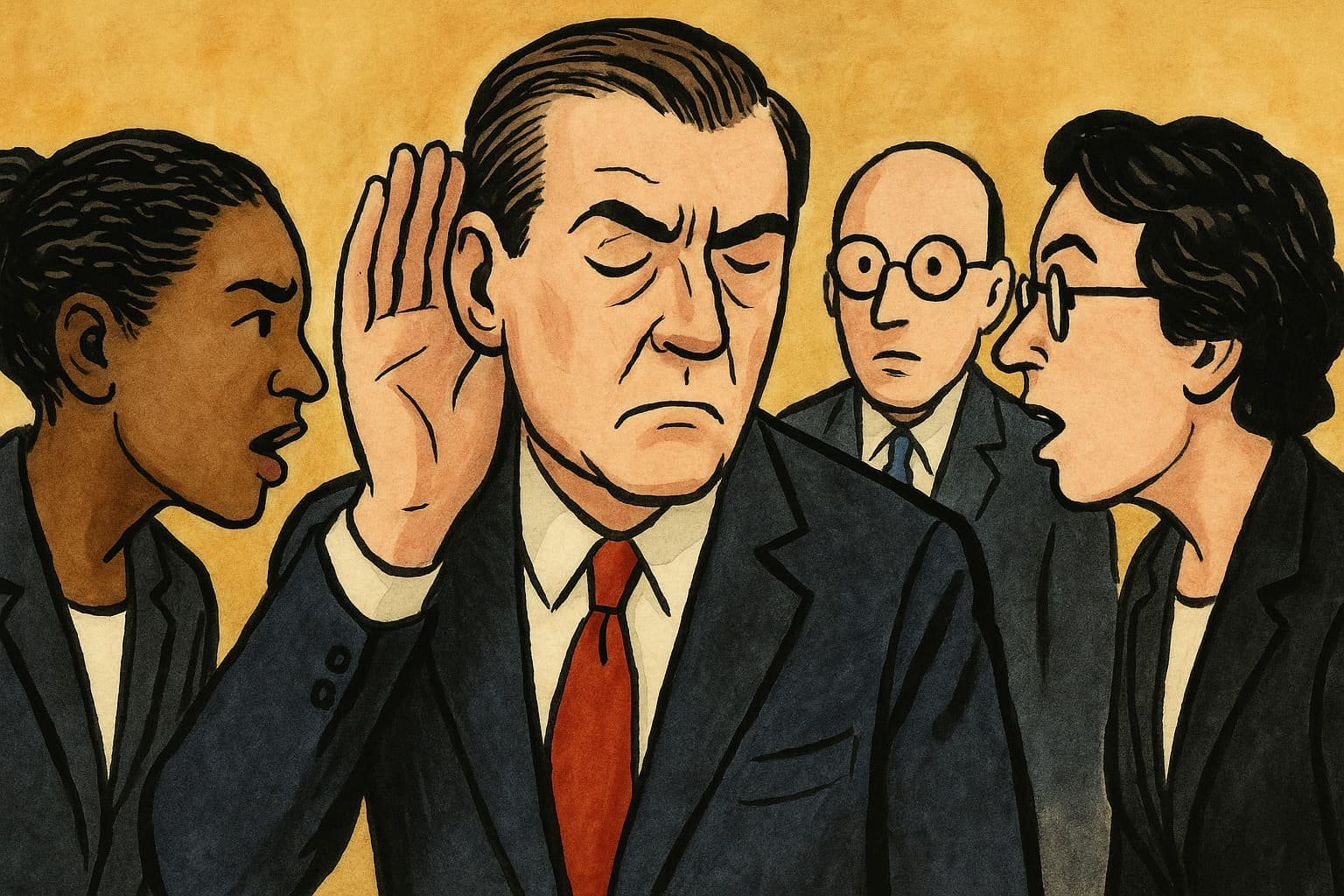
Beneath the cold fluorescence of a 31st-floor conference room, the city’s hum barely penetrates the insulated glass. Faces hover above gleaming mahogany, some fixed on tablets, others lost in the polished void. Words ricochet off walls padded with sound-absorbing panels, a far cry from the cacophony of the street below. At the table’s end, a leader leans forward with eyes glazed by obligation, nodding on cue while fingertips drum the underside. The team senses the performance; a ritual as old as power itself where silence masks truth, and every nod is as hollow as an echo in a marble hall.
Inside this penthouse stage, empathy is staged, not lived. The choreography of listening unfolds in micro-expressions: the glance at a smartwatch, the mechanical murmur of “I see,” the imperceptible sigh as another idea dies before it draws breath. This isn’t a meeting; it’s an audition for authenticity. Truth floats just out of reach, stifled by polite agreement and unread minutes. It’s the show before the real show, starring leaders who mistake performance for presence.
In the world’s most celebrated boardrooms, from Silicon Valley to Singapore, the ability to “actively listen” gets lauded as a core leadership trait. Yet, beneath TED Talks and LinkedIn quotes, most listening is transactional; a well-practiced con trick, delivered with a smile and followed by the swift erasure of dissent. The ritual continues because nobody wants to be the first to admit: almost everyone here is faking it.
Consider the legend of Nia Karim, founder of a global software company who could “listen with her eyes.” Former employee Jonas Lemke recalls, “She’d stare at you so intently, you’d forget your own name. But by lunch, every idea was gone, as if the meeting never happened.” Karim’s style is not rare. It’s a blueprint, replicated in executive suites worldwide. Even the greatest leaders sometimes weaponize the act of listening, not to connect, but to control.
Leadership folklore preaches the gospel of open doors and safe spaces, but real trust shivers at the threshold. The cost of fake listening is measured not in missed memos but in vanished creativity, simmering resentment, and teams that tiptoe around the real problems. The most dangerous lies are the ones nodded at, never spoken. Here, in the hush of professional theatre, authenticity is the first casualty. Welcome to the silent war where truth loses its voice, and the applause is always just a little too loud.
Quick Notes
- Leaders Who Nod, Not Listen: The art of pretending to listen is an ancient business ritual. Many leaders perfect it, but teams always sense when real attention is missing.
- Fake Listening Kills Innovation: When leaders only act attentive, ideas wither and team morale drops. Innovation dies in environments where people know they aren’t truly heard.
- The Science of Performance: Employees decode every gesture; side glances, fake smiles, and scripted empathy. The gap between what is said and what is heard becomes a silent drain on culture.
- Real Stories, Real Damage: Micro-stories from teams and founders expose the quiet frustration, lost opportunities, and even resignations triggered by leaders’ insincere attention.
- The Uncomfortable Truth: Faking listening isn’t just bad manners; it’s a strategic mistake. True connection demands courage, discomfort, and a willingness to be changed by what you hear.
Conference Room Masquerade—Where Empathy Puts On a Mask
Modern organizations often resemble sprawling stages, with conference rooms acting as their principal theaters. Leaders parade active-listening techniques; mirrored posture, affirming nods, note-taking gestures yet these moves rarely bridge the real chasm. Employees enter meetings armed with ideas, but leave with a subtle ache that their words evaporated, sucked into a void of polite indifference. In many companies, the performance of attention is valued more than the substance of engagement. This charade breeds frustration, teaching teams that honesty must first survive a leader’s selective hearing before it can drive change.
Famed advertising executive Maya Chen describes a team meeting that became legendary for its artificial warmth. “The CEO would ask for ‘honest feedback’ but kept looking at his phone,” she recalls. “No one believed he cared, so people stopped caring too.” The result? A campaign tanked not because of bad ideas, but because good ones never made it past the velvet rope of fake receptivity. This isn’t a rare misfire, but a chronic condition across sectors from tech giants to legacy banks where attention is currency, and authenticity is counterfeit.
The roots of this performance obsession stretch deep into management tradition. For decades, leadership books have extolled the value of “active listening,” yet rarely question the sincerity behind the act. Over time, teams develop an uncanny sixth sense for spotting insincerity, often reacting with a disengaged shrug or a carefully measured silence. The body language of a bored executive is more contagious than any virus, quietly infecting culture with learned apathy. In this environment, even well-intentioned leaders get swept up by the masquerade, losing themselves in the choreography.
Fake listening doesn’t just stifle ideas; it drains the emotional energy of entire teams. When people sense they’re speaking into a void, their willingness to risk honesty fades, replaced by guarded phrases and strategic omissions. Soon, meetings devolve into elaborate rituals where nothing new is said and everyone leaves with a little less hope. This silent erosion corrodes culture at the roots, teaching rising talent that safety means silence.
A striking story comes from Arjun Bhatt, once a rising star at a renowned fintech startup. He pitched a radical redesign during an all-hands, only to see the leadership “listen” and then swiftly shelve his idea without discussion. Months later, the company lost its edge to a nimble competitor. Bhatt’s takeaway: “The meeting was a masterclass in fake listening. They heard every word, but never listened.” The masquerade, it turns out, exacts a steep price: lost innovation, shattered trust, and a slow exodus of the boldest voices.
The Psychology of Pretending—Why Leaders Fake It (And Why Teams Play Along)
Beneath the surface of corporate rituals, an uncomfortable truth festers: leaders often fake listening because it buys time, maintains control, or deflects conflict. This behavior is rooted in a cocktail of fear, ego, and institutional inertia. Leaders rarely admit it, but tuning out is a defense mechanism; a way to avoid being disrupted, challenged, or forced to change. It’s easier to nod than to grapple with uncomfortable feedback or risky ideas.
Teams aren’t merely passive victims in this charade; they adapt to the signals their leaders send. Employees learn to edit themselves, delivering only the safest suggestions or echoing what they think the boss wants to hear. It becomes a dance of mutual protection: leaders dodge vulnerability by pretending to listen, while teams protect themselves by staying silent. This silent pact may keep the peace, but it starves the organization of the friction that sparks real growth.
A neuroscientific perspective adds another layer to the story. Research from organizational psychologists shows that people can subconsciously detect inauthenticity within seconds. Micro-expressions, changes in tone, and the absence of genuine engagement trigger instinctive distrust, even if no one says it out loud. Over time, teams develop a hypersensitivity to “performative empathy,” learning to read between the lines and to invest their best ideas elsewhere often outside the company.
Consider the rise and fall of Visionary Media, a digital agency once hailed for its innovative culture. The founder, Leon Dayal, earned praise for his “open-door” policy but was notorious for summarizing conversations with pre-written scripts. Employees quickly realized their suggestions were being filtered through a lens of predetermined outcomes. “You could see his eyes glaze over,” said senior designer Tara Winslow. “He’d already decided what he wanted.” As the agency stagnated, Dayal eventually conceded, “I listened, but never heard.” The psychology of faking attention isn’t a flaw; it’s a learned behavior, reinforced by organizational structures that reward comfort over conflict.
A close look at team dynamics reveals a deeper tragedy. When leaders don’t model authentic listening, psychological safety collapses. Employees sense risk in candor and revert to survival strategies agreeing publicly, dissenting privately, and innovating elsewhere. The organization becomes a mirror maze of half-truths, where everyone performs, nobody transforms. The cost isn’t just lost ideas; it’s lost connection, creativity, and meaning. Every fake “I hear you” is a tiny betrayal that compounds, until trust becomes an empty slogan.
Boardroom Ghosts—Stories of Silence, Resentment, and Vanishing Talent
Inside every company, ghost stories circulate; tales of ignored voices, unseen effort, and slow-building frustration. These stories never make the annual report, but their impact is real, shaping culture in invisible ways. Take the saga of Lucia Mendez, a data analyst whose breakthrough insights never made it past her manager’s distracted half-smile. Her story spread among colleagues, fueling a culture of quiet quitting and whispered warnings: don’t bother, they’re not really listening.
Real leaders know the power of attention is felt, not claimed. When fake listening becomes the norm, people develop creative ways to cope. Some resort to email “cover memos,” documenting ideas in writing so they can’t be erased. Others turn to side channels; Slack groups, backroom chats, or even public forums where real conversation happens out of leadership’s sight. The official meeting becomes a graveyard of potential, while life pulses in the shadows.
Silent resentment becomes a force of its own. Teams once eager to impress shift into survival mode, performing the minimum while reserving energy for side projects, moonlighting, or job hunting. High performers are often the first to leave, taking their ideas with them. The talent drain is slow but relentless, a quiet hemorrhage that erodes competitive advantage. Organizations that ignore this pattern soon find themselves outpaced by rivals where voices are heard and valued.
One global retailer tried to reverse this trend with “listening tours,” dispatching executives to stores to collect employee feedback. Store manager Benji Ramos remembers the experience as “a parade of corporate smiles and empty notebooks.” The tour was followed by months of silence and no visible change. Within a year, employee turnover spiked, and the listening act was quietly retired. The lesson: superficial gestures without genuine follow-through breed deeper cynicism than no gesture at all.
Not all stories end in defeat. At a midsize consulting firm, a new partner; Aisha Farouk reversed years of fake listening by holding unscripted “listening lunches,” inviting staff to speak freely about anything except business results. Over time, employees grew bolder, sharing hard truths and real hopes. Farouk credits this shift for a surge in retention and a flurry of successful client pitches that followed. “When people finally felt heard, everything changed.” In this rare success, the ghosts of silence faded, replaced by a new chorus of possibility.
The Hidden Cost of Theatrics—Innovation, Culture, and Competitive Decline
The consequences of fake listening aren’t limited to bruised egos or missed opportunities. The cost is systemic, running through the veins of innovation, culture, and strategic agility. When leaders fail to tune in, the organization tunes out; literally and figuratively. Ideas stop flowing. Problems fester. Mediocrity becomes normalized, camouflaged beneath glossy reports and PR slogans.
Culture suffers first. The fabric of belonging, so essential to high-performing teams, unravels quickly in the presence of performative attention. Employees no longer trust that their voices matter. Soon, leaders complain about a “lack of engagement,” not realizing they’ve engineered it through years of selective hearing. As trust drains away, collaboration falters, and siloed thinking takes over. In this environment, even the most talented teams become risk-averse, sticking to safe bets rather than daring to innovate.
Innovation withers under the weight of polite neglect. Every major breakthrough in business; Apple’s first iPhone, Netflix’s pivot to streaming, Nike’s “Just Do It” campaign can be traced back to a moment where someone listened deeply to an inconvenient truth. In contrast, companies that silence dissent or ignore unorthodox thinking find themselves trapped in a cycle of incremental tweaks. True transformation requires the discomfort of hearing things you don’t want to hear.
Competitive decline creeps in quietly. Firms that reward the performance of listening, rather than the substance, inevitably lose ground to hungrier, more adaptive rivals. Consider the story of Blockbuster, whose leadership “listened” to internal warnings about streaming but dismissed them as noise. Netflix, by contrast, embraced employee candor, surfacing insights that changed the game. The lesson is as old as business itself: cultures that fake attention eventually pay in relevance.
A more hopeful case comes from Remi Lawal, a tech entrepreneur who transformed his startup by creating “listening rituals” that made dissent a celebrated act. Lawal’s team introduced weekly “reverse town halls” where leaders were only allowed to ask questions, not respond. Within months, product velocity doubled, and engagement soared. Lawal’s takeaway: “People will run through walls for leaders who truly listen. But fake it, and you’ll find yourself running alone.”
The hidden cost of theatrics isn’t just lost profit; it’s lost purpose. Teams thrive on meaning, and meaning thrives on being heard. Strip that away, and you’re left with an organization that’s operationally efficient but spiritually empty. The stage lights may still shine, but nobody wants to perform.
Breaking The Spell—Practical Shifts That Spark Authentic Listening
Escaping the tyranny of fake listening requires a blend of courage, humility, and systemic change. The journey begins when leaders swap performance for vulnerability, admitting that they don’t have all the answers and inviting real dialogue. Authentic listening isn’t a soft skill; it’s a strategic imperative that drives creativity, trust, and transformation.
Start small. Simple rituals, like banning devices from meetings or adopting “no interruption” policies, signal that attention is valued. Leaders can model transparency by reflecting back what they’ve heard and following up with visible action. The best organizations institutionalize feedback loops, turning ideas into pilots or experiments rather than filing them away. When employees see their input shape real outcomes, a flywheel of engagement kicks in.
Technology can be an ally or an enemy. Tools like live polling, anonymous suggestion boxes, and open Slack channels democratize voice, but only if leaders respond with substance, not platitudes. Automation should never replace the messy, emotional labor of real conversation. Organizations that rely on apps to “listen” risk outsourcing empathy to code, losing the human magic that powers connection.
Contrarian leaders flip the script by rewarding dissent and making it psychologically safe to challenge authority. Case in point: at a cutting-edge design firm, founder Samira Patel awards “Courage Credits” for employees who respectfully disagree or raise uncomfortable questions. The credits aren’t just symbolic; they translate into real perks and visibility. The firm’s reputation for radical candor attracts top talent, sparking a virtuous cycle of listening and learning.
It all circles back to intention. Listening is not a checklist item or a leadership hack; it’s a practice rooted in humility and fueled by the belief that every voice contains wisdom. When leaders treat listening as a sacred responsibility, not a stage act, teams respond with trust, energy, and unfiltered creativity. The transformation is as tangible as it is profound: silence gives way to song, and the meeting room becomes a place where possibility lives.
The Echo That Changes Everything
After the applause dies and the boardroom empties, the only sound left is the low hum of the air conditioning; a faint reminder that performance has ended and truth remains. Shadows crawl across the walls as sunlight fades, leaving behind the memory of conversations that could have changed everything, had anyone truly listened. In this stillness, a leader lingers, staring at the chair where the boldest voice once sat, now empty.
The city below pulses with stories, each one waiting for an ear brave enough to hear it without judgment or agenda. Outside, rain tattoos the window, a syncopated drumbeat marking time lost to silence. Inside, the scent of cold coffee clings to the table, mingling with the taste of regret. It’s in these quiet moments, stripped of pretense, that leadership’s true test emerges; not in what is said, but in what is heard.
A text pings in the dim light. The leader hesitates, then reaches for the phone, finally reading a message left unsent weeks before: “Thank you for asking. I wish you had wanted to know.” This is the weight that lingers: the knowledge that attention, real or faked, shapes destinies far beyond the walls of any room.
So ask yourself: Will you become the leader whose attention rewrites stories or the ghost in the glass-walled booth, haunted by the echoes of truth left unheard?
Partnered. Provocative. Worth Your Scroll.
This is a Promoted Post by ESYRITE—yes, it’s paid, but never filtered. Our voice stays raw, real, and razor-sharp. We team up with bold ideas, game-changers, and stories that spark something real. If it’s here, it earned its place—no fluff, just impact. We don’t just promote—we provoke. Stay sharp. Dive deeper.
