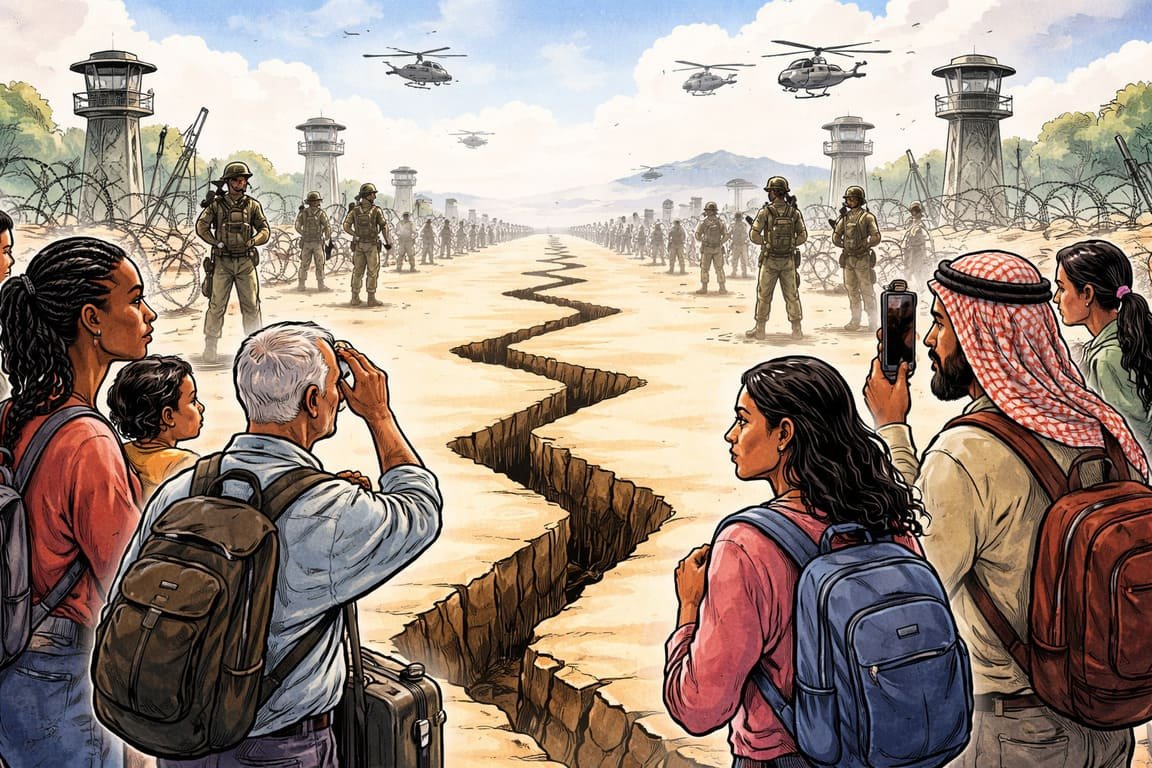
At a remote crossing, a weathered sign marks the edge of a nation. Paint flakes. A guard booth stands half alert. Trucks idle. People wait. The line itself feels tentative, thin, human made, and oddly vulnerable. Borders once carried the aura of permanence. They promised order, identity, and protection. Today, they feel strained by forces that barely acknowledge their existence. The world still draws lines. Fewer believe those lines will obey.
For much of modern history, borders organized reality. They separated inside from outside, citizen from stranger, responsibility from distance. States derived legitimacy from their ability to control territory. Maps became declarations of power. Defending borders meant defending sovereignty itself. That logic shaped wars and treaties. It still echoes loudly, even as lived reality pushes against it from every direction.
Globalization loosened control first. Goods crossed faster than laws. Capital ignored checkpoints entirely. Supply chains wrapped the planet in invisible threads. Borders remained visible on maps but lost authority in practice. Governments accepted the trade because prosperity followed. Control was exchanged for growth. The bargain felt rational until disruption revealed how dependent the system had become.
Migration then sharpened the strain. Conflict, inequality, and environmental pressure pushed millions across boundaries drawn without regard for lived geography. Borders became political flashpoints. Human stories collided with hardened slogans. Walls rose where cooperation once existed. Leaders framed movement as threat, ignoring the deeper failures that displacement reflects. Borders absorbed anger for problems they did not create.
Climate instability adds a deeper rupture. Rising seas erase coastlines. Drought empties regions. Storms redraw habitability faster than diplomacy can respond. Borders assume fixed land and predictable climate. Nature does not cooperate. When territory vanishes or becomes unlivable, legal definitions lag behind human need. The idea of permanence fractures under a moving planet.
Technology bypasses barriers entirely. Drones ignore fences. Cyber influence crosses without friction. Disinformation travels instantly. Economic coercion moves through networks, not checkpoints. Territorial control no longer guarantees autonomy. Power enters through systems people depend on daily. Borders guard land while influence slips through cables.
Conflict zones expose the fragility most clearly. Where borders are contested by force, the world is reminded that lines survive only if defended. Yet defense grows costlier and riskier. Escalation threatens global consequences. Protection becomes entangled with restraint. Borders demand resolve, but enforcing them can destabilize everything else.
Domestic politics intensify the pressure. Borders become symbols in cultural battles over belonging and fear. Simplified narratives promise security through closure. Reality resists. Economies rely on cross border labor. Families span nations. Culture refuses containment. Closing borders often reveals how interconnected societies already are.
International law struggles to keep pace. Frameworks designed for state disputes falter when challenges arise from climate collapse, non state actors, or economic asymmetry. Enforcement depends on consensus that rarely holds. Application becomes selective. Borders feel inviolable in some places and negotiable in others. Consistency erodes.
A generational shift complicates perception. Younger populations experience borders less as barriers and more as friction. Communication, identity, and opportunity feel fluid. National allegiance competes with global belonging. This does not erase nationalism. It makes it unstable. The tension produces confusion about what borders are meant to protect beyond symbolism.
Yet borders still matter. They organize governance. They assign responsibility. Without them, accountability dissolves. The challenge is not abolition. It is reinvention. Hard barriers fail against complex flows. Adaptive management, cooperation, and shared responsibility offer alternatives, but demand trust in short supply.
Some regions experiment quietly. Joint patrols. Shared resources. Mobility agreements. These models treat borders as membranes rather than walls. They regulate movement instead of denying it. Success depends on political maturity and public confidence. Both remain uneven.
Resistance persists. Fear persuades easily. The image of control reassures even when misleading. Leaders draw lines thicker and louder. Meanwhile, the forces testing those lines grow stronger and less visible. The mismatch widens.
As dusk settles over the crossing, shadows stretch across the painted line. For now, it holds, guarded more by habit than certainty. Beyond it, pressure accumulates patiently. And as nations cling to borders designed for another era, one question presses with uncomfortable clarity: when lines on a map can no longer shield people from the forces reshaping their lives, will societies defend the lines harder, or finally confront what those lines were never meant to solve?
