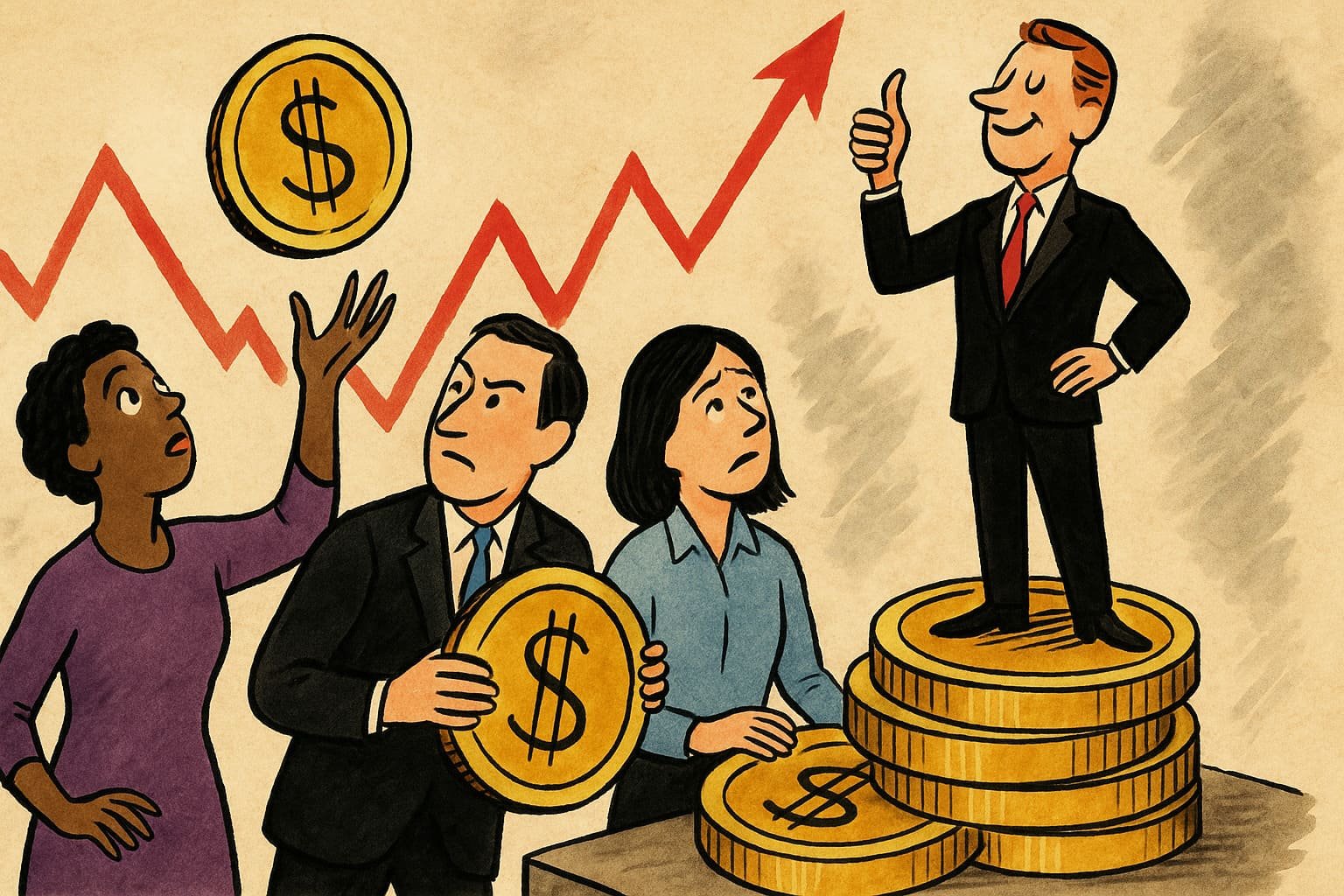
Night falls across the marble lobby of a global investment bank. Fluorescent lights hum. Glass doors flicker with the ghostly reflections of weary analysts clutching designer lattes, eyes darting to monitors pulsing with red and green. Here, in the heart of the financial theater, fortunes rise and vanish on whispers, not spreadsheets. There is no thunder of coins—just a chorus of bravado, the scent of aftershave, the tap of Louboutin heels, the soft laughter of those who pretend to know. Around the conference table, faces glow not with certainty but with the artful veneer of belief. Every smile, every memo, every handshake is a performance. The numbers look good, yet the real product traded is confidence itself—a vapor, but one that can buy an empire.
Out in Silicon Valley, a founder named Julian flips his hoodie over thousand-dollar hair, grins at a sea of venture capitalists, and tells a story so charming it makes even seasoned accountants lean forward. He talks about “market destiny,” skips the details, and pulls investment from air. His startup, with barely a product, is valued at millions before the code is stable. That’s how value works now: it’s not the ledger, but the illusion, the brand, the myth of inevitability. In this world, the right swagger turns paper into gold, and self-doubt kills faster than debt.
In a bustling Nairobi café, a young entrepreneur named Leah rehearses her pitch, praying her words can conceal the chaos behind her numbers. Her business teeters on the edge, but if she believes, others might too. The air tingles with desperation and hope—two flavors that fuel the modern economy far more than cash ever did. Across continents, a quiet truth echoes: confidence moves faster than currency, infecting balance sheets, boardrooms, and TikTok feeds alike.
Stock market floors are quieter now, replaced by glowing home offices and algorithmic traders who never blink. But the game remains: those who can sell certainty win, while those who hesitate drown in a tide of optimism they never learned to surf. Economists argue over fundamentals, but everyday people see a different world—a reality where buying a house means trusting your future job will exist, where the only stable thing is the story you tell yourself.
A global survey flashes on a monitor: “Trust in business is at an all-time low,” the headline blares, yet IPOs are oversubscribed, and influencer CEOs sell “belief” like bottled water. The data doesn’t match the feeling. That’s the real magic trick. The economy is no longer a fortress of facts—it’s a hall of mirrors, each reflection powered by the courage to believe, to bluff, and to play along. Welcome to the masquerade. The music has started. Will you dance, or are you just watching from the shadows?
Quick Notes
- Trust Is the Ticket, Not Cash: Money may move the markets, but in reality, it’s trust that opens doors and lands deals. Watch what happens when belief falters: even the biggest brands stumble.
- Charisma Sells More Than Books: A single pitch, full of vision and bravado, can outshine months of honest accounting. The right story beats the perfect spreadsheet every time.
- Risk and FOMO Rule the Game: Scarcity, hype, and fear of missing out set prices and spark stampedes. You don’t need proof when you have the right feeling.
- The Emperor’s New Auditors: When everyone acts as if value exists, it does—until it doesn’t. A bank run, a viral rumor, or a tweet can topple what seemed untouchable.
- Your Mind Is the Market: Every swipe, click, or double-take you give is currency in this new world. The ultimate economy happens in your head—confidence is the only coin that matters.
The Mirage Economy—Building Fortunes on Thin Air
Every business tale worth repeating starts with a leap of faith. A roomful of executives once watched a leader promise a market turnaround by year’s end, knowing full well the numbers didn’t add up. Instead of revolt, they nodded, copied the language, and soon the whole company marched forward as if profit had already arrived. That moment wasn’t just about hope—it was about how belief, when widely shared, can become more powerful than reality itself. In modern finance, this is not delusion, but strategy.
You can see this play out in tech, where companies pitch products years before they exist. Investors don’t just fund what’s real—they buy into a founder’s confidence, betting that vision will someday fill the gap between promise and performance. Consider how Elon Musk once revealed a prototype onstage, taking preorders and headlines before production had even begun. The audience didn’t need proof. They needed a leader who made risk feel like destiny.
This pattern isn’t new, but the pace is. Social media amplifies every whisper into a chorus. A single viral tweet from an influencer CEO can spark a run on a product or crash a share price before anyone checks the facts. In this world, speed matters more than certainty. It’s not who’s right, but who’s first—and who can persuade the most people, fastest.
Anecdotes from Wall Street tell of junior analysts who “saved” their firm by bluffing through a pitch meeting, inventing confidence when data was thin. It’s a risky dance, but in many cases, the act becomes reality: capital arrives, the product ships, and what began as illusion turns into substance. For every collapse, there are a hundred stories where the bluff paid off, rewriting history with hindsight.
Yet, the danger is ever-present. History is littered with names like Theranos and Enron, where too much confidence turned into catastrophe. But these aren’t warnings to stop believing. They’re proof that, for better or worse, belief itself can shape the world—sometimes for good, sometimes for chaos. The trick is knowing when you’re buying substance, and when you’re just paying for the show.
The Ledger of Trust—Accounting for Invisible Assets
Accountants once measured value in coins and ledgers. Today, the real assets live in minds and hearts, not balance sheets. Corporate valuation meetings now feature brand reputation, network effects, and “sentiment scores” as line items as crucial as property or patents. What’s unspoken is clear: intangible trust now tips the scales more than tangible inventory ever did.
Stories abound of startups with little more than a compelling story attracting capital by radiating certainty. During a tech conference in Berlin, a little-known fintech founder named Sofia turned her two-person side hustle into a $10 million darling overnight, not with data, but by turning her origin story into a movement. Investors weren’t buying her numbers—they were buying her unwavering faith.
Traditional accounting struggles here. GAAP rules require numbers, but there’s no clear cell for “public excitement” or “brand momentum.” Instead, firms hire agencies to measure “sentiment,” using social media algorithms as modern-day soothsayers. In an era when reputation moves faster than facts, even the most skeptical CFOs admit: you ignore the intangible at your peril.
There are real stakes. An oil giant saw its value cut in half after a viral campaign questioned its ethics, erasing years of balance sheet growth in a single news cycle. Conversely, a vegan burger company doubled its reach when a celebrity tweeted a rave review, sending demand—and valuation—skyrocketing in hours. The lesson is simple: the market now tracks stories as closely as earnings reports.
In boardrooms everywhere, the conversation has shifted. Savvy executives now treat trust like any other critical resource: it’s monitored, managed, and, above all, fiercely protected. Lose it, and the books won’t save you. Build it, and the numbers start working for you—often in ways spreadsheets can’t predict.
FOMO Finance—Scarcity, Hype, and the New Price of Risk
It’s no longer enough to have a solid plan. You need drama. A marketing manager at a lifestyle brand once sold out a line of sneakers by “leaking” limited quantities to influencers. Scarcity became the story, and the story drove a frenzy. People didn’t care about the shoe’s quality—they cared that everyone else wanted it. The true currency was fear of missing out.
Look at the crypto world. Digital tokens, once obscure, soared in value when social media personalities hyped “the next big thing.” Value wasn’t in the code, but in the story that millions might get rich together. Every chart spike and headline reinforced the message: buy now, or forever regret it. Behind every rally, there’s a whisper—“you’re about to miss the train.”
Risk, once a thing to avoid, has become fashionable. A new generation of day traders streams their wins and losses to millions, turning gambling into entertainment. Their followers know the odds, but believe the narrative: this time, it’s different. The allure isn’t just money, but the thrill of being part of something exclusive, if only for a moment.
Product launches mimic movie premieres. A tech company previews a gadget, hinting at secret features, then “accidentally” lets rumors slip. The result? Preorders surge, even before specs are public. The real product is anticipation—the promise that you, too, can own a piece of tomorrow, if you act fast.
Yet, the cycle is brutal. As quickly as a trend soars, it can crash. A fitness startup that went viral for its smart jump rope saw demand evaporate when a rival dropped a flashier version. Hype, once lost, is hard to reclaim. The only insurance is a new story, a new FOMO, ready to set the crowd chasing once more.
Market Psychology—Why the Crowd Always Wins
Markets used to run on fundamentals. Now they run on mass emotion. Behavioral economists call it “herd instinct,” but it feels more like mob magic. Watch what happens during a sudden market dip: social media fills with panic, and soon people sell not because of the facts, but because everyone else is running. The crowd’s mood creates reality.
You see it in the meme stock mania, where ordinary investors turn companies into overnight sensations. A bored office worker named Ray pooled resources with friends to “stick it to Wall Street,” fueling a rally that headlines still marvel over. Their motive wasn’t just profit. It was to feel part of a movement, to matter in a world that often feels indifferent.
Professional traders now monitor Reddit threads and Twitter hashtags as closely as economic reports. A rumor can move billions before the truth comes out. This is why sentiment analysts are the new rock stars of finance, translating the mood of millions into actionable insights. In this economy, feelings matter more than fundamentals.
Brand loyalty works the same way. A sneakerhead will camp outside for days, not for comfort, but for the story: the sense of being first, of belonging to a tribe. Marketers know this. They shape campaigns to spark not just desire, but shared experience. The best brands are less products and more cults.
Every now and then, the crowd stumbles. A viral scandal, a failed promise, or a meme gone wrong can unravel even the strongest narratives. But more often, the masses move as one, proving that, at scale, belief becomes fact. The lesson? If you want to shape markets, don’t sell products. Sell stories the crowd can own.
The Great Unraveling—When Confidence Collapses
For every boom built on faith, there’s a crash waiting in the wings. A fast-growing retailer once saw its share price double on the strength of a charismatic CEO’s vision. But when whispers of misconduct surfaced, confidence vanished. Within days, customers left, investors fled, and what was once a darling became a cautionary tale. The numbers hadn’t changed—only the mood had.
Financial history is littered with spectacular implosions: a beloved streaming service overpromised on growth, then missed a single milestone. The result was not just a drop in value, but a cascade of canceled subscriptions, job cuts, and headlines. No fraud was found, but the illusion cracked, and with it went everything else.
Yet collapse is never just destruction. A local bakery lost everything in a recession but rebuilt by leaning into transparency, sharing every step of their recovery online. The community rallied, trust returned, and sales rebounded. Their secret wasn’t a better business plan—it was the courage to invite customers into their struggle.
Rebuilding trust is hard, but possible. A financial advisor named Carmen once helped clients weather a market crash by refusing to sugarcoat the risks. She told the truth, even when it hurt, and over time, her honesty turned into loyalty. Confidence, once broken, can return—but only with vulnerability and time.
In the end, confidence is the most fragile currency of all. It can be created in a tweet, destroyed by a headline, and revived with a story. The winners are those who understand this cycle, who can ride the wave without losing themselves. The illusion may crack, but the lesson endures: behind every boom and bust lies a simple question—do you believe?
When the Masquerade Ends
Silence drapes the once-crowded ballroom as the chandeliers dim and paper confetti settles on empty floors. There’s a single briefcase left on the table, untouched and humming with secrets, while half-finished glasses of champagne catch the light from screens now gone dark. In the shadows, the architect of the evening stands quietly, suit wrinkled, face soft with uncertainty, eyes searching the space where applause once thundered. The music of ambition is over, and only the echo of belief remains.
Faint footsteps click on polished tiles, passing by fallen programs listing promises that never made the stage. A young analyst gathers the scattered notes of the night, realizing that every forecast, every confident smile, every urgent whisper about “next quarter” was just another layer of the show. The room feels colder now, stripped of certainty, yet not of hope. In this hush, the truth is unmasked: all along, the currency was never numbers or gold, but the fragile, flickering bond of trust between dreamers and the crowds who cheered.
A CEO leans against the window, watching city lights blink in the distance. Memories swirl: pitches that soared, failures that left scars, the endless dance of optimism and dread. There’s a weight in their chest—the realization that every empire is built, not on assets, but on the electric faith of those who choose to believe, if only for a moment. Behind every dazzling success, there’s always a whisper: “Will they believe again tomorrow?”
As the ballroom empties, a final thought drifts through the air, unsaid but alive:
You hold the only currency that matters—so will you spend it chasing illusion, or building something that lasts?
