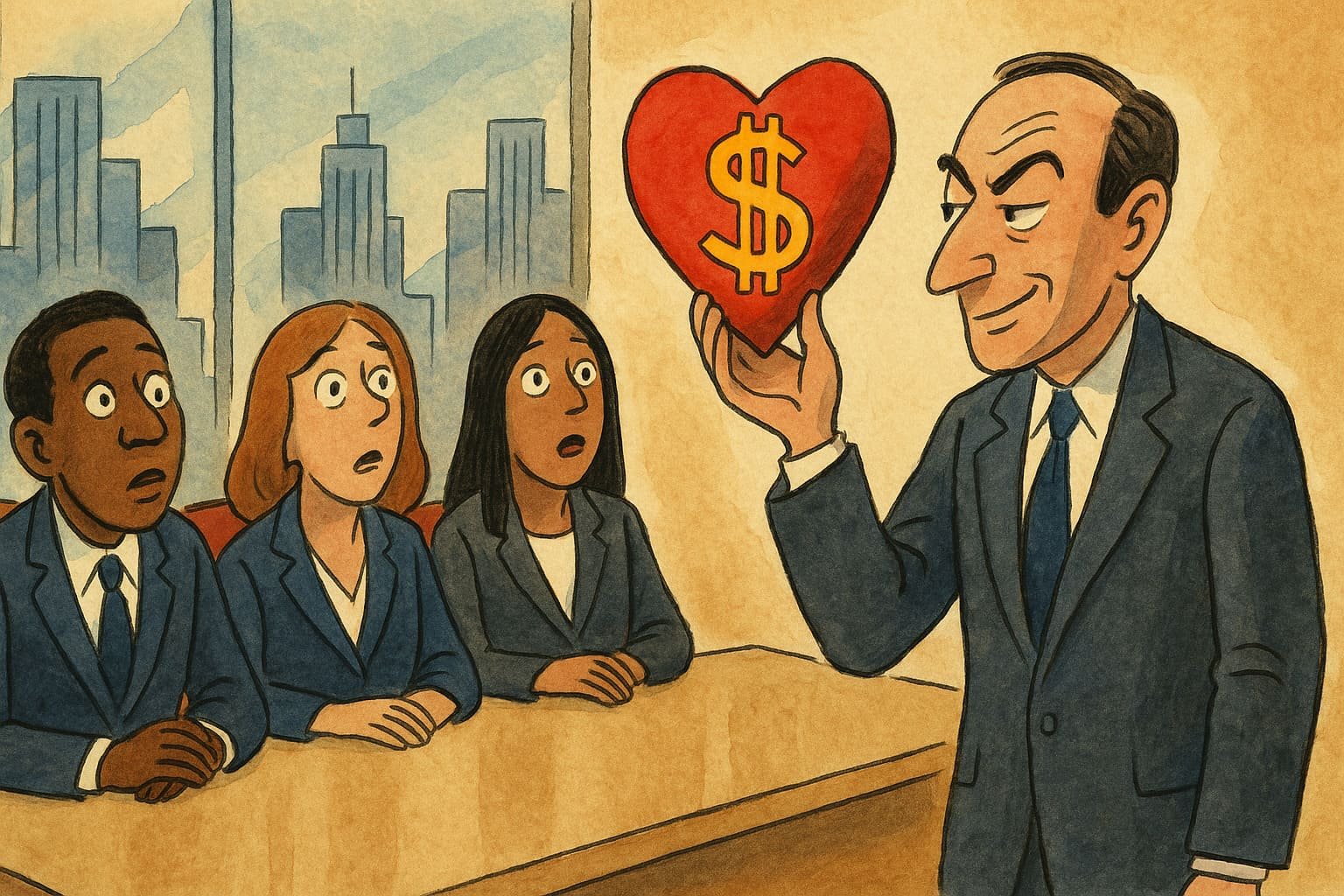
Office lights flicker as midnight leaks into the city’s arteries, reflecting back from skyscraper glass like digital confessionals. Here, in the silent aftermath of the quarterly earnings call, coffee stains the CEO’s trembling hand while a tired assistant slouches beneath the pixelated glow of spreadsheets. It’s a modern ritual: faces tight with ambition, emails pinging like Morse code, hearts thudding in rhythm with closing bells and push notifications. Silence hangs in the air, thick and sweet, laced with the aftertaste of risk and applause, as if the ghost of Gordon Gekko is humming through the vents. This isn’t just capitalism: it’s performance art, where every handshake, every smile, and every backroom bargain is part of a show so seamless, so addictive, nobody notices the cost until their soul feels overdrafted.
Now, imagine a pitch meeting that begins not with vision, but with an algorithm calculating what people will fear, crave, or envy next. The projection screen doesn’t flash innovation or purpose, but a single word: “More.” Greed, dressed in bespoke suits, parades as strategy. In the corner, a young product manager texts her partner, “I feel like I’m losing myself in here.” Her message gets lost in a torrent of Slack notifications, swallowed by the tempo of endless growth. Everyone here is a hero in their own movie, fighting for legacy, status, or just survival. The irony? Every participant thinks they’re too clever to be consumed by the very machine they’re fueling.
Real-life whispers echo in the background. A senior analyst from a global consulting firm once told a friend, “Our success feels empty sometimes, like we’re just selling adrenaline.” A mid-level marketer at a tech unicorn snaps a selfie in front of the company logo, but can’t remember the last time she celebrated a win that mattered beyond a headline. This is the modern gold rush, but the nuggets are data points and the rivers run with anxiety.
Corporate secrets don’t hide in locked drawers or encrypted files. They float in open-plan offices, slip through quarterly all-hands, and nestle between performance reviews and pizza Fridays. The most corrosive secret? Greed’s not an outsider. It’s the air supply: a vapor that seeps through mission statements, stock options, and whispered justifications after layoffs. Nobody sets out to trade their heart for a number, but bit by bit, the trade becomes habit, then policy, then culture.
Before anyone notices, a company’s moral compass spins so fast it catches fire. That’s the backdrop of every business epic: the hero’s journey from hopeful to hardened, the slow fade of conviction to calculation, the transformation of passion into pipeline metrics. Greed, once a punchline, becomes gospel. And nobody hears the warning bell until it’s already gone quiet.
Quick Notes
- Profit Over Pulse: When the drive for numbers outpaces meaning, businesses trade empathy for efficiency. People start measuring their worth in PowerPoint slides and net promoter scores, forgetting the faces behind the figures.
- Culture Eats Conscience: Success becomes a ritual, and nobody dares question the rules. The stories told in hallways are about outsmarting rivals, not out-serving communities.
- Invisible Losses: Every quarter’s win leaves invisible bruises. Teams work weekends, friendships fray, and a silent loneliness grows behind busy calendars.
- Hero Worship, Hollowed Out: Celebrity CEOs become modern deities, but their followers rarely ask, “At what cost?” The worship of vision drowns out the whispers of conscience.
- The Reckoning Hides in Plain Sight: Burnout, disengagement, and the subtle resignation of the human spirit are the hidden invoices greed always collects. Success measured in pure growth, without heart, turns every workplace into a haunted house of empty ambition.
The Heart For Sale – Why Greed Became the Best Dressed Guest
Walk into any bustling startup or blue-chip office and you’ll feel it: the pulse of urgency masquerading as purpose. The room brims with slogans about innovation and impact, but beneath the surface, everyone’s eyes dart to the bottom line. The air carries a scent of competition, masked as collaboration, and every conversation circles back to revenue, bonuses, or market share. The irony is not lost on those who joined to change the world and now spend most days perfecting metrics or optimizing click rates. Somewhere, idealism was quietly replaced by incentives, and nobody remembers the exact moment it happened.
Stories of transformation flicker like headlines. Take the tale of a boutique retailer, founded by friends on the promise of ethical sourcing. For a while, every decision balanced profit and principle. But as venture capital poured in, pressure mounted. “If we don’t scale now, someone else will,” warned a board member, himself a former champion of slow growth. Within months, supplier standards slipped, staff turnover spiked, and the founding mission became a nostalgic footnote on the About page. The friends still posed for photos, but the laughter felt staged, a brand instead of a bond.
Psychologists call it the slippery slope of self-justification. A leader makes a single compromise; hiring a rainmaker with questionable ethics or greenlighting a cost cut that quietly erodes employee morale. Soon, what was unthinkable becomes policy, then culture. Greed isn’t a villain with a monocle. It’s an expert at rationalizing, always ready with a spreadsheet or a case study. Just ask the project manager at a multinational who confessed to a colleague, “Every quarter, I have to do one thing I promised myself I never would, just to keep my job.”
The pop-culture machine glamorizes the high-rolling executive who bends rules for the greater good. Yet, behind the scenes, it’s the janitor who notices the energy drinks piling up after midnight deadlines or the receptionist who sees team members coming in on Sundays. Greed rarely shouts. Instead, it whispers in the hallways, slides into the boardroom, and leaves little notes on every performance review: “Do more with less. Or else.”
There’s an old joke: “How do you boil a frog? Slowly.” In business, the pot is always on, the heat rising degree by degree. Nobody sets out to sell their heart. They just forget what it felt like to guard it, until the only thing left to measure is what’s lost.
Numbers Don’t Bleed – How Metrics Became a Moral Escape Hatch
You’re told every dollar is a vote. Budgets become battlegrounds, where teams fight for resources with charts sharper than swords. In these meetings, stories of customers or employees become afterthoughts. “What gets measured gets managed,” someone quotes, but the unspoken truth is what gets measured also gets manipulated. When performance is the only currency, the soul of the business is up for auction.
Consider the cautionary fable of a once-beloved airline. Once famous for its “people-first” culture, it hired a new CEO with a reputation for financial wizardry. Almost overnight, perks vanished, routes were slashed, and the break room emptied of everything but anxiety. Quarterly profits soared briefly. Then, service collapsed, loyalty eroded, and competitors swooped in to poach disillusioned staff. “You can’t spreadsheet your way to loyalty,” quipped a flight attendant who took early retirement. The numbers looked brilliant until the humans revolted.
In this world, metrics morph from tools into shields. Managers hide behind dashboards, reluctant to face the messier realities of human motivation and morale. Employees who dare to mention burnout or ethics are dismissed as “not a team player.” The drive for efficiency squeezes out empathy, turning every day into a zero-sum game where someone must lose for the numbers to win.
You can see the effects in micro-moments: the exhausted developer who fixes bugs in the dark while her child’s birthday passes uncelebrated, or the sales rep who bends the truth because the CRM demands a quota, not a conscience. Metrics may never lie, but they also never bleed. They don’t mourn the late nights, the missed dinners, the friendships strained by competition. Greed camouflages itself as “just good business,” convincing smart people to celebrate wins that taste like ash.
The business world loves a turnaround story, but rarely admits the human costs of squeezing one more point of margin from the same exhausted team. The dirty secret? Behind every chart-topping quarter, there’s a ledger of invisible debts: burned-out minds, frayed nerves, and hearts that quietly checked out long before their badge access expired.
The Cult of Vision – When Ambition Masks the Exit Wounds
Vision is the new currency, and every leader is told to “think big or get out of the way.” You might see a founder with starry eyes pitching a better tomorrow, their voice echoing through TEDx stages and Twitter threads. The world cheers, hungry for the next Jobs or Musk, rarely pausing to ask who gets trampled in the stampede. Ambition, once a torch, can scorch everything it touches when left unchecked.
Picture a celebrated tech startup, famous for its raucous launch parties and charismatic founder. Employees posted photos of late-night brainstorms and “family” dinners at the office. But under the neon glow, resentment simmered. An anonymous Glassdoor review described “a culture where saying no is a career-limiting move.” The founder’s vision was undeniable, but so was the burnout. By year’s end, most of the founding team had left, their stock options unvested, their friendships fractured beyond repair.
The business press loves to spotlight unicorn stories, but skips the chapters where teams dissolve and values get vaporized. Greed isn’t always about grabbing cash. Sometimes, it’s about winning at all costs, chasing legacy over loyalty, applause over authenticity. Vision, weaponized, turns into a trap where only the loudest survive, and everyone else learns to wear a mask.
Management theorists often argue that culture is “what happens when no one is watching.” Yet, in the era of social media and always-on branding, every moment is performative. Teams gather for wellness seminars, but nobody admits to crying in the bathroom after another round of layoffs. Leaders tweet about gratitude, then sign off on policies that squeeze every ounce of productivity from tired souls. It’s not hypocrisy. It’s survival, dressed up as inspiration.
Stories circulate of leaders who broke the pattern. Consider the mid-sized agency where a new creative director banned after-hours emails. Staff whispered at first, “He’ll never last.” But by quarter’s end, productivity soared, and so did trust. Sometimes, the greatest rebellion isn’t disruption, but restraint: drawing a line in the sand and saying, “Our hearts aren’t for sale.”
Behind the Mask – The Human Cost of Corporate Camouflage
Behind every cheerful quarterly update or slick product launch, people trade pieces of themselves for applause. “Fake it till you make it” became gospel, yet nobody tells you how draining it is to live a double life. Workplaces are full of secret actors, memorizing scripts, choreographing meetings, perfecting their roles for one more standing ovation. Underneath, the human need for belonging gets suffocated by the pressure to perform.
Consider a financial analyst at a booming fintech firm. His LinkedIn profile boasts of rapid promotions and “game-changing” projects, but his closest friends know he texts them memes at 2 a.m. just to stay awake. At a recent company retreat, he joked, “Sometimes I wonder if my job is making slides or making sense of my life.” The laughter was nervous, edged with exhaustion. When the applause faded, he confessed to a colleague, “I miss being proud of my work. Now I just want to make it to Friday.”
HR gurus preach “bring your whole self to work,” but rarely mention the penalty for honesty. Employees learn which faces fit and which don’t. Every organization has its unwritten rules; don’t question the new boss, don’t challenge the sacred metrics, don’t show weakness. Greed exploits this silence, thriving where people fear speaking up. Over time, conformity becomes currency, and anyone who resists the script gets sidelined.
The most haunting stories come from those who left. “I didn’t quit because I couldn’t keep up,” said a former head of operations at a logistics company. “I quit because I didn’t recognize myself anymore.” She spent her last months faking enthusiasm, nodding through meetings she privately disagreed with, and dreaming of quieter days. Her exit interview was polite, but the truth lived in her silence.
There’s a kind of loneliness in modern business that no amount of Slack messages or team lunches can cure. It’s the emptiness of striving for rewards that no longer spark joy, of playing parts that never feel real. Greed isn’t just a thief of hearts. It’s a master of disguise, convincing good people that survival is the same as success.
Redemption on the Edge – Breaking the Cycle with Courage and Clarity
Redemption rarely arrives with trumpets or viral hashtags. It’s quieter, riskier, more personal; a whispered decision in the dark to do things differently. Somewhere, a team leader cancels a late-night meeting, deciding her people deserve rest more than one more slide deck. A founder admits a mistake onstage, turning applause into a conversation. A young analyst walks away from a “sure thing” job to work for a mission-driven nonprofit, texting friends, “I want my work to matter again.”
The most powerful stories of change don’t come from billion-dollar turnarounds but from small rebellions that ripple outward. Take the marketing team at a global retailer who refused to run a fear-based campaign, despite pressure from above. They lost a short-term bonus but built trust with customers that outlasted any quarterly spike. Months later, the company’s reputation weathered a crisis that toppled competitors who’d chased profits at all costs.
Change doesn’t happen in grand gestures. It takes root in micro-choices: calling out unfairness, supporting a burned-out peer, questioning a dubious strategy, or standing up for someone whose voice is drowned out. The true heroes aren’t the headline-makers. They’re the ones who hold the line against the easy path, who remember that the purpose of business isn’t just profit, but people.
Business schools teach about disruption, but rarely teach how to recover from self-betrayal. Recovery takes humility and a willingness to rebuild trust, one conversation at a time. Companies that thrive over decades are those that let people bring their full selves; messy, imperfect, but alive back into the boardroom. When a leader says, “I care more about your well-being than your output,” something shifts. Suddenly, loyalty returns, innovation blooms, and the culture breathes again.
There’s a lesson hiding in every organization’s history: It’s never too late to rewrite the story. The companies that endure are those that rediscover their heartbeat before it’s too late. The bravest thing any leader can do isn’t to drive growth at all costs, but to ask, “What are we willing to lose, so we don’t lose ourselves?”
Echoes in the Glass – Will You Sell Your Soul or Save It?
Lights dim across the open-plan offices as one by one, screens power down and elevators sigh their last ride home. In the glass reflection, a figure lingers; a founder tracing her finger along the mission statement etched on the lobby wall. Somewhere, a junior designer deletes a late-night email and chooses sleep. The building is quiet, but the questions echo louder than ever.
Beneath the glossy surface of every success story lies a hidden script: the tradeoffs nobody posts on LinkedIn, the phone calls that go unanswered, the voices that fade when profits roar. Greed is a shapeshifter, always promising one more reward if you’ll just turn the other way. Sometimes, the bravest act in business isn’t launching the next big thing, but stopping long enough to listen to the silence and ask what it’s really costing you.
The modern business world worships the myth of the lone genius or relentless striver, but the truth is, hearts can’t thrive on numbers alone. Cultures that outlast their founders are those built not just on ambition, but on belonging, kindness, and courage. The cost of selling out is never measured in quarterly reports; it’s measured in sleepless nights, empty laughter, and the slow erosion of meaning.
Somewhere tonight, a company is teetering on the edge: Will it choose more metrics or more meaning? Will it keep asking for more, or remember what “enough” felt like before the hunger set in? The world doesn’t need another giant; it needs companies that leave a light on, not just for profit, but for people.
So ask yourself: When the doors close and the silence returns, will you be proud of the story your business tells or haunted by the secrets it tried to hide?
Why scroll… When you can rocket into Adventure?
Ready to ditch the boring side of Life? Blast off with ESYRITE, a Premier Management Journal & Professional Services Haus—where every click is an adventure and every experience is enchanting. The ESYRITE Journal fuels your curiosity to another dimension. Need life upgrades? ESYRITE Services are basically superpowers in disguise. Crave epic sagas? ESYRITE Stories are so wild, your grandkids will meme them. Want star power? ESYRITE Promoted turns your brand cosmic among the stars. Tired of surface-level noise? ESYRITE Insights delivers mind-bending ideas, and galactic-level clarity straight to your inbox. Cruise the galaxy with the ESYRITE Store —a treasure chest for interstellar dreamers. Join now and let curiosity guide your course.
