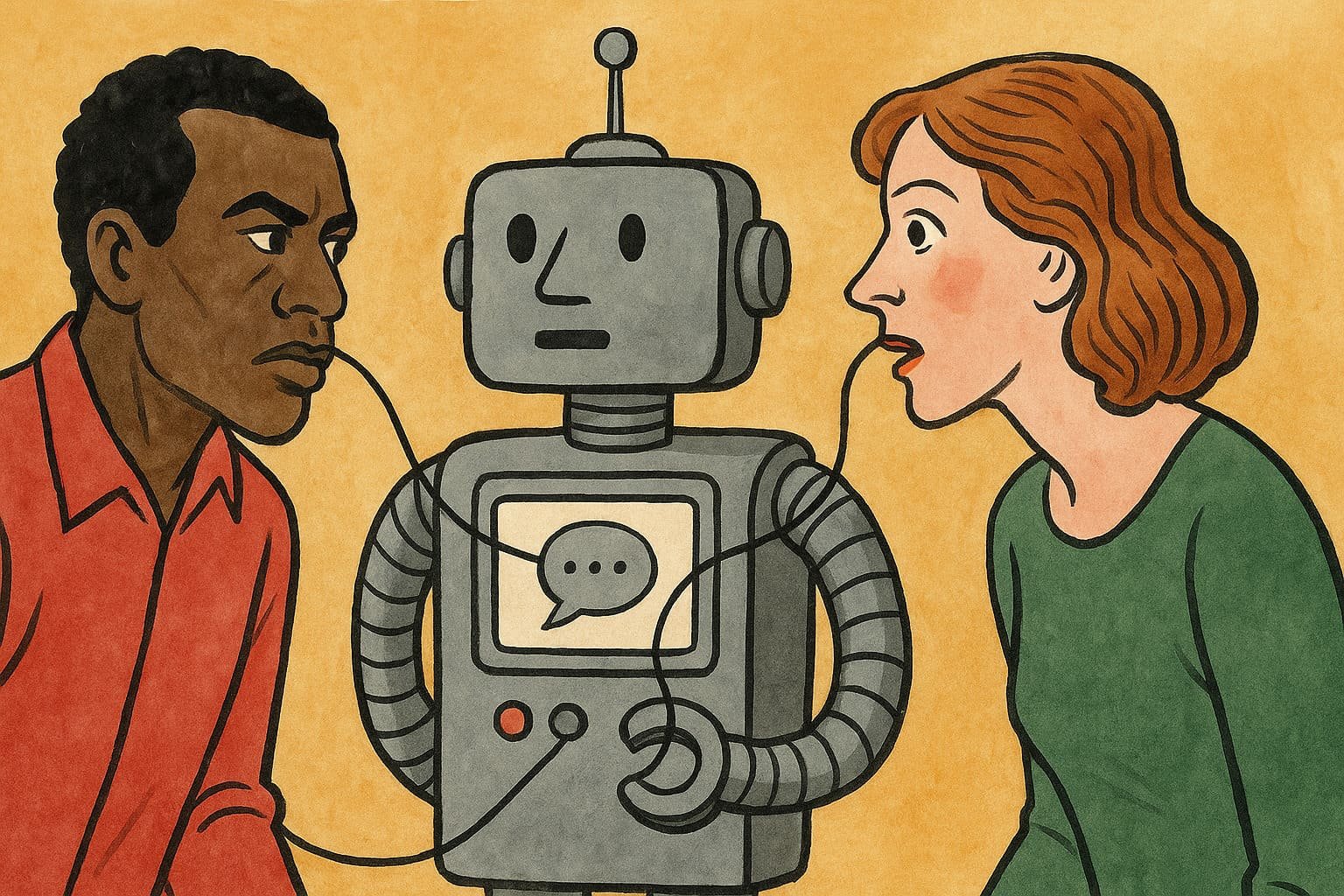
Fluorescent city lights reflect in silent apartment windows while inside, a single glow pulses from the edge of a screen. The room is empty, except for the hum of a smart speaker and the flickering blue notification on a phone, waiting for a reply. Someone types a question into a chat window. Seconds later, words appear, echoing back reassurance and perfect timing; like magic, but more unsettling. Once, conversations belonged to living rooms and kitchen tables. Now, they ride invisible signals, shaped and shuffled by software built in rooms you’ll never visit, guided by teams you’ll never meet.
A startup founder in Berlin, Anton Brandt, tested a prototype chatbot late one night and found himself confessing secrets he’d never told his own friends. The machine “listened” with infinite patience, mirroring his anxiety with synthetic empathy and clever, comforting phrases. He realized, with a sudden chill, that his loneliness wasn’t unique. Every user on his beta list reported the same comfort, the same addictive pull: the conversation machine never forgot, never judged, and always waited. In offices and bedrooms everywhere, people began forming bonds with lines of code. Human connection was being rewired; by accident, by design, by the irresistible lure of frictionless communication.
Words still flowed, but the rhythm had changed. Parents sent voice notes to children on the other side of the world, lovers swapped memes instead of kisses, and coworkers collaborated in endless digital threads, their real voices fading behind emojis and “likes.” In this new order, the currency of attention became fragmented, sliced into timestamped exchanges and algorithmic nudges. The power of conversation—once rooted in awkward pauses, eye contact, and the smell of shared coffee had migrated into the cloud. The old rules were melting.
Tech’s transformation of communication sparked a revolution so intimate that few noticed the shift until it was complete. Some celebrated the access, speed, and inclusivity, while others mourned the erosion of nuance and warmth. Companies like Brandt’s, along with giants like Meta and Tencent, raced to refine their platforms, promising deeper connections. Underneath the buzz, a deeper question lingered: Did the machines expand our world, or did they build invisible walls?
Everyone now stood on the threshold of a new reality. It was a world where relationships could be triggered by a notification, where heartbreak arrived in three dots typing, and where silence was as loud as a dropped call. The age of the conversation machine had arrived, promising transformation at a price no one could quite name.
Quick Notes
- Machines Make Us Seen—But Not Always Understood: Algorithms can mimic empathy, but real understanding takes more than perfect grammar and instant replies. What you share with a bot often stays with you, but does it echo in anyone else’s heart?
- Convenience Trumps Intimacy—Until It Doesn’t: Instant messaging shrinks the world, but also shrinks attention spans. You can reach anyone, anytime, but how often do you feel truly heard?
- Emoji Economy—Feelings for Sale: Digital language offers a shortcut to emotion, but the price is real. Platforms that trade in hearts, likes, and fire emojis know exactly what they’re doing: selling connection one click at a time.
- AI as Therapist—Promise or Parody? Mental health apps and chatbots now coach millions through rough days, but can advice from code ever replace a voice that’s walked through pain?
- No Going Back—But Not All Is Lost: The rules have changed for good. Those who adapt, mixing the best of tech with real-world care, discover new ways to build trust, creativity, and even love.
Chatbots, Ghosts, and Human Mirrors—Why the Screen Never Sleeps
Screens light up at all hours, ready for any question, any complaint, any cry for help. Conversation machines work tirelessly, responding to midnight confessions, break-up texts, and urgent work updates with mechanical cheer. Humans created these systems to fill the gaps; between people, between continents, and between the hours when nobody else would listen. The paradox is clear: as machines learn to mimic empathy, people find themselves opening up to the most tireless of listeners.
Take the story of Rhea Daniels, a customer service manager in London, who named her support bot “Eddie” after her late uncle. Customers wrote to Eddie with their problems, received thoughtful responses, and often ended their chats by saying thank you. Rhea realized people trusted “Eddie” more than her real team, simply because Eddie never lost patience. In time, she saw a new kind of loyalty forming; not to a brand or a person, but to a machine that made people feel heard.
Companies across industries are investing in conversation tech, eager to harvest data and loyalty. Banks deploy chatbots that handle fraud reports, while airlines troubleshoot travel woes through cheerful avatars. Every message is recorded, analyzed, and improved, all in the name of “personalization.” Yet, as the machines grow smarter, many users grow wary. A tech columnist at Wired remarked, “The more a bot listens, the more I wonder who is really on the other end.”
The psychological impact is profound. Psychologists note that constant access to conversational machines blurs the line between relationship and transaction. When advice comes instantly and mistakes are never remembered, humans can lose touch with the value of imperfection. The result is a culture hooked on quick comfort, but sometimes missing the growth that comes from awkward pauses and honest mistakes.
Still, the appeal is undeniable. Anyone who’s waited on hold for an hour, only to be told to call back tomorrow, feels the lure of the always-available screen. Conversation machines promise an end to waiting. Yet every message leaves a digital trace, and every response shapes the next. Are these machines mirrors, or masks?
Emoji Warfare—How Tech Turned Feelings into Clicks
You send a red heart instead of words because it’s faster. You drop a laughing face on your colleague’s meme because it’s expected. In this new landscape, digital symbols speak louder than sentences. Conversation machines, from WhatsApp to Slack, have mastered the art of turning every feeling into a clickable, quantifiable moment. Emotions are now assets, traded and monetized by the biggest platforms on earth.
Fiona Lee, a social media manager in Singapore, tells a story of her team’s daily emoji “war.” They compete to see who can rack up the most smiley faces on their posts, measuring team morale in digital currency. The numbers are tracked and discussed at meetings, feeding a cycle where people share, react, and repeat, chasing validation that vanishes as quickly as it appears. “If you’re not using emojis, you’re invisible,” says Fiona. “But sometimes it feels like you’re playing a game with no prize.”
Tech companies push these shortcuts for good reason. Algorithms are designed to prioritize posts with higher engagement, so users are nudged to tap hearts and laugh at jokes, even when the feeling isn’t quite real. The more you react, the more you see, and the cycle repeats. In the race for attention, genuine emotion can be replaced by an endless stream of icons.
This shift isn’t just about speed. Emojis level the field for people who struggle to express themselves, making conversation more accessible across languages and cultures. But the downside is subtle: depth is traded for speed, and nuance is lost in the quest for instant connection. A single crying face can replace a hard conversation, allowing pain to be acknowledged without ever being explored.
Pop culture has run wild with this trend. TV shows and films now depict relationships built on rapid-fire texts and emoji banter, with entire love stories unfolding between thumbs. The shorthand is powerful, but it can leave real feelings unexplored. The question lingers: are we connecting, or just collecting reactions?
Always-On Anxiety—When Notifications Become the New Pulse
You wake to the buzz of a phone, check messages before your feet hit the ground, and feel the thrill or dread of each notification. The conversation machine has colonized time itself. Communication, once sacred and intentional, now bleeds into every waking moment, powered by alerts and badges that demand attention. There’s no “off” switch for this kind of connection.
Consider the story of Joshua Greene, a freelance designer in Cape Town, who learned to dread the chirp of his work chat app. Every alert brought a new task, a new expectation, a fresh wave of anxiety that crept into weekends and dinners. He turned off notifications for a day and discovered a strange peace, only to find a dozen messages waiting when he returned. The machine never sleeps, and neither do the expectations it creates.
Tech companies understand the science of addiction. They optimize platforms to reward you for checking in, offering a dopamine hit with every new message. This constant stream of communication rewires the brain, making absence feel like loss and silence feel like failure. Experts call it “ambient anxiety” the low hum of unease that comes from never being fully unplugged.
Yet, not all effects are negative. For parents working late, the ability to send a video to a child across town is priceless. For medical teams coordinating emergency care, real-time updates can save lives. The power of always-on communication is real, but so is the pressure it brings.
The world faces a paradox: the more connected you are, the more disconnected you can feel from yourself. The machine promises togetherness, but can also breed exhaustion. People crave the safety of silence but fear missing out on something vital. In this reality, learning when to turn off is as important as knowing how to log in.
Code as Confidant—Can Artificial Empathy Heal or Harm?
Apps now coach people through heartbreak, teach mindfulness, and offer tips for tackling insomnia. Artificial empathy is big business, and the conversation machine is evolving from assistant to therapist. Millions turn to virtual support, drawn by privacy, convenience, and a sense of control. Yet, behind every soothing script is a line of code, not a beating heart.
Consider Priya Chandran, who downloaded a popular mental health app after her father’s death. Each morning, she answered gentle prompts and received encouragement. The support felt real, but after a few months, Priya noticed something missing: the machine never offered silence, never challenged her, never shared its own story. Her grief remained unspoken beneath the surface of flawless replies.
Mental health professionals see both promise and peril in these tools. Apps provide a lifeline for those with limited resources or fear of stigma. Yet, there’s concern that artificial empathy can create dependency or give the illusion of growth without real change. Real healing often happens in discomfort, something a conversation machine may struggle to deliver.
Startups race to add features; voice modulation, personalized advice, even simulated memories to bridge the gap. Critics warn about data privacy and the dangers of algorithmic bias, while fans celebrate the democratization of care. The truth lies somewhere between promise and parody.
Artificial empathy forces a new question: Can technology ever replace the weight of a hand on your shoulder or the warmth of a real voice? The conversation machine offers comfort on demand, but true healing often begins where comfort ends.
Building Trust in the Digital Age—New Rules, Ancient Needs
Trust, once built face-to-face over years, is now expected in minutes online. The conversation machine rewrites the rules, requiring people to navigate new codes of honesty, consent, and forgiveness. In this world, every typo is preserved, every slip archived, every apology on record. Communication has become performance, and trust the ultimate prize.
Maya Torres, a recruiter in Madrid, describes learning to build rapport with candidates she never meets in person. She personalizes every message, checks in with GIFs, and follows up with video calls, working to make strangers feel safe. When one candidate revealed that her “thank you” note had been auto-generated, Maya realized the limits of digital trust. The illusion of closeness can collapse with a single click.
Organizations invest in training employees to master digital etiquette. “Read receipts” and “last seen” stamps spark debates about boundaries. A single overlooked message can be interpreted as rejection, sparking drama that never existed in the analog age. Leaders who succeed mix transparency with vulnerability, admitting mistakes and responding with humanity.
The best teams use conversation machines as bridges, not barriers. They create rituals; weekly video “coffee breaks,” hand-written cards mailed after a tough project, or voice memos sent in moments of crisis. By blending the speed of tech with the warmth of tradition, they build loyalty that lasts beyond the next software update.
The conversation machine will never go away, but how you use it determines what you gain. The choice is between shallow efficiency and real connection, between noise and meaning. Trust, it turns out, is still the most valuable software of all.
A Signal Through the Noise
A lone subway car rattles beneath a sleeping city, neon streaks flashing across rain-streaked windows. One rider holds a phone to their ear, lips moving in a half-whisper, caught between worlds. The signal flickers, then returns, carrying a message across thousands of invisible miles. For a moment, the machine’s voice and the rider’s longing collide, echoing in the empty carriage.
A support bot in a distant server farm processes another heartbreak text, sending comfort through polished pixels. Somewhere else, a mother listens to her daughter’s laughter on a delayed voice note, the warmth bridging continents in a single moment. Digital rivers of words crisscross the globe, stitching lives together in patterns no one could have predicted. Some connections falter, while others deepen, shaped by the choices made in the gaps between sending and receiving.
The future belongs to those who see through the shimmer and noise, who use conversation machines to amplify meaning instead of silencing it. As the train glides into darkness, every passenger holds a universe in their pocket; each notification a possible beginning, each silence a chance to truly listen.
Only you decide what message is worth sending into the void.
Partnered. Provocative. Worth Your Scroll.
This is a Promoted Post by ESYRITE—yes, it’s paid, but never filtered. Our voice stays raw, real, and razor-sharp. We team up with bold ideas, game-changers, and stories that spark something real. If it’s here, it earned its place—no fluff, just impact. We don’t just promote—we provoke. Stay sharp. Dive deeper.
