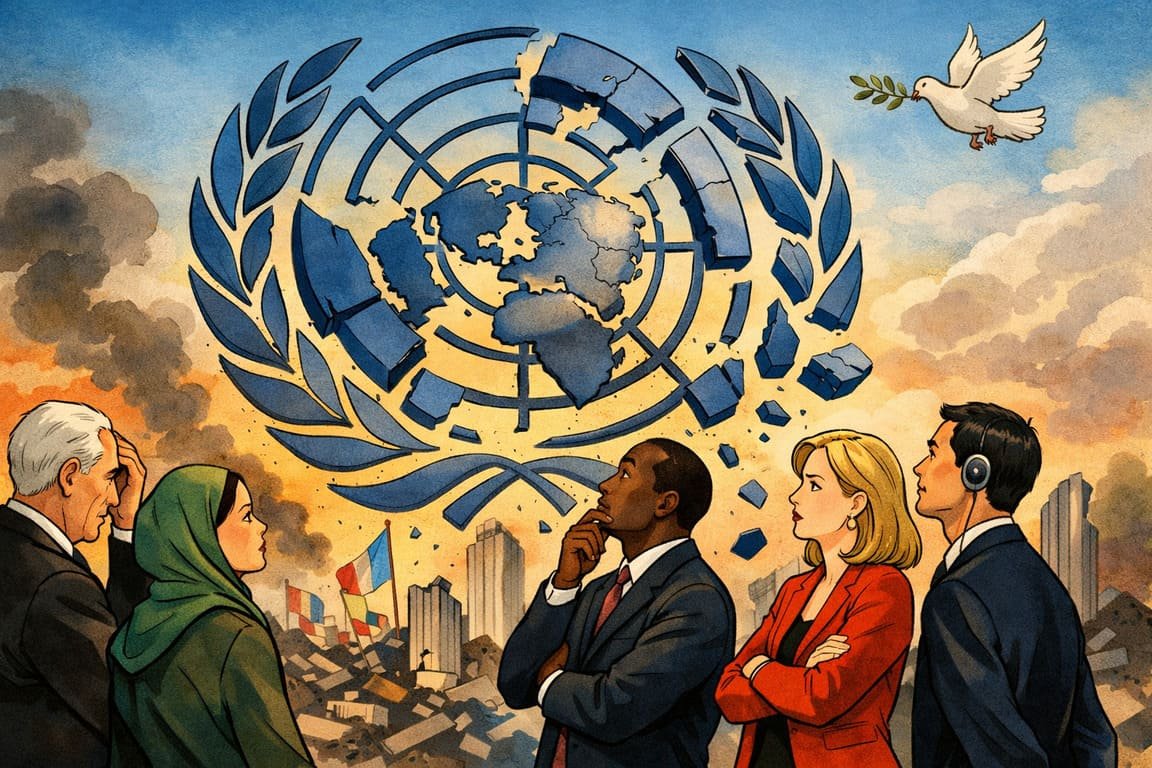
The hall is immense, almost ceremonial, yet something essential feels absent. Rows of seats wait patiently. Translation booths glow behind glass. Flags stand frozen, symbols of unity stitched in fabric rather than practice. This is the place where the world once believed coordination could replace catastrophe. Today, the atmosphere carries a quieter emotion. Not outrage. Not hope. Doubt. The kind that lingers long after speeches end.
The United Nations was born from wreckage and resolve. It was not designed as a perfect machine, but as a safeguard against humanity’s worst instincts. Cooperation was meant to be the default, not the exception. For a time, the system held. Norms formed. Dialogue replaced silence. The idea of collective responsibility gained moral weight. Then the world changed faster than the institution could.
Criticism often begins with paralysis. Decisions stall. Vetoes freeze action. Crises unfold while language is negotiated to exhaustion. To many observers, the UN appears trapped inside its own architecture, built for a balance of power that no longer reflects reality. Rising powers demand influence. Established powers defend privilege. Procedure becomes protection. Action becomes optional.
The Security Council embodies this tension most clearly. Its structure reflects a moment in history rather than the present distribution of power. When enforcement depends on the consent of the strongest, justice feels selective. Smaller nations notice. So do civilians living inside conflicts where condemnation arrives without consequence. Legitimacy erodes when fairness feels conditional.
A fictional humanitarian coordinator once described standing outside a besieged city with approval to act but no means to enforce safety. Mandates existed. Paperwork was complete. Protection did not arrive. The frustration was not ideological. It was visceral. The distance between declarations and reality measured itself in human cost.
Public perception has shifted alongside performance. The UN feels distant to many, bureaucratic and reactive. It rarely captures imagination the way it once did. Grassroots movements and direct aid organizations inspire more immediate trust. The blue helmet no longer carries mythic authority. Symbols weaken when outcomes disappoint repeatedly.
Yet dismissing the institution as irrelevant misses its quieter influence. The UN still shapes language, norms, and expectations. Human rights frameworks, environmental standards, and humanitarian principles persist long after headlines fade. Courts reference them. Activists rely on them. Governments respond to them, even when reluctantly. This is power that operates slowly, often invisibly.
The organization also remains one of the few spaces where rivals still sit together. Dialogue continues when bilateral channels collapse. Communication survives when hostility hardens. These moments rarely produce dramatic victories. They prevent disasters that never become news. Absence of catastrophe is difficult to celebrate, yet deeply consequential.
Reform dominates internal debate. Expanding representation. Limiting veto power during mass atrocities. Strengthening enforcement mechanisms. Ideas circulate endlessly, blocked by the same power dynamics they seek to correct. Change moves slowly because those with the most influence fear losing it. Pressure builds each time the system fails visibly.
Philosophically, the UN represents an idea larger than its performance. It embodies the belief that cooperation is possible even among rivals. That belief feels fragile in an era defined by fragmentation and nationalism. Abandoning the institution would normalize a world where power alone decides outcomes, a return to rules humanity once promised itself it had outgrown.
There are successes that rarely trend. Disease eradication campaigns. Refugee coordination. Environmental monitoring. Technical agencies staffed by experts continue their work regardless of political turbulence above them. These efforts do not dominate news cycles, yet they save lives and stabilize systems quietly.
The real crisis is trust. Citizens doubt relevance. States doubt fairness. Rebuilding credibility requires transparency, accountability, and courage to adapt. It also requires member nations to invest political will rather than outsource responsibility. The UN cannot rise if it is treated only as a scapegoat for collective failure.
As the lights dim in the assembly hall and delegates disperse, the promise lingers, unresolved but not extinguished. The system is undeniably strained, shaped by compromises that no longer fit neatly. Yet the alternative is a world without a common table, where disputes settle through force or indifference. Whether the United Nations rises again depends less on reform language and more on a shared decision still waiting to be made: in a fractured century, is cooperation an inconvenience to avoid, or the last structure capable of holding a divided world together?
