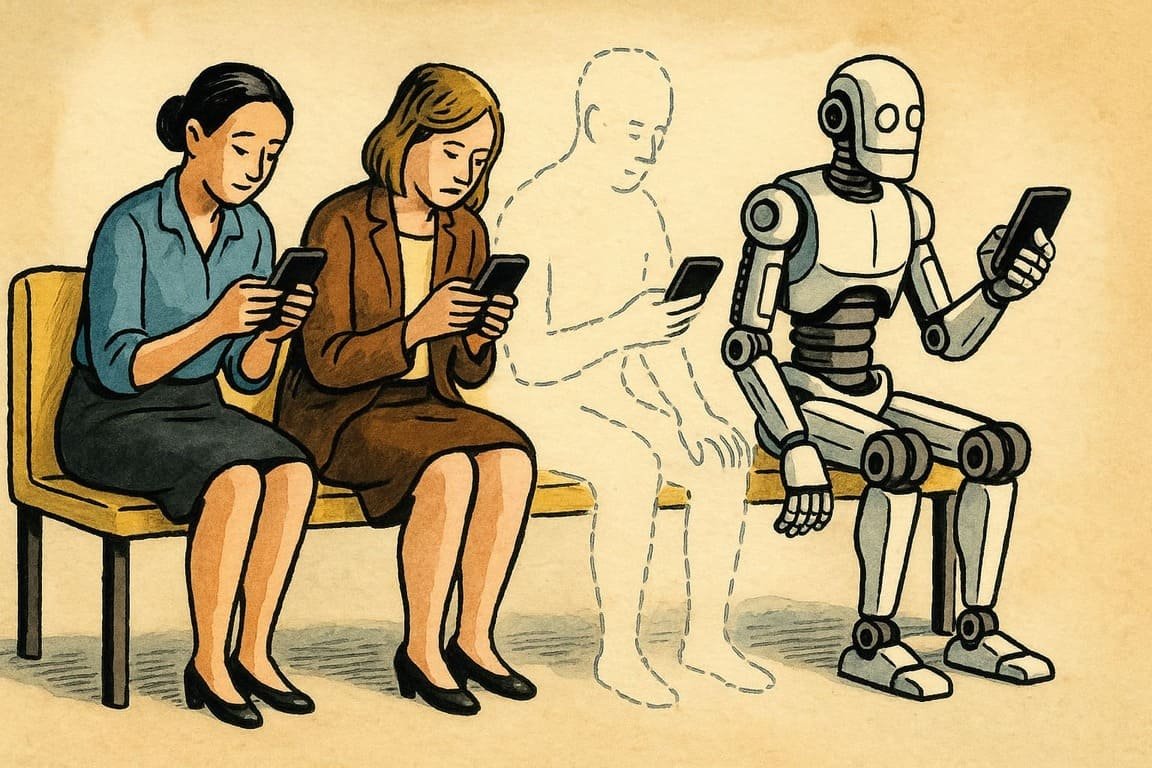
Sunlight creeps through the glass atrium of a corporate headquarters, illuminating row after row of unused desks. Screens flicker to life without a single keystroke, coffee machines hum with robotic precision, and delivery drones swirl above empty streets. The receptionist’s desk gathers dust—a potted plant withers by the window, untouched since the last human left. In the warehouse, conveyor belts sing a metallic rhythm as robotic arms sort packages with tireless grace. Above it all, a boardroom table sits polished and silent, every chair vacant, save for a single blinking conference speaker.
Somewhere in the city, a cashier checks her phone, reading the text that her shift has been cut—again. She scrolls past headlines of “record profits” and “next-gen AI solutions,” her own name missing from the company’s future plans. In the darkened server rooms below, rows of machines hum with indifferent energy, orchestrating supply chains, schedules, and firings with an efficiency that never pauses for regret.
Outside, a former cab driver waves at empty taxis, replaced by self-driving cars that neither greet nor grumble. An IT analyst refreshes her inbox, half-hoping, half-dreading the next automation announcement. Streets once busy with lunch rushes and coffee breaks now feel eerily quiet. The world is running smoother, faster—and emptier. In this new age of machines, the greatest skill is learning to survive obsolescence.
Quick Notes
- Automation’s Allure Is Ruthless: Companies chase productivity and profits by replacing workers with machines, sacrificing people for algorithms.
- People Become Collateral: Entire careers, industries, and communities vanish or shrink, leaving real pain beneath the headlines of efficiency.
- Adaptation Has Limits: Training and “upskilling” only help some; for many, the pace and scale of change are too fast to outrun.
- Resilience and Rebellion: Workers, leaders, and communities are fighting back—reinventing roles, demanding fairness, and reshaping what it means to be valued.
- Meaning Over Metrics: The future depends on putting people back at the center—rethinking progress so machines serve humanity, not the other way around.
The Seduction of the Algorithm
You’ve been told that automation means liberation. No more paperwork, no more dull routines—just creativity and meaningful work. But as factories and offices fill with sensors, scripts, and bots, the liberation starts to look like exile. For every hour saved by a machine, there’s a person cut adrift.
Companies boast of “digital transformation” with charts that spike upward, but behind each spike lies a lost paycheck, a shuttered storefront, a story untold. Sara, a loyal payroll clerk in Ohio, watched her position vanish as accounting software rolled out. “They called it progress,” she said, “but I just felt erased.”
The logic is seductive: faster, cheaper, smarter. Why pay salaries when a server works for pennies? Why risk human error when an algorithm learns from every mistake? Yet every time a company “optimizes” a workflow, a little bit of humanity drains from the process. Mistakes are replaced by glitches, conversations by chatbots, trust by transaction IDs.
This is not just a factory story. In law offices, AI drafts contracts. In hospitals, robots deliver meals and medicines. Even creative fields feel the squeeze: editors replaced by grammar bots, artists competing with image generators. The promise is abundance, but the reality is loneliness for those left behind.
What happens to a society when efficiency replaces empathy? What’s lost when the bottom line outpaces the human one?
Collateral Damage—People, Families, and Forgotten Places
The cost of automation isn’t just measured in jobs—it’s measured in broken routines, battered self-worth, and fractured communities. When machines replace people, ripple effects spread far and wide.
In Detroit, where factories once roared, automation left entire neighborhoods quiet. Carlotta, a former line supervisor, remembers her plant closing: “My friends scattered. Some moved, some just gave up.” The diner across the street closed; the barbershop lost customers. Automation didn’t just erase jobs—it erased community anchors.
Service industries once thought safe now feel the pinch. When a regional bank replaced tellers with touchscreen kiosks, elderly customers stopped coming. The local bakery lost morning traffic, students lost after-school jobs, and a sense of welcome faded from the neighborhood.
Even tech workers feel the anxiety. Parth, a junior developer, watched an AI tool automate the very code reviews he’d trained for. “If I’m not needed now, will I be needed next year?” he wonders. The old advice—just retrain—sounds thin when change comes faster than skill-building.
The pain is most acute where support is weakest: small towns, single-industry cities, aging workers, and newcomers. For many, the new economy is a locked room with no key.
Can Everyone Really Adapt?
The story goes that displaced workers will “upskill” and find new roles, but the reality is more complicated. Training programs pop up, but many are oversubscribed, underfunded, or out of touch with market needs. It’s hard to learn coding when you’re already juggling two jobs or caring for children.
Michelle, a single mother in Atlanta, took a subsidized course in cloud computing after her retail job was automated. She finished with high marks—but found every entry-level opening required “three years’ experience.” For many, the promise of a new start is a mirage.
Young people face a paradox. Schools rush to teach coding, but as AI advances, even software jobs risk obsolescence. Those without access to fast internet, supportive mentors, or up-to-date hardware find themselves at a permanent disadvantage. The digital divide deepens; the rich get retrained, the poor get left behind.
Companies praise “agility” and “resilience,” but rarely provide a safety net. Layoffs are dressed as “strategic pivots,” while stock prices climb. The pressure to adapt never relents.
Resilience is real, but it has limits. Not everyone can reinvent themselves at the speed of the latest update. The burden should not fall on individuals alone.
The Pushback—Redefining Value and Fighting for Fairness
People aren’t taking automation lying down. Across industries, workers are organizing—demanding better severance, retraining, and a say in how new tech is deployed. In Berlin, supermarket cashiers staged a walkout when self-checkout kiosks halved their hours. The result: management agreed to limit kiosks and invest in customer service training.
Some leaders are rethinking what work means. A manufacturing CEO in Minnesota, instead of automating away his whole assembly line, invested in cross-training: robots handle dangerous tasks, while people do quality control and creative problem-solving. Productivity rose, but so did morale and retention.
Communities are finding their own answers. A group of displaced taxi drivers in Mumbai pooled their savings to start a car repair cooperative—servicing the very self-driving vehicles that took their old jobs. “If the world changes,” said one founder, “so do we—but on our terms.”
Innovation can be harnessed to lift everyone, not just a select few. Policies that tax automation and invest in people, laws that guarantee a right to retrain, and businesses that choose inclusion over mere efficiency: these are the seeds of real progress.
The Human Case for Slow Tech
A better future is possible—but only if humanity leads. Machines are powerful, but they lack empathy, creativity, and conscience. The next wave of progress must focus not just on what can be automated, but what should be preserved.
Slow tech is an idea gaining ground. Instead of chasing the fastest and cheapest, some companies are investing in craftsmanship, care, and community. In Kyoto, an old textile mill integrated gentle robotics to assist aging artisans, letting tradition and technology coexist. Output dipped, but the products—woven with both human and machine hands—won worldwide acclaim.
For individuals, it means reclaiming control. Seek out businesses that value people. Learn new skills, yes, but also demand support and fairness. Value the relationships, intuition, and judgment that no machine can replicate.
For leaders and policymakers, the message is clear: don’t let efficiency eclipse humanity. Build safety nets, foster lifelong learning, and reward organizations that lift people up, not just profits.
The race to automate will never end—but the fight to be human has only begun.
Last Shift: Who Remembers the Names?
Night falls across the city, and office lights blink off one by one. In an empty break room, a faded photo collage hangs—smiling faces, team lunches, birthdays remembered. No machine pauses to look back. On the street, a cashier passes a self-checkout lane and catches her reflection in the plexiglass, remembering the friends she made and the stories she heard. The future beckons, relentless, but the need to be seen, valued, and remembered endures. One day, machines may run the world—but only you can decide if the world still feels alive.
