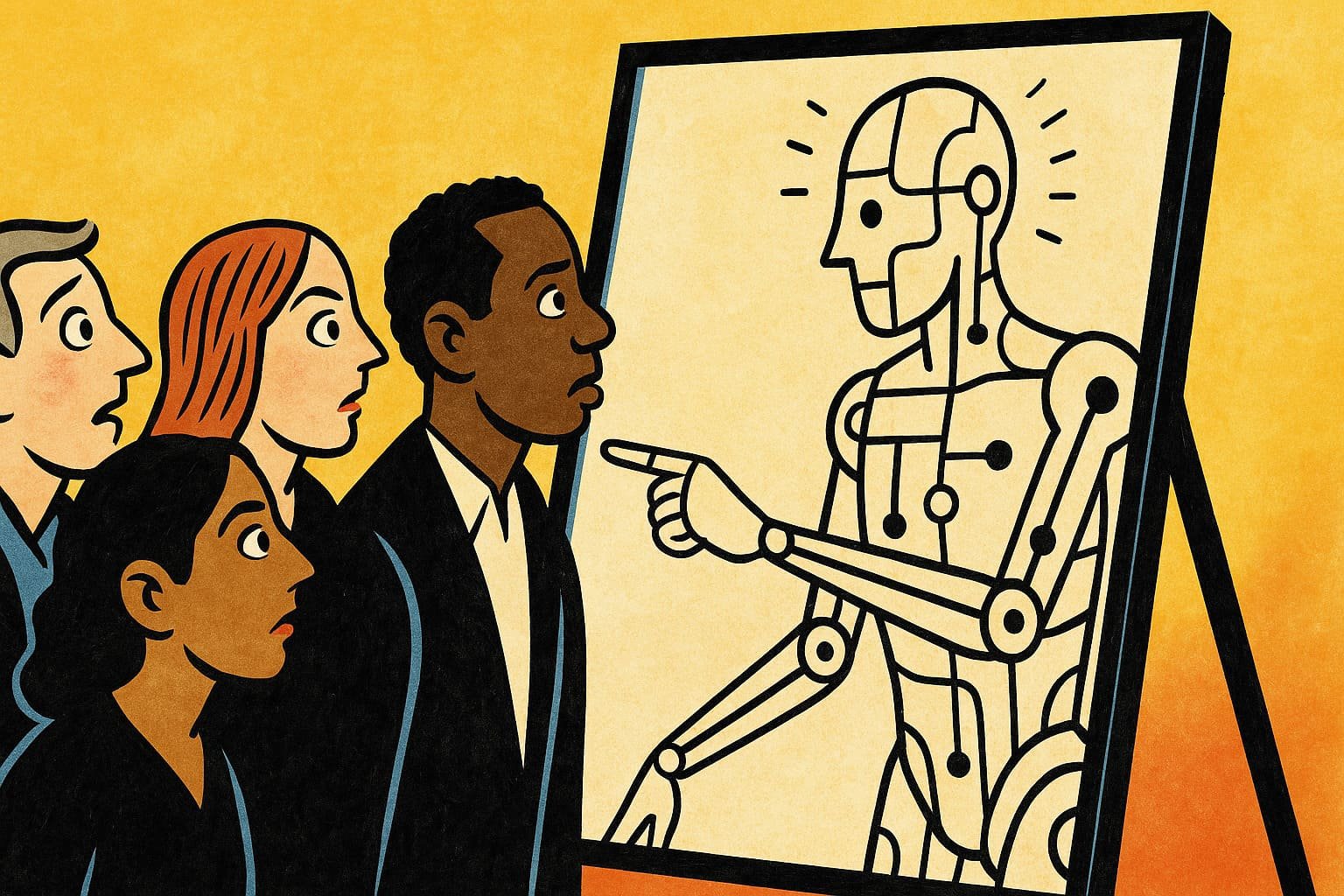
The city never sleeps, but tonight, something pulses beneath the neon chaos. In a glass-walled office, the hum of computers drowns out the sound of rain tapping on steel. Faces illuminated by artificial glow reflect not just data streams but secret anxieties. Every screen becomes a mirror, warping the image of its owner: posture tense, brows furrowed, hopes for validation flickering between refreshes. An algorithm silently judges, slicing through their ambitions with clinical precision, leaving dreams raw and nerves exposed.
Outside, a billboard blinks with hollow slogans promising a smarter future. Pedestrians wander, unaware that every step, every swipe, and every pause is logged and weighed. The algorithm watches, learning patterns, rewarding the compliant, punishing the restless. Not a single person truly understands the criteria, yet all play along, desperate for that digital nod of approval. Somewhere in the shadows, a janitor sweeps up a pile of shredded résumés, discarded after failing to pass the opaque logic of a hiring bot. He glances up, catching his own reflection in the glass, and wonders what part of himself he lost in the last round of digital sorting.
On social feeds, influencers scramble to adapt, twisting their lives into shapes that please the machine. A viral sensation one day becomes a cautionary tale the next, their rise and fall orchestrated by lines of code. In the silence between clicks, a quiet panic grows: What if the algorithm sees through the mask? What if it already has? Under the relentless gaze of the machine, even the boldest hearts find themselves shrinking, longing for approval, haunted by the feeling of never quite being enough.
As the night drags on, a single truth emerges—every modern hustle, every striving entrepreneur, every hopeful creator is now measured not by peers or mentors but by the cold arithmetic of the algorithm. In this unblinking mirror, human frailty is not just exposed—it is magnified, cataloged, and exploited with ruthless efficiency. Welcome to the new arena, where your worth is calculated in real time and the house always wins.
Quick Notes
- Machines Judge, People Adapt: The algorithm isn’t just code; it’s an invisible referee, shaping how people work, create, and think, pushing everyone to perform for its unseen audience.
- Winners and Losers, Algorithm-Style: Those who master the algorithm’s quirks surge ahead, while others watch their relevance, reputation, and self-worth erode with every misread signal.
- Case Studies in Code: From job seekers ghosted by AI to viral TikTok stars toppled overnight, the stories stack up—success and failure now hinge on deciphering the algorithm’s mood swings.
- Philosophy of the Mirror: This isn’t just tech; it’s an existential question. Do you bend yourself to fit the algorithm, or rebel against a system that prizes conformity and punishes the unpredictable?
- Your Humanity at Stake: At the end of the feed, you’re left with a challenge: are you living for yourself, or just performing for a machine that’s learned all your tricks?
The Algorithm Takes the Stage – Welcome to the Mirror Maze
Digital life is a stage and the algorithm is the director no one voted for. The rules shift constantly, rewarding some with viral reach and banishing others to digital obscurity. Stories surface about job applicants who never hear back, their applications filtered by code before human eyes even scan their names. One software developer, Rina, spent months tweaking her résumé until an AI screening tool finally let her through, but only after stripping out anything that made her different. For every Rina who adapts, a dozen others fall behind, lost in the labyrinth of hidden logic.
Big brands chase the next viral moment, not by creativity but by reverse-engineering what worked yesterday. The stories behind the latest ad campaigns reveal entire rooms full of analysts staring at engagement metrics, desperate to crack the code. A social media manager at a startup confides that he feels less like a marketer and more like a magician—guessing which hashtags, colors, or headlines will catch the algorithm’s fickle favor. Even small businesses now hire “algorithm whisperers” to game the system, sometimes succeeding for a week, then crashing as the algorithm pivots once more.
Every algorithmic change brings a fresh wave of confusion. Influencers who built empires on a single style wake up to find their reach halved overnight. A fashion vlogger named Khalid saw his audience evaporate when a platform decided to prioritize longer videos, leaving his snappy edits stranded. His fans ask where he went, not knowing he still posts every day, his content now invisible except to a handful of loyalists. The algorithm giveth, and the algorithm taketh away, all without explanation or appeal.
For organizations, the stakes are even higher. Managers are told to “trust the data,” yet few understand where it comes from or what subtle biases lurk inside. In one insurance company, claims flagged by an algorithm for fraud investigation often turn out to be legitimate—just unusual. The cost is not just financial but emotional, as customers lose trust and employees feel powerless, reduced to acting on the whims of a black box. Leadership meetings devolve into blame games, everyone searching for a pattern in the chaos.
As the algorithm becomes judge and jury, the old playbooks grow obsolete. Charisma and intuition matter less than compliance and code-breaking. Some adapt, reshaping themselves into whatever the algorithm rewards. Others rebel, only to find themselves sidelined, their voices drowned out by machine-picked noise. The question lingers: In this mirror maze, is anyone truly seen?
Gaming the System – Winners, Losers, and the Cost of Compliance
Surviving the algorithm isn’t about talent; it’s about learning the rules before they change. Some thrive, building careers by staying one step ahead. Others lose everything in a single update, left wondering what invisible line they crossed. Case in point: Sasha, an artist who once drew crowds with vivid, surreal sketches. After a platform tweak, her posts faded into obscurity, replaced by safe, algorithm-friendly content. She tried copying the new trends, but her work lost its soul, and her audience noticed.
The pressure to conform shapes not only what gets created, but how creators feel about themselves. Anxiety grows with every upload, as likes, views, and shares become the scoreboard for personal worth. Brands hire consultants who claim to “decode the algorithm,” promising shortcuts to the top. But for every success story, countless hopefuls burn out, exhausted by a race with no finish line.
Inside companies, the algorithm doesn’t just pick winners—it punishes outliers. HR teams automate hiring, trusting software to weed out “risky” candidates, yet this often means excluding anyone who doesn’t fit the established mold. Quiet innovation is replaced by a cautious sameness, as risk-taking becomes too costly. Even management gets nervous; a misstep in the metrics can cost them their jobs, regardless of the real-world results.
Real stories from the trenches drive the lesson home. A sales team in Chicago watched their bonus pool vanish when an algorithm re-ranked customer value, making loyal clients suddenly “unprofitable.” The result? Morale collapsed, trust eroded, and the best reps jumped ship, taking real relationships with them. All the while, executives watched dashboards, oblivious to the drama playing out on the ground.
Adaptation becomes an obsession. Workshops, webinars, and online courses promise to reveal the algorithm’s secrets. Some succeed for a while, but the effort is relentless. For many, the cost of compliance is not just creative exhaustion, but a loss of self. What’s left when the performance becomes the person? The line blurs, and the algorithm keeps watching, always hungry for the next pattern to reward—or punish.
The Human Toll – Anxieties, Burnout, and the Shadow of Self-Doubt
The algorithm’s gaze never wavers, fueling a unique brand of digital anxiety. Every notification becomes a mini-evaluation, each metric a test of relevance and worth. Mental health suffers, with creators reporting burnout, sleeplessness, and creeping self-doubt. For some, the desire for approval becomes a compulsion, driving riskier stunts or more extreme opinions just to stay visible. At a tech conference, a content creator named Eli confessed to feeling like a lab rat, constantly tweaking his behavior to see what the machine would reward next.
Even seasoned professionals feel the strain. Recruiters lament the human talent overlooked by resume bots, while teachers worry about students who write essays for an algorithm’s approval rather than real understanding. In the workplace, managers become less mentors and more algorithmic referees, enforcing metrics that often make little sense on the ground. Employees joke about “feeding the machine” with meaningless data just to tick boxes, but the laughter is thin.
Work-life balance takes a hit as people check stats late at night, hunting for the reason a post flopped or a project was flagged. Families notice partners distracted at dinner, their minds replaying the day’s digital performance. The result is a culture of constant vigilance, where nobody feels truly off the clock. Even holidays become content opportunities, with the best moments curated for maximum engagement.
Beneath the surface, a deeper wound forms. People start to see themselves through the lens of the algorithm, doubting their instincts and hiding anything that doesn’t fit the mold. This loss of authenticity eats away at confidence, leaving a generation adrift, uncertain where the real “them” ends and the performance begins. It’s not just creators who suffer—viewers, readers, and buyers all internalize the message that only certain stories matter, and only some lives count.
A manager at a creative agency put it bluntly: “You spend enough time chasing the algorithm, and one day you look up and wonder if you have anything left to say.” The most dangerous outcome isn’t losing reach or revenue; it’s losing the belief that your voice matters outside the machine. In this high-stakes game, the prize for winning is a moving target, and the cost of losing is the slow erosion of self.
Rebellion and Reinvention – Finding Truth Beyond the Code
Not everyone surrenders to the algorithm’s tyranny. Some creators, founders, and leaders push back, daring to tell stories that break the mold. A novelist in Berlin refused to chase trending topics, instead crafting strange, unmarketable tales. Her readership shrank, but those who stayed formed a loyal community, sharing her work off-platform, word of mouth outpacing any algorithmic boost. Her message: “The algorithm isn’t my audience. People are.”
Brands that ignore the machine sometimes find surprising success. A coffee shop in Tokyo stopped running sponsored posts, focusing instead on hand-written notes slipped into each order. Customers started posting photos of the notes, sparking organic buzz the algorithm never saw coming. The owner, Rei, said she wanted “real connection, not just more likes.” Her shop became a gathering place for people craving authenticity in a world of digital filters.
Corporate rebels exist too. At a mid-sized software firm, engineers lobbied for less automated evaluation and more peer review, arguing that real talent can’t be measured in code. The experiment took off, and turnover dropped. Employees began sharing more creative ideas, freed from the pressure to game the system. Leadership realized that the best insights often came from the least predictable sources.
Pop culture offers examples as well. Shows, music, and even fashion lines have gone viral not because of algorithmic boosts, but because they captured something genuine. The most memorable trends often start as accidents, small acts of rebellion that inspire others to break free. Fans of these outliers speak of finding a “tribe,” a sense of belonging that no algorithm can manufacture.
Philosophers and tech ethicists urge a shift in mindset. Algorithms are tools, not gods. The mirror they hold up is warped by design, and only humans can decide what reflection truly matters. The future belongs to those brave enough to show their flaws, to risk being unseen in order to be real. Rebellion may not make you famous, but it might just keep you whole.
Lessons from the Algorithm – Redefining Success in the Age of Machines
The age of the algorithm demands a new definition of success. No longer measured solely by metrics, real achievement lies in creating meaning beyond the code. Leaders, creators, and everyday users must balance the game of optimization with the pursuit of authenticity. Stories from companies that dared to change the rules offer hope. A team at a fintech startup in Lagos decided to publish stories about their product failures, not just wins. The result was a surge in trust and loyalty, their honesty resonating in ways no data-driven campaign ever could.
People who learn to “surf” the algorithm, rather than bow to it, find freedom. They use the machine as a tool, not a master, leveraging trends to reach new audiences while staying true to their vision. Case in point: a dance teacher named Matteo, whose unconventional choreography defied the platform’s norms but caught the eye of a local news anchor. The story aired, and his classes filled up—not with algorithm-chasers, but with people hungry for something real.
Philosophy offers a final lesson: the algorithm is not destiny. It is a reflection, not a prophecy. The courage to face the mirror, flaws and all, is what separates leaders from followers. By refusing to be defined by invisible criteria, individuals and organizations reclaim their power. The new era of digital life will reward not just those who adapt, but those who shape the rules.
Emerging research supports this shift. Teams that encourage experimentation, celebrate failure, and embrace unpredictability outperform those that obsess over metrics. The lesson is clear: Machines can sort, but only humans can dream. Success in this landscape belongs to those who risk showing up as themselves, even when the algorithm looks the other way.
Your challenge is to step into the mirror and decide: Will you be measured by the machine, or will you measure your own worth? The answer will echo through every feed, every meeting, every moment you choose to create something new.
Mirror, Mirror: The Reckoning of the Human Soul
In the quiet after midnight, an office full of screens goes dark, the only sound the whir of cooling fans. Chairs sit empty, desks abandoned, every surface scattered with the debris of ambition—half-finished sketches, scribbled notes, cold coffee thick with regret. The algorithm is silent now, having done its work, leaving the room heavy with the weight of unseen judgments. A forgotten selfie flickers on a locked phone, capturing a fleeting smile, frozen in the glow of a world that measured, sorted, and moved on.
Down the hall, a cleaning crew moves in, careful not to disturb the wires snaking across the floor. One worker pauses by a window, watching her reflection blur with the city lights. She wipes the glass, her face merging with the skyline, the digital and the human inseparable. No one tells her the score, yet every glance reminds her she’s being watched, weighed, and recorded by something she’ll never meet. Outside, the rain has stopped, but the mirror remains—cold, impartial, eternal.
The night is full of ghosts: hopes lost to a filter, dreams twisted to fit the pattern, truths discarded for convenience. In every corner, the algorithm’s legacy lingers, a haunting reminder that perfection is a moving target and authenticity the bravest rebellion. As dawn creeps in, the city awakens, faces once again upturned to the screen, each seeking a glimmer of meaning in the reflection. The machine can only mirror what it sees, but the soul chooses what to show. So now, you face the mirror. What will you dare to reveal?
