A rooftop crowd gathers under dim neon, where every gesture feels slightly rehearsed and every laugh arrives a fraction too early. Someone adjusts their outfit, not because it feels right, but because it might photograph better. Conversations orbit around what is new, what is rising, what is already fading. No one says it out loud, yet everyone senses it. Cool is here, for a moment, and already preparing to leave. The air carries a quiet urgency, as if meaning itself is on a timer.
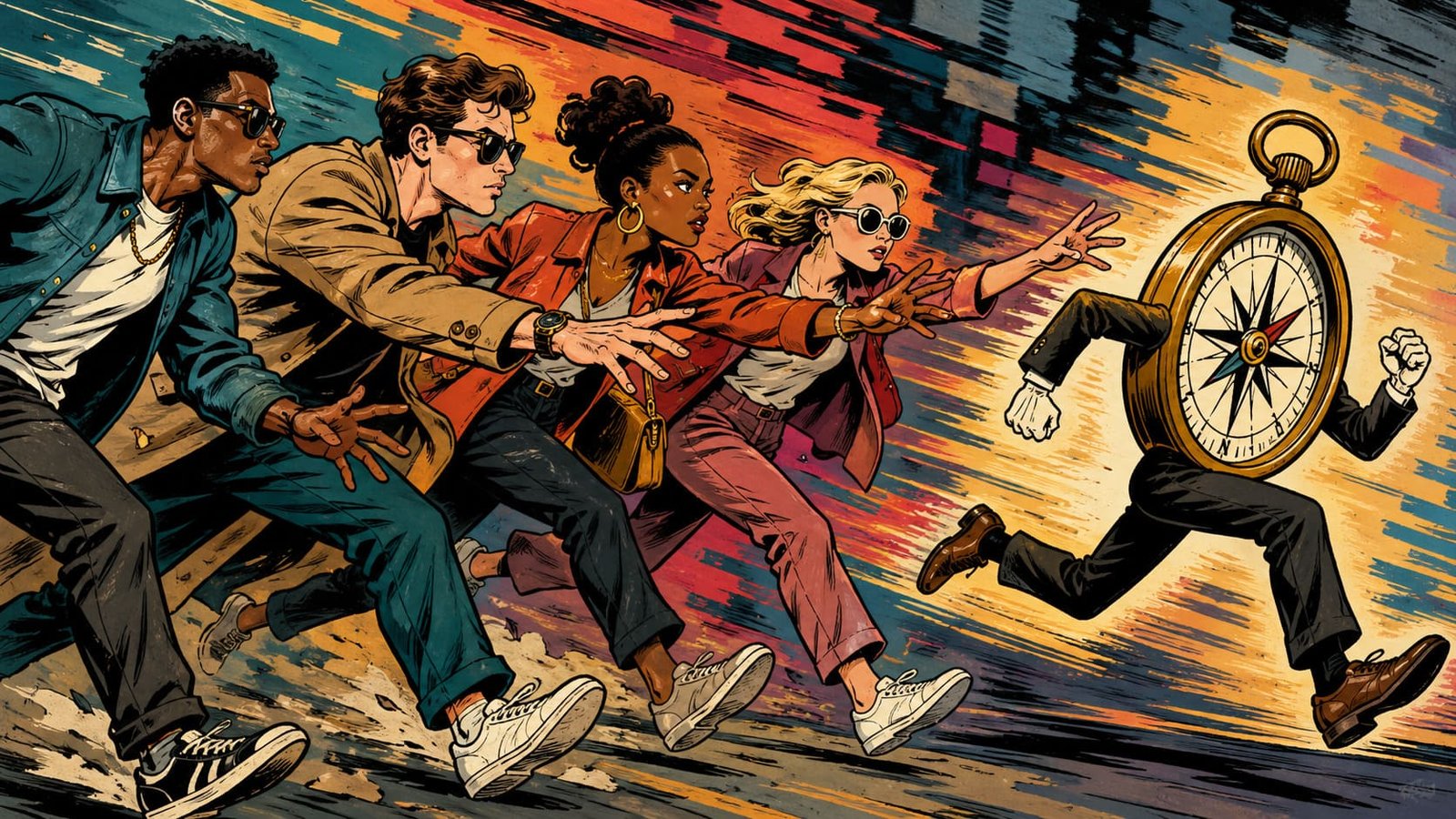
Cool has always been unstable, but it now moves with a speed that strips it of depth. What once signaled subculture, resistance, or identity now cycles through visibility so quickly that it rarely has time to root itself. The moment something becomes widely recognized, it begins to lose the very quality that made it compelling. The system rewards discovery, then punishes it for succeeding. Meaning becomes collateral damage in the process.
There was a stylist named Niko who built his reputation on spotting emerging aesthetics before they reached mainstream attention. His early work felt raw, almost accidental in its brilliance. As his profile grew, brands sought his ability to identify what would be “next.” Niko found himself accelerating his process, scanning faster, deciding quicker, moving ahead of his own instincts. The results remained impressive, but something shifted. He no longer discovered cool. He manufactured it under pressure, and it showed in ways only he could feel.
The chase itself changes the object. When cool becomes a target, it loses its spontaneity. It begins to feel constructed, calculated, slightly hollow. This creates a paradox. The more effort applied to capturing cool, the less authentic it appears. A brand strategist named Elara once described this during a campaign debrief. “The moment we explain why something is cool,” she said, “it stops being cool.” Her team had spent months analyzing trends, only to produce work that felt technically perfect but emotionally flat.
This dynamic extends beyond fashion or media into broader cultural behavior. People begin to orient their choices around anticipation rather than experience. Instead of asking what resonates, they ask what will resonate next. This subtle shift creates a distance between action and meaning. Decisions become strategic rather than expressive. The result is a kind of cultural performance where authenticity is simulated rather than lived.
A musician named Kian experienced this tension while navigating a rapidly growing audience. His early tracks carried a sense of exploration, sounds layered with uncertainty and curiosity. As attention increased, expectations followed. Listeners began to associate him with a specific style. Kian felt pressure to evolve quickly, to stay ahead of what his audience might tire of. In doing so, he moved away from the process that had originally defined his work. The music remained polished, but it lost a certain unpredictability that had made it compelling.
Pop culture amplifies this cycle by constantly refreshing what is considered relevant. Platforms highlight novelty, pushing new content to the forefront while older work fades regardless of its quality. This creates an environment where staying visible requires constant reinvention. The pace leaves little room for reflection. What matters is not what something means, but how quickly it can be replaced.
A creative director named Amadou once experimented with slowing this cycle within his team. He encouraged projects that resisted immediate release, allowing ideas to mature without external pressure. The initial response was discomfort. Without the urgency of trends, the team felt uncertain about direction. Over time, however, the work developed a different character. It carried depth that did not depend on timing. It resonated in ways that felt less immediate but more enduring.
The psychological impact of chasing cool is often overlooked. It creates a continuous state of comparison, where individuals measure themselves against a moving standard. Satisfaction becomes temporary, quickly replaced by the need to adjust. This can lead to a sense of instability, where identity feels contingent on external validation. The pursuit becomes less about expression and more about maintaining relevance.
A small collective of designers led by Sorin chose to step outside this cycle. They focused on projects that aligned with their own rhythms rather than external signals. Their work did not always align with current trends, and it did not always receive immediate attention. Yet over time, it developed a distinct presence that attracted those seeking something different. Sorin often described their approach as “building meaning first, letting cool follow if it wants to.”
The broader culture continues to oscillate between fascination and fatigue. Cool remains a powerful force, shaping perception and influencing behavior. Yet its increasing speed creates a sense of emptiness that is difficult to ignore. When everything can be labeled cool, the label itself begins to lose significance.
There is a quieter alternative that exists beneath the surface. It does not reject cool entirely, but it refuses to chase it. It allows meaning to form through sustained engagement rather than rapid recognition. This approach feels slower, less visible, sometimes even out of step with the moment. Yet it offers a different kind of stability, one that does not depend on constant adjustment.
The rooftop crowd begins to thin, not dramatically, just enough to reveal the space between people. The neon still glows, the music still plays, but the urgency softens. Cool has already moved somewhere else, leaving behind traces that feel less substantial than they did an hour ago. The scene remains, but its center has shifted.
Stand in that space for a moment and consider: are you chasing what disappears, or building something that still matters when the attention moves on?
