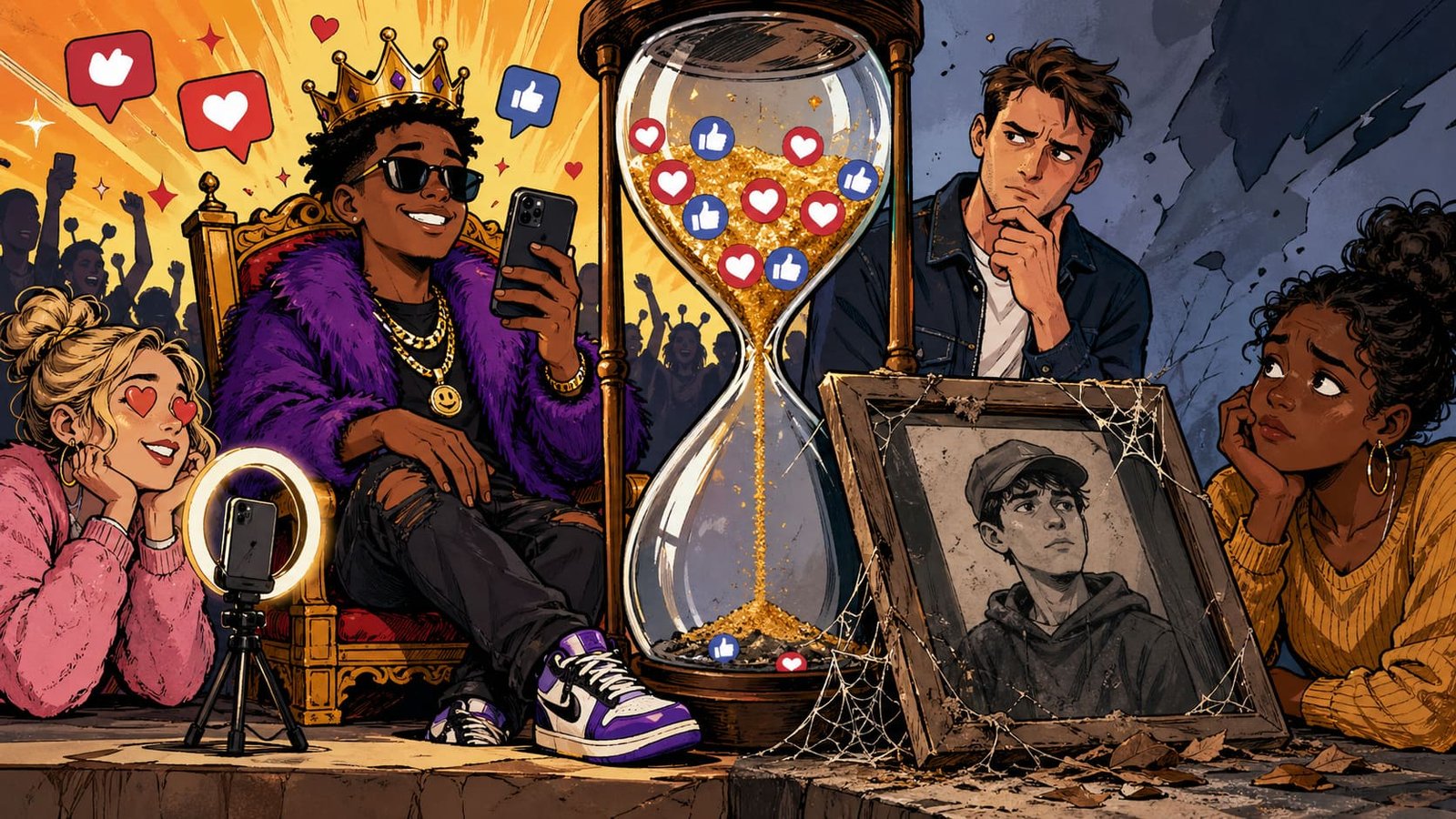
A clip flickers to life on a stranger’s screen, less than a minute long, bright enough to interrupt a tired thumb. Laughter erupts somewhere far away, then closer, then everywhere at once. Within hours, the face in that clip is no longer a person but a pattern, replicated, remixed, stitched into thousands of variations that feel both original and identical. The crowd gathers not around meaning but around motion. Something has happened, though no one can quite say what. An icon has been born, already aging.
Virality does not build slowly. It detonates. It takes ordinary moments and stretches them across the surface of culture until they feel unavoidable. The promise is intoxicating. Anyone can become visible. Anyone can break through. The reality is sharper. Visibility arrives without context, without foundation, without time to stabilize. It is attention without gravity. It lifts quickly, then drops just as fast, leaving behind the echo of something that never fully formed.
There was a street photographer named Juno who captured a candid moment of a dancer on a rainy evening. The image carried a strange energy, a mix of defiance and grace that people could not ignore. It spread overnight. Accounts reposted it with captions that shifted its meaning each time. Within days, the dancer was invited to events, offered collaborations, pulled into a narrative she did not create. Juno watched as the image detached from its origin. The dancer became a symbol, then a meme, then a memory. Weeks later, the attention moved on. The offers slowed. The story dissolved, leaving behind fragments that no longer connected.
Virality rewards immediacy. It favors what can be understood quickly, shared instantly, repeated endlessly. This shapes the kind of content that rises. Complexity struggles. Nuance gets trimmed. What remains is a distilled version of an idea, sharp enough to cut through noise but often too thin to sustain interest. The system does not ask if something should last. It asks if it can spread.
A product designer named Elias once described his experience launching a tool that unexpectedly went viral. Traffic surged, sign-ups flooded in, and for a brief moment it felt like validation. Then the cracks appeared. Users who arrived through hype expected immediate perfection. Feedback turned impatient. Retention dropped as quickly as it had risen. Elias realized that virality had skipped a step. It delivered scale without relationship. The product had been seen before it had been understood.
This creates a peculiar tension between recognition and relevance. Being known is no longer the same as being valued. A viral moment can create the illusion of importance, but it rarely builds the depth required for longevity. Icons formed through virality often lack the infrastructure to sustain themselves. They are celebrated intensely, then replaced without ceremony.
Pop culture amplifies this cycle with remarkable efficiency. A phrase, a dance, a sound, each can dominate global attention within hours. Brands rush to attach themselves, creators scramble to participate, audiences consume and move on. The speed is exhilarating, but it compresses time in a way that leaves little room for reflection. What once took years to build can now rise and fall within days.
A content strategist named Mirek worked with emerging creators navigating this landscape. He noticed a pattern. Those who experienced sudden virality often struggled more than those who grew steadily. The pressure to replicate success became overwhelming. Every new post was measured against the peak. Creativity narrowed under expectation. Mirek encouraged one client to slow down, to resist the urge to chase another viral hit. The audience shrank. The engagement deepened. It was less dramatic, but more sustainable.
Virality also reshapes how culture assigns value. It shifts focus from substance to signal. What matters is not only what something is, but how widely it circulates. This creates a feedback loop where visibility reinforces itself. The more something is seen, the more it is perceived as important. The system rarely pauses to ask whether that importance is earned.
There is a psychological cost to this rhythm. Constant exposure to rapidly changing icons creates a sense of instability. What feels significant today may feel irrelevant tomorrow. This can erode trust in long-term commitments, whether to ideas, people, or projects. It encourages a mindset that prioritizes immediate impact over enduring meaning.
A small independent musician named Rhea chose a different path. She released songs quietly, without chasing trends or optimizing for shareability. Her audience grew slowly, almost invisibly at first. Listeners returned not because the music was everywhere, but because it stayed with them. Years later, her work carried a weight that viral hits often lack. It was not defined by a moment. It was defined by accumulation.
The broader culture continues to celebrate the spectacle of sudden rise. It is compelling, dramatic, easy to narrate. Yet beneath that spectacle lies a quieter reality. Most viral moments do not translate into lasting influence. They flare, they scatter, they disappear into the archive of things that once mattered briefly.
The tension remains unresolved. People are drawn to the possibility of instant recognition, even as they recognize its fragility. The system offers a shortcut, but it rarely delivers the depth that comes from slower growth. It creates icons that shine brightly, then fade before they can fully take shape.
The screen refreshes again, presenting a new face, a new moment, a new surge of attention waiting to be amplified. The previous icon slips into the background, not erased, but no longer central. The cycle continues, smooth and uninterrupted, driven by a constant appetite for what comes next.
Hold that image for a moment and consider: are you chasing visibility that vanishes, or building something that can survive when the spotlight moves on?
