A whiteboard fills with neat arrows and clean boxes, each one reducing a messy situation into something that looks almost elegant. The room feels lighter once the diagram is complete, as if confusion itself has been solved. Outside that room, the situation remains tangled, full of contradictions that refuse to sit inside those boxes. Yet the simplified version travels further, faster, and with far more confidence than the truth it replaced.
Simplicity has always been attractive, but in the current media environment it has become dominant. Clear narratives move easily across platforms, while layered explanations struggle to keep pace. The philosopher Hannah Arendt warned that complex realities are often flattened into digestible forms, especially in times of uncertainty. That flattening creates comfort, but it also distorts. When ambiguity is removed, so is a significant part of what makes reality real.
The shift shows up in how decisions are made, often without being noticed. A strategy consultant named Bruno once presented two options to a client. One was a simplified plan with clear steps and predictable outcomes. The other acknowledged uncertainty, offered multiple paths, and required ongoing adjustment. The client chose the simpler option almost immediately. Months later, the project faced challenges that the second plan had anticipated. Bruno reflected on the moment not with frustration, but with recognition. The simpler story had felt safer, even though it was less accurate.
Inside organizations, the pressure to simplify can become structural. A communications lead named Amara described it during a workshop where the air carried the faint smell of dry markers and paper. She explained that internal reports often undergo multiple rounds of editing, each one trimming nuance in favor of clarity. By the time the message reaches leadership, it reads as decisive and clean. The uncertainty that shaped the original analysis has been quietly removed. Decisions are then made on the basis of a version of reality that feels complete, but is not.
This tension becomes even sharper in public discourse. Complex issues rarely fit into neat categories, yet they are often presented that way. Consider debates around economic policy or climate strategy. Multiple variables interact, outcomes remain uncertain, trade-offs are inevitable. When Yuval Noah Harari speaks about narratives shaping collective understanding, it highlights how simplified stories can guide large groups of people, even when they omit critical details. The story becomes a tool for coordination, but also a filter that removes complexity.
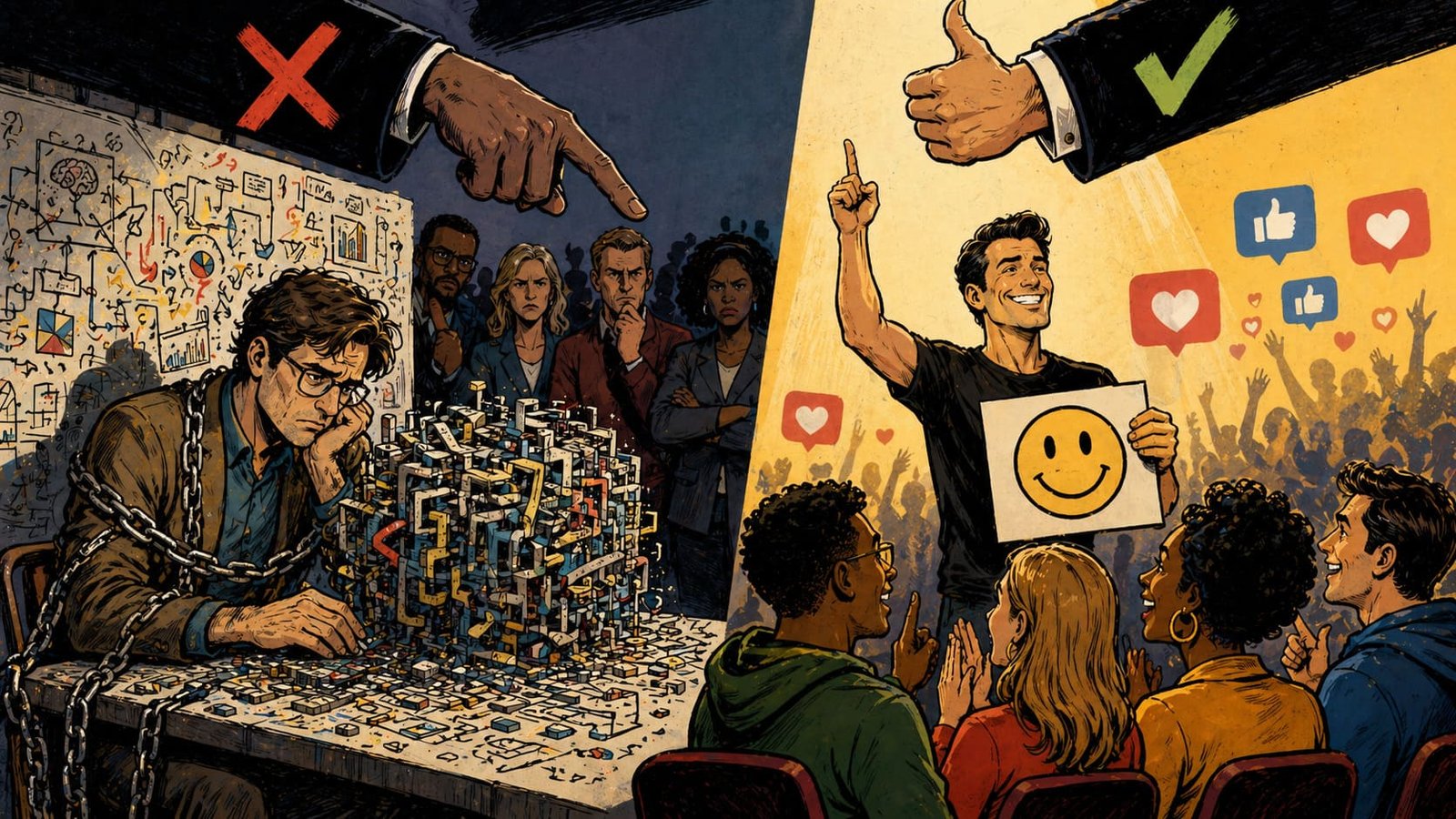
A small research lab in Helsinki once experimented with presenting findings in two formats. One report embraced nuance, detailing uncertainties and multiple interpretations. The other distilled the same findings into a clear, singular narrative. The simplified version spread quickly, cited in discussions and media coverage. The nuanced report received praise from experts but limited attention. The team noticed something that felt almost paradoxical. The version that carried less information had more impact. Clarity had outperformed accuracy.
Pop culture reinforces this preference with relentless consistency. Stories that follow clear arcs, with defined roles and outcomes, dominate attention. Characters are either heroes or villains, conflicts resolve in ways that feel satisfying. These patterns shape expectations beyond entertainment. When real-world situations do not conform to these structures, they can feel unsatisfying or incomplete. The audience begins to prefer stories that resemble fiction, even when dealing with reality.
The deeper consequence is not only misunderstanding. It is the marginalization of complexity itself. A policy analyst named Noor once observed during a public forum that speakers who acknowledged uncertainty were perceived as less confident, even when their insights were more grounded. The audience gravitated toward those who spoke in absolutes. Certainty, even when unfounded, carried more authority than careful reasoning. Complexity was not just overlooked. It was quietly penalized.
There is a moment when this pattern becomes visible, often accompanied by a subtle discomfort. It feels like noticing that the map being used to navigate the world has been simplified to the point of distortion. The roads look clear, the directions straightforward, yet the terrain does not match. This realization does not make navigation easier. It makes it more honest. It introduces friction where smoothness once existed.
Somewhere in a quiet library, a researcher sits surrounded by texts that refuse to resolve into simple conclusions. The air smells faintly of paper and time, the kind of space where ideas unfold slowly. Outside, conversations move quickly, driven by headlines and soundbites. Inside, complexity remains intact, demanding patience, resisting compression. The contrast feels almost stark.
As simplified narratives continue to dominate the conversation, a question lingers, steady and difficult to dismiss: if clarity has become the currency of attention, what truths are being quietly traded away in the process, and how much of reality are people willing to lose for the comfort of a story that finally makes sense?
