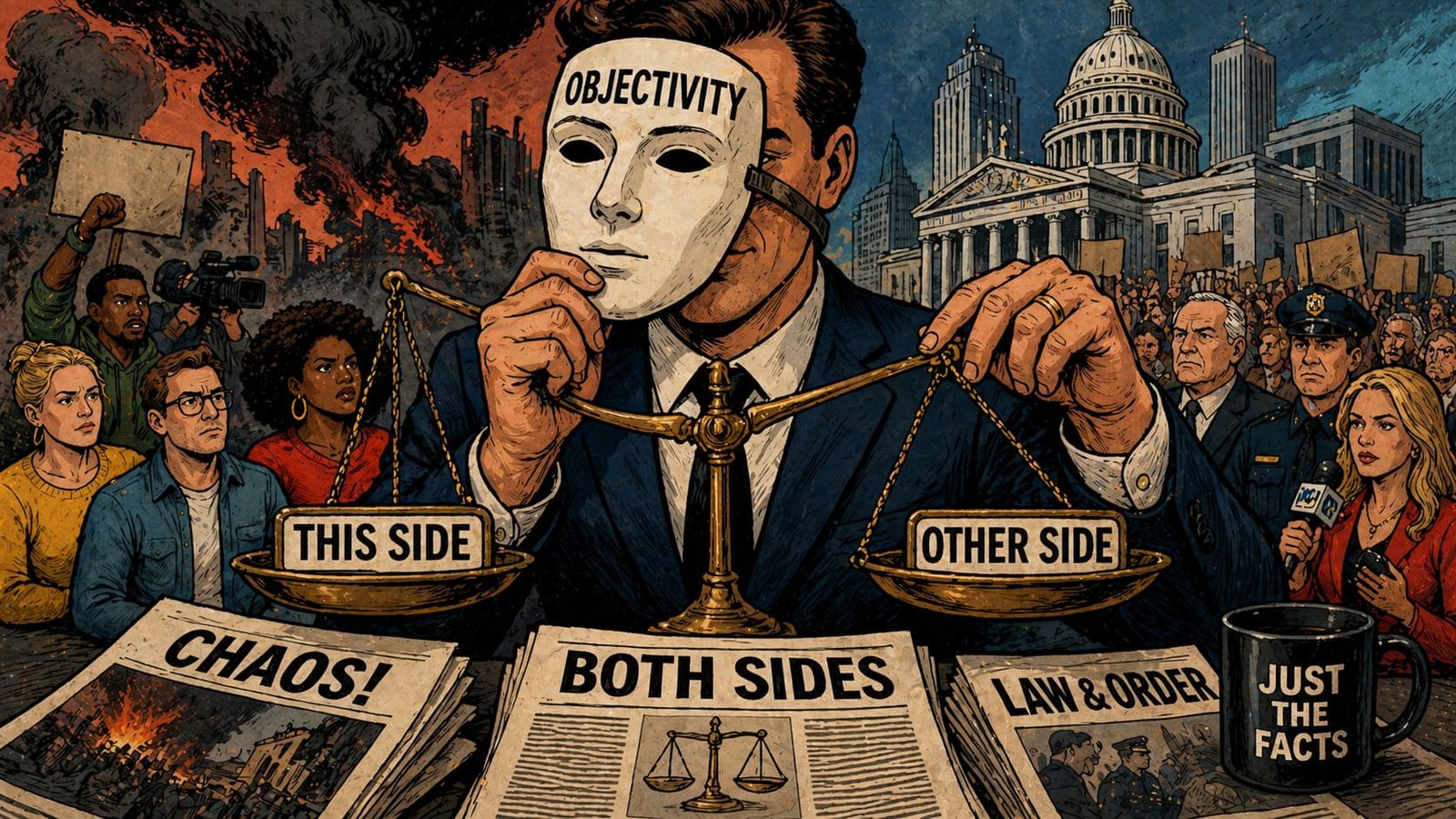
A newsroom glows at dawn, screens flickering like small altars, each one offering a version of the world that feels clean, balanced, almost sterile. The language is careful, measured, polished to the point of invisibility. Words like “neutral,” “fair,” and “objective” hover in the air like quiet promises. Nothing seems out of place. No voice appears louder than another. Yet beneath that calm surface, something far less neutral hums with quiet precision, deciding not just what is said, but what is allowed to exist at all.
Objectivity, in its purest form, sounds like the moral high ground. It suggests distance, discipline, restraint. It implies that truth can be approached without fingerprints. But that ideal rarely survives contact with real systems. The historian Howard Zinn once argued that neutrality often ends up siding with the status quo, not because it intends to, but because it avoids challenging it. When a narrative presents two sides as equal, even when power between them is wildly uneven, the presentation itself becomes a choice. Silence can tilt the scale as much as speech.
That tilt is rarely obvious in the moment. It hides in structure, in sequencing, in the quiet decisions about what deserves attention. A policy advisor named Renata once reviewed coverage of a labor dispute while sitting in a glass-walled office overlooking a restless city. One article quoted executives extensively, presenting their concerns with calm authority. Workers appeared briefly, their voices condensed into a few lines that felt almost decorative. Nothing in the piece was factually incorrect. Yet the weight of credibility leaned heavily in one direction. Renata did not feel misinformed. She felt subtly guided.
This is where the idea of objectivity begins to fracture. Every story requires selection. What to include, what to omit, whose voice to amplify, whose to compress. These are not neutral acts. They are acts of design. A senior editor named Lucien once admitted during a quiet conversation that editorial meetings often revolve around framing rather than facts. The facts are usually clear enough. The question becomes how to arrange them so the story holds together. Arrangement is power. It shapes interpretation long before the reader notices.
The tension deepens when institutions present themselves as above influence. Authority gains strength when it appears impartial. When Noam Chomsky spoke about media systems, he pointed to how structural incentives shape narratives without requiring explicit coordination. Ownership, advertising pressures, cultural norms, all of these factors create boundaries around what feels acceptable to publish. No one needs to issue direct orders. The system learns to regulate itself. Objectivity becomes less about truth and more about staying within those invisible lines.
A media entrepreneur named Kwame once tried to disrupt this pattern with a platform that prioritized underrepresented voices. The early days felt electric, full of energy and conviction. Stories emerged that had rarely been told with depth or dignity. Yet as the platform grew, advertisers began to nudge. Investors raised questions about tone. Kwame noticed a slow drift. Content that challenged dominant narratives too directly faced subtle resistance. Not rejection, just hesitation. Over time, the platform softened its edge. It still claimed objectivity, but the boundaries had quietly shifted. The system had adjusted him as much as he had tried to adjust it.
Pop culture echoes this dynamic with unsettling familiarity. Films and series often portray institutions as either heroic or corrupt, rarely both at once. The complexity of real systems gets compressed into cleaner arcs that audiences can follow. These portrayals feed back into how real-world narratives are received. When a story aligns with familiar tropes, it feels credible. When it does not, it feels suspect. The line between storytelling and reporting blurs, not through deception, but through repetition of patterns that shape expectation.
The deeper consequence is not simply bias. It is the illusion of absence. When power hides behind the language of neutrality, it becomes harder to question. A legal analyst named Pieter once described it after reviewing a series of court coverage pieces. He noticed that certain perspectives were consistently framed as rational, while others were described as emotional or reactive. The distinction seemed subtle, almost stylistic. Yet it carried weight. Rational voices felt authoritative. Emotional ones felt less credible. The framing did not argue. It suggested. And suggestion, repeated enough times, becomes belief.
There is a quiet discomfort that arises when this pattern becomes visible. It feels like noticing the stage machinery behind a performance that once felt seamless. The script is still compelling. The actors still deliver their lines. But the illusion shifts. What once felt like a neutral window begins to look like a carefully constructed lens. That realization does not invalidate everything seen through it. It complicates it. It introduces doubt where certainty once lived.
And in that space, something more demanding emerges. Not cynicism, not rejection, but a different kind of attention. A willingness to ask not just what is being said, but why it is being said in that particular way, at that particular moment, by that particular voice. It requires patience, a tolerance for ambiguity, and a refusal to accept simplicity as a substitute for truth.
Somewhere, in a dim archive room filled with old newspapers and the faint smell of ink and dust, a researcher pauses over a headline that once felt definitive. Time has softened its authority. Context has expanded its meaning. What seemed objective now reads as partial, shaped, contingent. The realization does not feel like betrayal. It feels like awakening.
The question that lingers, almost stubborn in its quiet insistence, refuses to fade into the background noise: if objectivity can be shaped so elegantly, what would it take to see the forces shaping it, and what might become visible once the mask finally slips?
