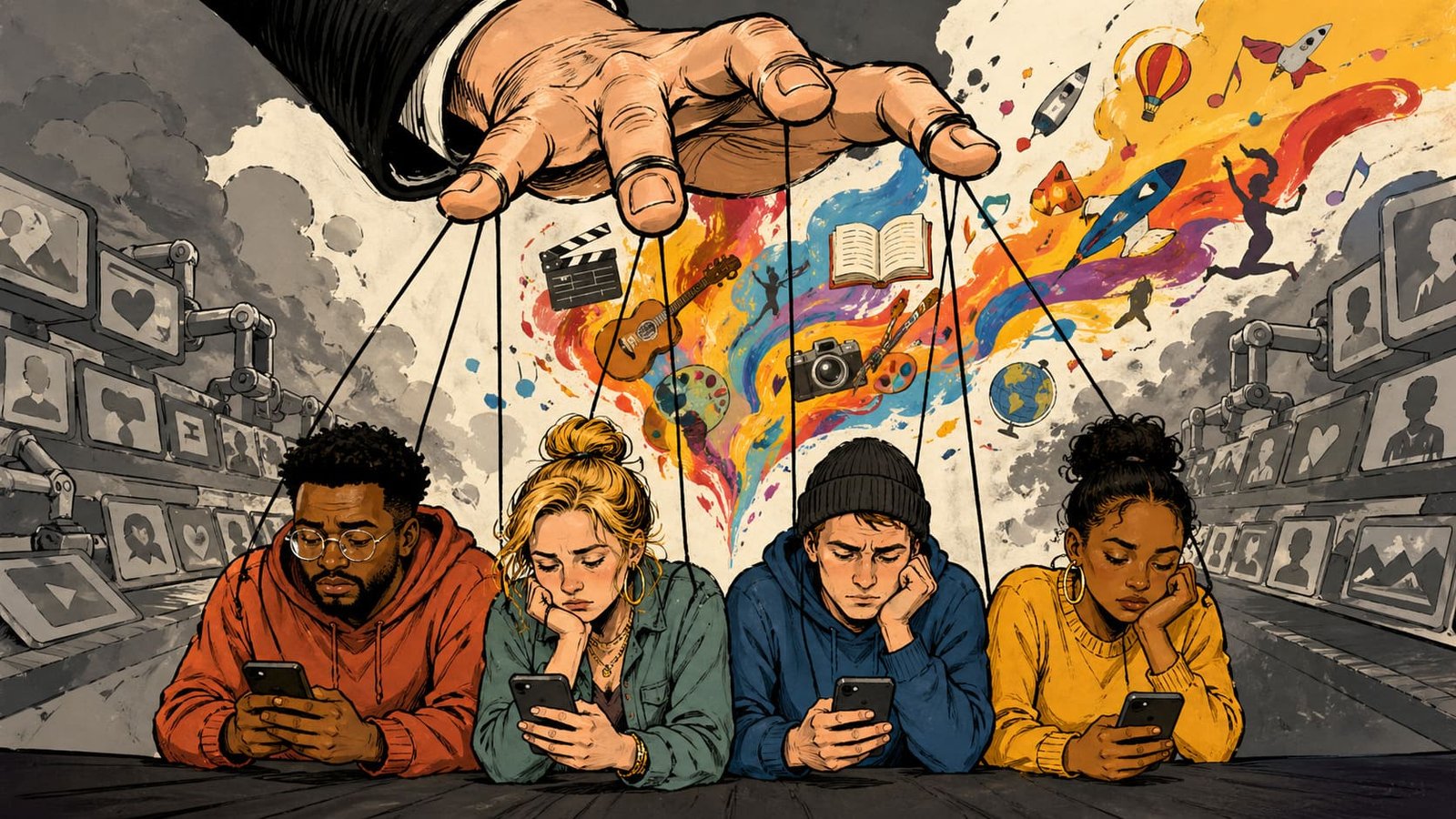
A recommendation engine hums quietly in a glass-walled server room, invisible yet deeply intimate. It watches patterns, not people. It does not care what anyone says they enjoy. It studies what they linger on, what they skip, what they return to at 2 a.m. when no one is watching. Somewhere between those signals, taste begins to take shape, not as a personal journey, but as a guided path. No announcement is made. No consent is requested. The shift happens in the background, as if preference itself has been outsourced.
Freedom used to feel like wandering through a bookstore, getting lost between shelves, discovering something unexpected. Now the shelves come to you, curated, ranked, filtered. Spotify tells you what to listen to next. Netflix suggests what you will likely enjoy. TikTok delivers a stream so precise it feels almost psychic. The convenience is undeniable. So is the quiet narrowing. When everything is tailored, the unfamiliar starts to disappear.
A product manager named Lila noticed it during a routine test of a streaming platform. She created two identical user accounts, then fed them slightly different behaviors. One leaned toward documentaries, the other toward reality shows. Within days, the recommendations diverged so sharply that it felt like two entirely different worlds. Neither account was wrong. Both were simply guided. Lila stared at the dashboards and realized something unsettling. The system was not just reflecting taste. It was shaping it.
This shaping happens through reinforcement. Algorithms reward what keeps attention alive. If you watch one video about minimalism, you are shown ten more. If you engage with a certain genre of music, it becomes your sonic environment. Over time, repetition feels like preference. It becomes harder to tell whether you truly enjoy something or if you have simply been exposed to it often enough. The line between choice and conditioning begins to blur.
The business implications are profound. Platforms are no longer neutral distributors of content. They are active curators of culture. When TikTok decides which videos to amplify, it influences what trends emerge, which creators rise, and which ideas gain traction. The algorithm becomes a gatekeeper, not through explicit decisions, but through patterns that favor certain behaviors. It is not censorship in the traditional sense. It is selection at scale.
There is also a subtle psychological comfort in this system. A marketing analyst named Ibrahim once described it as “frictionless living.” He no longer needed to search for music, movies, or even news. Everything arrived, already aligned with his past behavior. It felt efficient, almost luxurious. Yet after a while, he noticed something missing. Surprise. The kind that disrupts assumptions, that introduces something completely outside your usual orbit. Without it, the experience became smoother, but also flatter.
Pop culture reflects this shift in quiet ways. The rise of niche communities, hyper-specific aesthetics, and micro-trends often originates from algorithmic clustering. People who might never have found each other in the physical world are grouped together based on shared signals. This creates strong communities, but also reinforces existing preferences. It becomes easier to stay within a familiar loop than to step outside it. Exploration begins to feel unnecessary.
A musician named Elena felt the impact directly. Her earlier work blended genres in unpredictable ways, drawing from influences that did not neatly fit into one category. As streaming platforms became more dominant, her label encouraged her to focus on a more consistent sound. The data showed that listeners preferred clear categories. Elena adapted. Her audience grew, her streams increased, but her music felt narrower. The algorithm had not forced her. It had simply made certain paths more rewarding than others.
The deeper tension lies in how easily this system integrates into daily life. It does not demand attention. It does not feel oppressive. It feels helpful. That is precisely why it is so effective. When guidance becomes invisible, it is rarely questioned. The idea of freedom remains intact on the surface, even as the range of choices quietly contracts underneath.
Somewhere, a young student named Kofi scrolls through a feed that feels perfectly tuned to his interests. Every video resonates, every suggestion feels right. He does not notice what is missing, because absence is harder to detect than presence. The feed feels complete, even though it is only a fraction of what exists. That fraction becomes his world, shaped not by intention, but by interaction.
In a quiet corner of a data center, the system continues to learn. It refines, adjusts, predicts. It does not need to control everything. It only needs to guide enough to keep the loop intact. The illusion of choice remains powerful, comforting, even necessary. Yet beneath it, a different reality unfolds, one where taste is less discovered and more directed.
Somewhere in that seamless flow of recommendations, a question begins to surface, soft but persistent. If every preference is anticipated, every interest predicted, and every choice gently guided, what part of taste still belongs to you?
