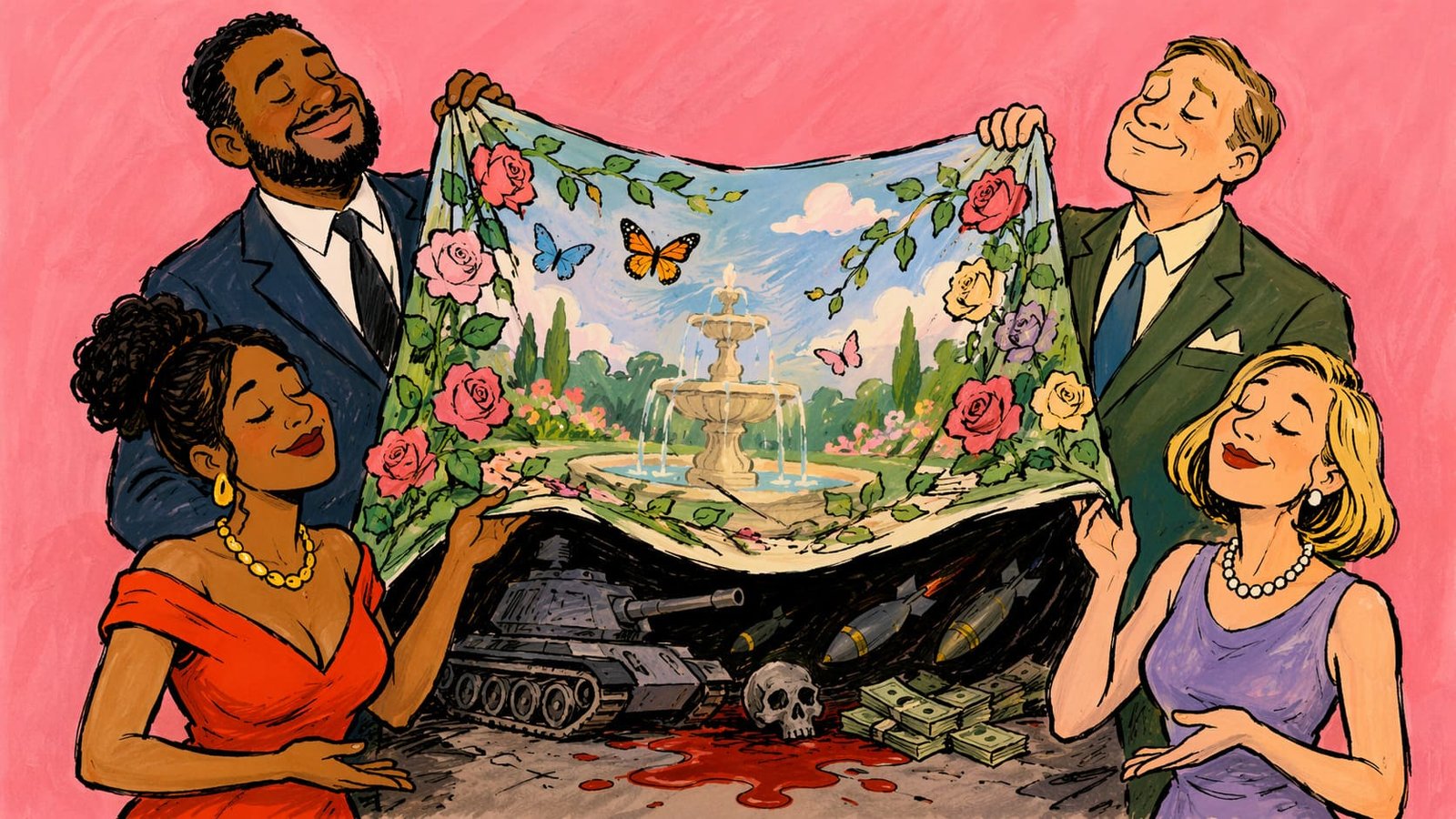
A polished hallway stretches under perfect lighting. Marble reflects footsteps with a soft, expensive echo. The air smells faintly of citrus and restraint. On the wall, a minimalist slogan promises progress, innovation, something clean and inevitable. No one raises their voice here. No one needs to. Authority does not shout in rooms like this. It whispers through design, through symmetry, through the quiet assurance that everything is exactly where it should be.
Power once announced itself with visible force. Armies, uniforms, gates, the unmistakable language of dominance. Today, it often arrives wrapped in beauty. Interfaces feel smooth. Offices feel calming. Messaging feels inclusive. The edges are softened, the tone is friendly, the visuals are carefully curated. Control has not disappeared. It has been redesigned. Aesthetics now carry what force once declared openly.
A product strategist named Helena redesigned a financial app that had been struggling with user trust. The functionality stayed the same. The policies remained strict. What changed was the surface. Softer colors, rounded buttons, friendly copy. Users reported feeling safer, even though the underlying system had not shifted. Helena noticed something quietly powerful. People did not just interact with systems, they interpreted them through design. Beauty had reframed authority as care.
This is where aesthetics become more than decoration. They become a form of persuasion. A clean interface suggests competence. A minimalist office implies discipline. A carefully curated brand voice signals empathy. None of these signals guarantee substance, yet they influence perception with surprising force. The human mind associates order with safety. When something looks right, it often feels right, even before it is understood.
Consider the influence of companies like Apple Inc.. Their design philosophy has shaped not just products, but expectations. Simplicity, clarity, elegance. These qualities create an emotional response that extends beyond functionality. A device becomes more than a tool. It becomes an experience, one that feels intentional, almost ethical. The design communicates values, even when those values are not explicitly stated.
There is also a cultural dimension to this shift. Aesthetic refinement often signals a certain level of access. Clean spaces, curated environments, subtle branding. These elements suggest control, not just over objects, but over life itself. A person surrounded by intentional design appears composed, disciplined, perhaps even enlightened. The aesthetic becomes a narrative, one that others read and respond to.
A creative director named Marcus once led a campaign for a large organization facing criticism over its labor practices. The strategy focused on visual storytelling. Warm imagery, human-centered narratives, soft lighting. The campaign did not address the criticism directly. Instead, it reframed the organization’s image. Public perception improved. Marcus later reflected on the experience with a hint of discomfort. The campaign had shifted emotion without resolving the underlying issue.
Pop culture reinforces this dynamic constantly. Films like American Psycho reveal how surface perfection can mask deeper violence. The protagonist’s immaculate lifestyle contrasts sharply with his actions, creating a disturbing tension. The message lingers. Beauty can conceal, distract, even justify. It can make the unacceptable feel distant, almost abstract.
There is a subtle psychological mechanism at play. When something appears beautiful, the mind lowers its defenses. It becomes more receptive, less critical. This is not a conscious choice. It is a reflex. Designers, marketers, and institutions understand this, sometimes intuitively, sometimes deliberately. The result is a world where power rarely looks threatening. It looks appealing.
A startup founder named Amina built a co-working space that quickly became popular among young professionals. The interiors were carefully designed, plants placed with precision, lighting adjusted to create a sense of calm. Members described the space as “inspiring” and “safe.” Over time, Amina introduced stricter policies, higher fees, more control over how the space was used. Resistance was minimal. The environment had already established trust. The transition felt natural, almost expected.
Yet there is a tension that refuses to disappear. Aesthetics can elevate experience, but they can also obscure reality. When beauty becomes a shield, it prevents necessary scrutiny. Systems that should be questioned become accepted because they feel right. The danger is not in design itself, but in its ability to redirect attention away from substance.
A policy analyst named Victor once visited two institutions with similar functions but different presentations. One was austere, direct, almost uncomfortable. The other was sleek, welcoming, visually refined. Both enforced equally strict rules. Visitors reacted differently. The first felt intimidating, the second felt reasonable. Victor’s conclusion was simple but unsettling. Perception of fairness was influenced as much by environment as by policy.
In a quiet gallery filled with carefully arranged objects, a visitor pauses in front of a piece that appears simple, almost effortless. The lighting highlights its contours, the space around it feels intentional, sacred. There is no indication of the labor, the conflict, the decisions that led to its creation. Only the final form remains, polished and complete.
In that stillness, where beauty feels like truth, a question begins to form, slow and persistent: when something looks this right, what might it be asking you not to see?
