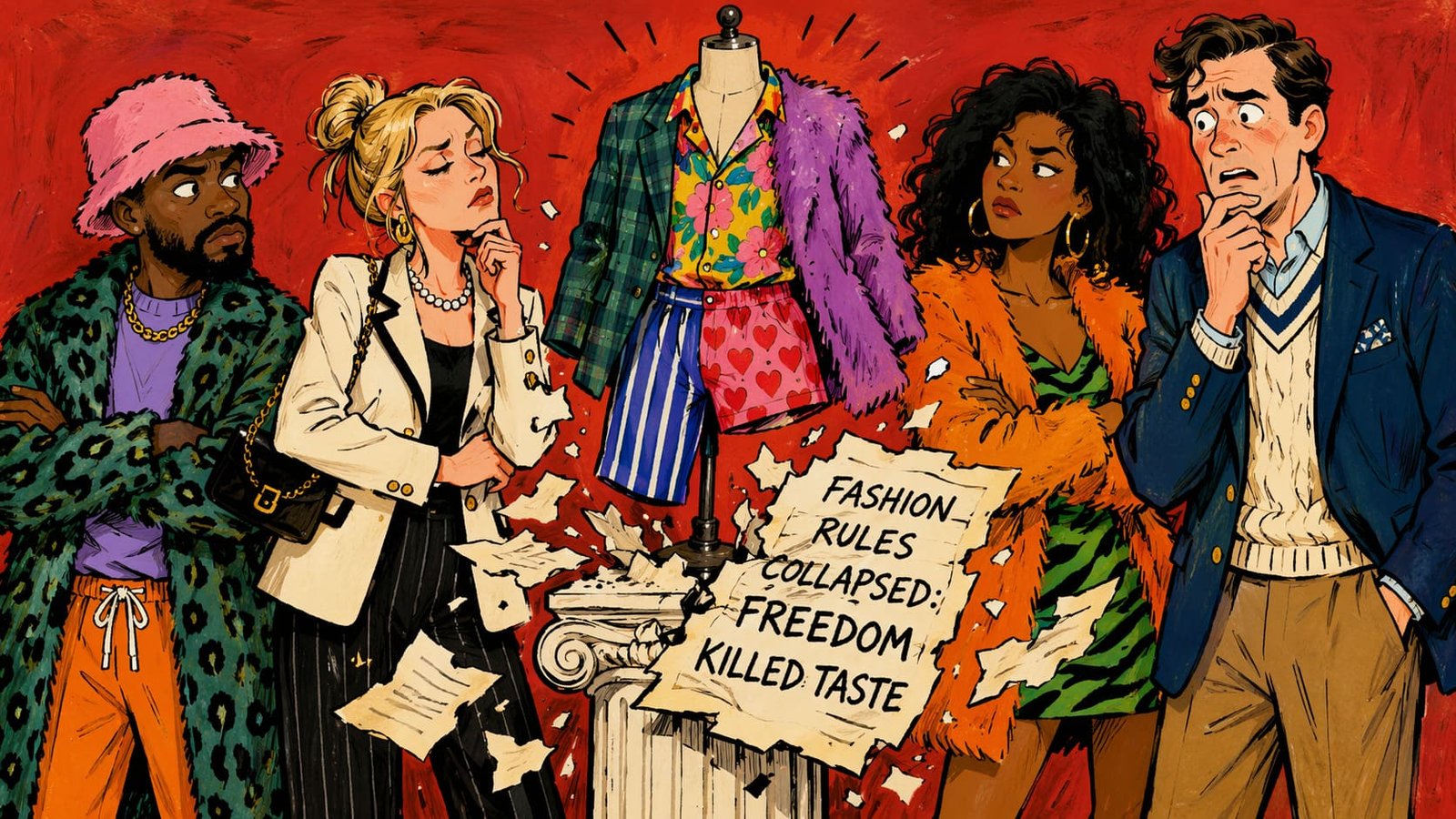
A runway stretches through a cavernous hall where nothing seems out of place because everything is allowed. Fabric clashes with fabric. Silhouettes collapse into abstraction. The audience watches with a strange mix of admiration and confusion, unsure whether to applaud the audacity or question the absence of restraint. Cameras flash, critics scribble, and somewhere beneath the spectacle, a quiet tension lingers. When every rule is broken, what exactly remains to be discovered?
Fashion once thrived on tension. It lived between rebellion and refinement, between discipline and expression. Designers pushed boundaries, but always against something solid. Structure gave rebellion its meaning. Without structure, rebellion becomes noise. The modern landscape celebrates freedom as its highest virtue, yet that freedom has begun to feel strangely hollow. When everything is permitted, taste becomes difficult to define, and even harder to defend.
The collapse of fashion rules did not happen overnight. It unfolded gradually, fueled by a culture that prizes individuality above all else. Personal style became a declaration of identity, a visible claim to uniqueness. That shift carried genuine value. It opened doors for voices that had long been excluded. It allowed experimentation to flourish. Yet somewhere along the way, the idea of taste itself became suspect, as if judgment were an act of exclusion rather than discernment.
Consider Marcus, a young designer who built his reputation on breaking conventions. His early collections felt sharp, intentional, almost surgical in their defiance. Each piece challenged expectations while still acknowledging them. Over time, the pressure to remain disruptive grew. The collections became louder, less precise, more chaotic. Critics praised the boldness, but something had changed. The work no longer felt like a statement. It felt like a reaction, chasing attention rather than shaping it.
There is a difference between freedom and absence. Freedom operates within awareness. It understands what exists and chooses how to move against it. Absence removes the reference point entirely. Without that reference, expression loses its edge. It becomes difficult to tell whether something is innovative or simply unfiltered. The line between creativity and carelessness blurs, and in that blur, standards quietly disappear.
The rise of social media accelerated this shift. Style became content. Outfits became moments designed for capture rather than continuity. The algorithm rewards novelty, not coherence. A look that shocks will travel further than one that refines. Over time, this incentive reshapes behavior. Designers and consumers alike begin to prioritize visibility over substance. The result is a landscape filled with fragments, striking in isolation but lacking a cohesive narrative.
A stylist named Elena once described her frustration during a late-night fitting. She held two garments side by side, one meticulously crafted, the other intentionally chaotic. The second drew more attention online. “It photographs better,” her client said, almost apologetically. In that moment, Elena realized the standard had shifted. The question was no longer whether something was well made or thoughtfully designed. It was whether it could survive the scroll.
This does not mean that fashion has lost its brilliance. There are still designers who understand the balance between freedom and discipline. Houses like Maison Margiela and Comme des Garçons have long operated in that space, challenging conventions while maintaining a clear internal logic. Their work feels intentional, not arbitrary. It invites interpretation without abandoning structure. That distinction is subtle, but it defines the difference between art and noise.
The cultural conversation around fashion often frames rules as restrictive, as barriers to self-expression. Yet rules, when understood deeply, act as tools. They provide a language through which ideas can be communicated with precision. Breaking them without understanding them is not liberation. It is guesswork. True innovation requires fluency in what came before, not a rejection of it.
A buyer named Theo once recounted a meeting with an emerging label that prided itself on “absolute creative freedom.” The collection was visually striking, filled with unexpected combinations. Yet when he asked about the underlying concept, the answers felt vague. The pieces did not connect. They existed as isolated gestures rather than parts of a larger vision. He left the meeting with a lingering thought. Freedom had been mistaken for direction.
The tension between taste and scale also plays a role. As fashion becomes more accessible, more global, more immediate, the pressure to appeal broadly increases. Taste, by its nature, is selective. It excludes as much as it includes. In a mass-driven environment, that selectivity can feel risky. It is safer to embrace everything, to avoid judgment, to let the audience decide. Yet when everything is accepted, nothing stands out with clarity.
In a quiet studio far from the noise of the runway, a single garment hangs under soft light. Its lines are clean, deliberate, almost restrained. There is nothing loud about it, nothing that demands attention at first glance. Yet the longer it is observed, the more it reveals. The stitching carries intention. The proportions feel balanced. It does not shout. It speaks, and in that quiet, it holds its ground.
Fashion, at its best, has always been a conversation between discipline and desire. It asks not only what can be done, but what should be done. That question requires judgment, and judgment requires courage. In a culture that celebrates limitless freedom, that courage becomes rare. It is easier to create without boundaries than to define them.
The hall empties. The lights dim. The garments remain, suspended in a silence that feels almost reflective. Some will be remembered for their spectacle. Others will fade as quickly as they appeared. A few will endure, not because they followed rules, but because they understood them well enough to reshape them with intention.
Somewhere in that quiet, a question lingers, sharper than any trend, more persistent than any season: if everything is allowed, what will you choose to stand for?
